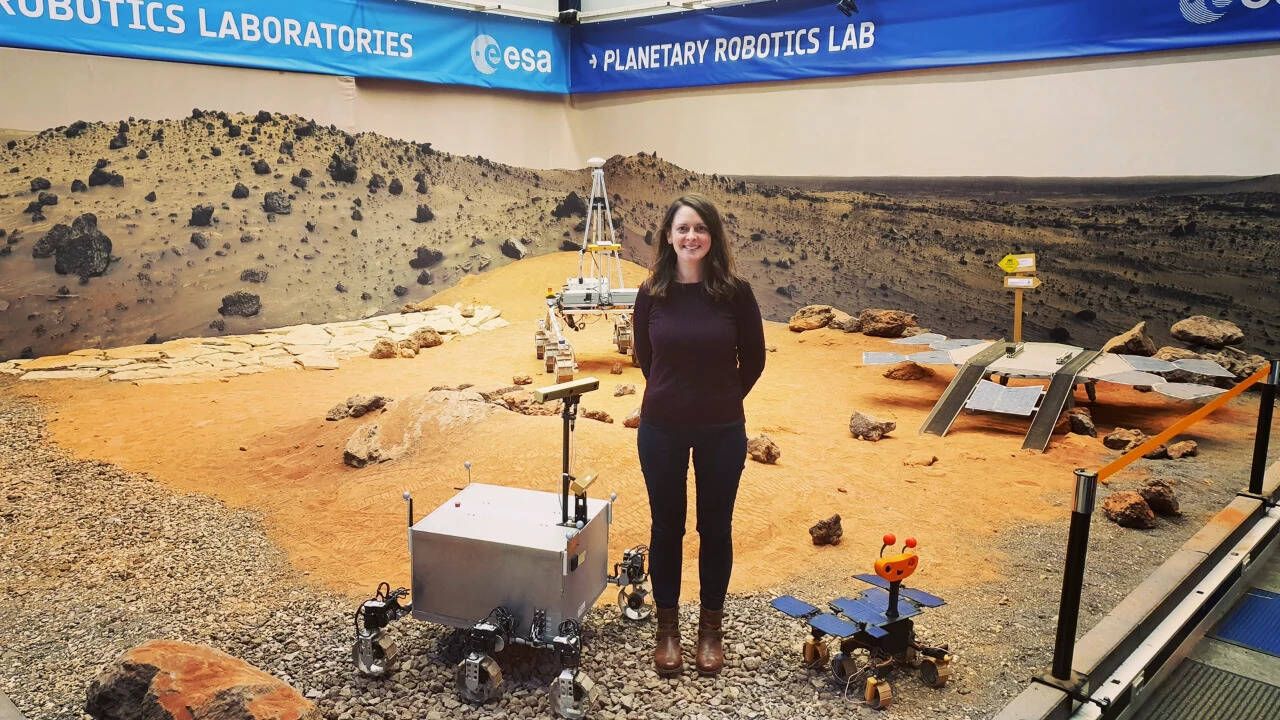
Rejected by NASA at 14, she took a work placement cleaning a space toilet instead; today, she is leading Mars exploration teams.
She had even applied for work experience at NASA , hoping for a chance to work around spaceships and astronauts.
However, after being rejected, she did not give up and instead took a placement at the National Space Science Centre in Leicester, England.
Alongside unpacking items such as the space suit worn by Helen Sharman, the first British astronaut, Parfitt also cleaned a space toilet that later went on display in the exhibit.
The story also highlights the growing demand for engineers who can develop systems for future space missions.
Rejected by NASA at 14, she took a work placement cleaning a space toilet instead; today, she is leading Mars exploration teams. Image Credit: ESA
From a rejection letter to a career in space
Helping build the next generation of Mars missions
A replica of a Space Shuttle toilet, similar to the exhibit Claire Parfitt helped clean during her teenage work placement that sparked her career in space engineering. Image Credits: Wikimedia Commons
A reminder that space careers rarely follow a straight path
Not all careers in the space industry begin with rocket launches and spacewalking astronauts. Sometimes, it starts with a rejection letter and the unglamorous task of cleaning a space toilet.Claire Parfitt was 14 years old when she dreamt of having a career in the space industry. She had even applied for work experience at NASA , hoping for a chance to work around spaceships and astronauts. However, after being rejected, she did not give up and instead took a placement at the National Space Science Centre in Leicester, England. Cleaning a space toilet replica became one of her initial tasks.More than two decades later, Parfitt leads teams within the European Space Agency (ESA) that play an important role in designing future expeditions to Mars.Like many children who were intrigued by the night sky, Claire Parfitt also knew from a very young age that she wanted to do something in the field of space exploration. At the age of 14, she even applied for an internship at NASA, but was rejected.But instead of letting this rejection come between her dreams, Parfitt went about looking for other means of entering into the field and eventually got an internship with the National Space Science Centre, which was at the time preparing its exhibits for what later became the National Space Centre in the UK.It was not glamorous. Alongside unpacking items such as the space suit worn by Helen Sharman, the first British astronaut, Parfitt also cleaned a space toilet that later went on display in the exhibit. But through such mundane things, Parfitt learned much more.One person left a lasting impression. Alex Hall, then director of the space centre, showed the young student that leadership roles in the space sector were within reach. Seeing a woman in a senior leadership role helped Parfitt imagine a future for herself in an industry where women have historically been underrepresented. A study supports the importance of such role models. A study published in the Proceedings of the National Academy of Sciences (PNAS) found that exposure to successful female role models can strengthen girls' aspirations and persistence in science, technology, engineering and mathematics (STEM), helping them envision themselves in similar careers.Determined to pursue that future, she went on to study physics before completing a PhD in spacecraft power systems engineering. Those academic foundations eventually led to a career at the European Space Agency's European Space Research and Technology Centre (ESTEC) in the Netherlands, the agency's largest technical hub.Today, Parfitt works at the forefront of European planetary exploration, contributing to missions designed to answer some of humanity's biggest scientific questions.Among the projects she has worked on is the ExoMars Rosalind Franklin rover, which the European Space Agency developed to search for signs of past microbial life beneath the Martian surface. Unlike previous rovers that mainly examined surface rocks, Rosalind Franklin has a drill capable of reaching up to two metres underground, where ancient organic material may have been protected from harmful radiation.Parfitt has also contributed to ESA's SMILE mission, an international collaboration studying how the solar wind interacts with Earth's magnetic environment. Although focused on Earth rather than Mars, the mission helps scientists understand how space weather affects planetary environments and spacecraft operations.Her current responsibilities involve leading engineering teams planning future exploration missions, ensuring spacecraft systems can withstand the harsh conditions of deep space.Mars remains a major focus of scientific exploration in the Solar System. According to a comprehensive review published in Mars: New Insights and Unresolved Questions , exploration of the Red Planet continues to drive research into planetary evolution, the search for ancient life and preparations for eventual human missions. The review notes that robotic exploration remains central to understanding whether Mars once hosted habitable environments and how future explorers might safely operate there.Parfitt's story suggests that early setbacks do not determine future success in science and engineering. The story also highlights the growing demand for engineers who can develop systems for future space missions. Space exploration involves far more than astronauts; it depends on thousands of professionals building spacecraft, conducting experiments and developing the systems that make it possible.Artificial intelligence and autonomous systems, along with robotics, are expected to become increasingly relevant for future missions to the Moon and Mars. NASA scientists have said artificial intelligence will help astronauts operate robots and carry out other missions.Looking back, Parfitt has said she always knew she wanted to work in space. The rejection from NASA did not change that ambition; it redirected it. Cleaning a space toilet may not have looked like the start of a dream career, but it put her in an environment where curiosity, engineering and determination mattered more than job titles.As she helps develop technologies that may contribute to future Mars missions, her story shows that the road to major accomplishments can include detours. Sometimes, a career turning point comes from an unexpected job that few others want.