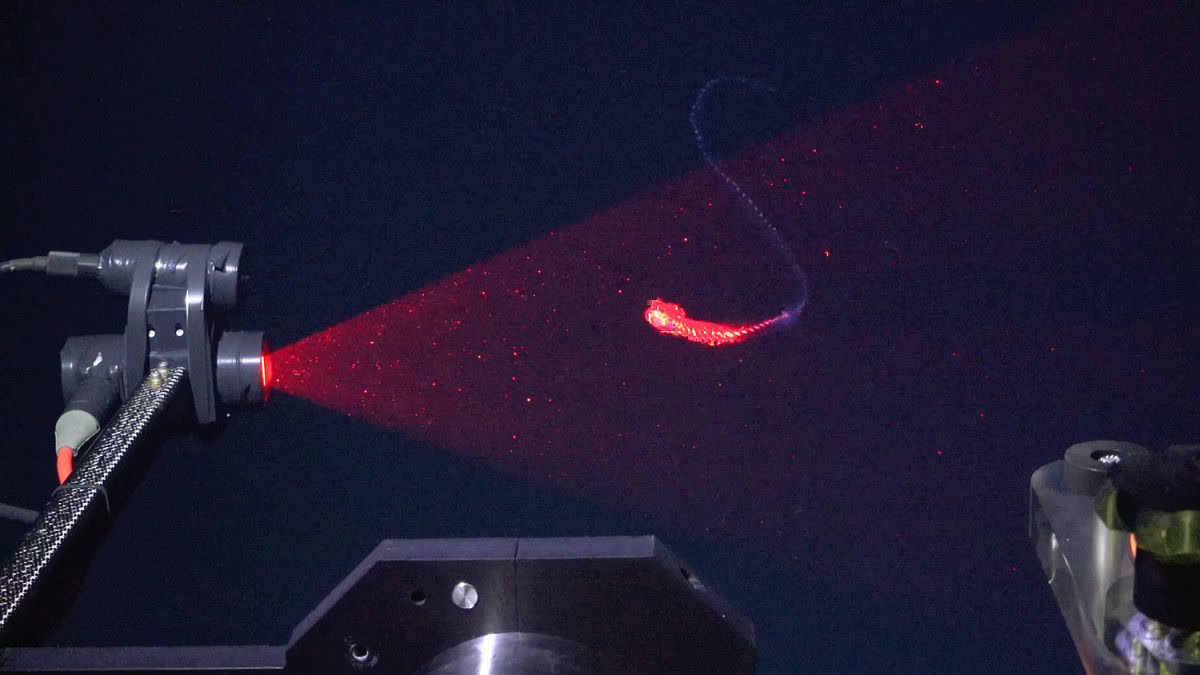
ETV Bharat / technology31 Alien-Like Marine Species Discovered Off Brazil's Coast, Including Ghostly SquidThis is a new species from the genus Tomopteris, commonly known as gossamer worms.
Tomopterids spend their entire lives in the water column, living just below the surface to over 4000 meters.
The expedition science team tested new technology that provides scientists with new, non-invasive ways to study these remarkable animals.
( Image Credit: ROV SuBastian / Schmidt Ocean Institute )Hyderabad: Scientists have discovered 31 previously unknown marine species during a deep-sea expedition off the coast of Brazil, revealing an extraordinary collection of alien-like creatures living hundreds of metres beneath the ocean's surface.
Instead of relying solely on collected specimens, scientists used advanced technology to study the animals within their natural habitat.
ETV Bharat / technology
31 Alien-Like Marine Species Discovered Off Brazil's Coast, Including Ghostly Squid
This is a new species from the genus Tomopteris, commonly known as gossamer worms. Tomopterids spend their entire lives in the water column, living just below the surface to over 4000 meters. Little is known about their lives despite prior studies of their unusual, brilliant yellow bioluminescence. The expedition science team tested new technology that provides scientists with new, non-invasive ways to study these remarkable animals. ( Image Credit: ROV SuBastian / Schmidt Ocean Institute )
Hyderabad: Scientists have discovered 31 previously unknown marine species during a deep-sea expedition off the coast of Brazil, revealing an extraordinary collection of alien-like creatures living hundreds of metres beneath the ocean's surface. The discoveries include a transparent juvenile glass squid, a fast-moving gossamer worm, unusual comb jellies, mysterious siphonophores, and several strange fish species, This discovery highlights just how little humankind knows about Earth's largest ecosystem.
What is this expedition all about?
The international research team spent two weeks in June exploring the South Atlantic aboard the Schmidt Ocean Institute's research vessel, Falkor (too). Their mission focused on the ocean's midwater zone, a region located roughly 180 to 1,000 metres below the surface. Despite covering an enormous portion of the planet, this ecosystem remains one of the least explored, due to extreme pressure, darkness, and the technical challenges involved in studying it.
This juvenile glass squid, collected by ROV SuBastian at 779 meters depth in the South Atlantic, was photographed on R/V Falkor (too) using a prototype multiview macro camera system. (Image Credit: Emily Clark / MBARI)
Researchers say the expedition demonstrates just how much marine biodiversity remains undiscovered.
How the new species were found?
Instead of relying solely on collected specimens, scientists used advanced technology to study the animals within their natural habitat. The remotely operated vehicle SuBastian captured high-resolution images and video deep underwater, while the team also deployed laser-based imaging systems, virtual-reality visualisation tools, advanced microscopes, and specialised cameras capable of recording delicate organisms from multiple angles without causing them harm.