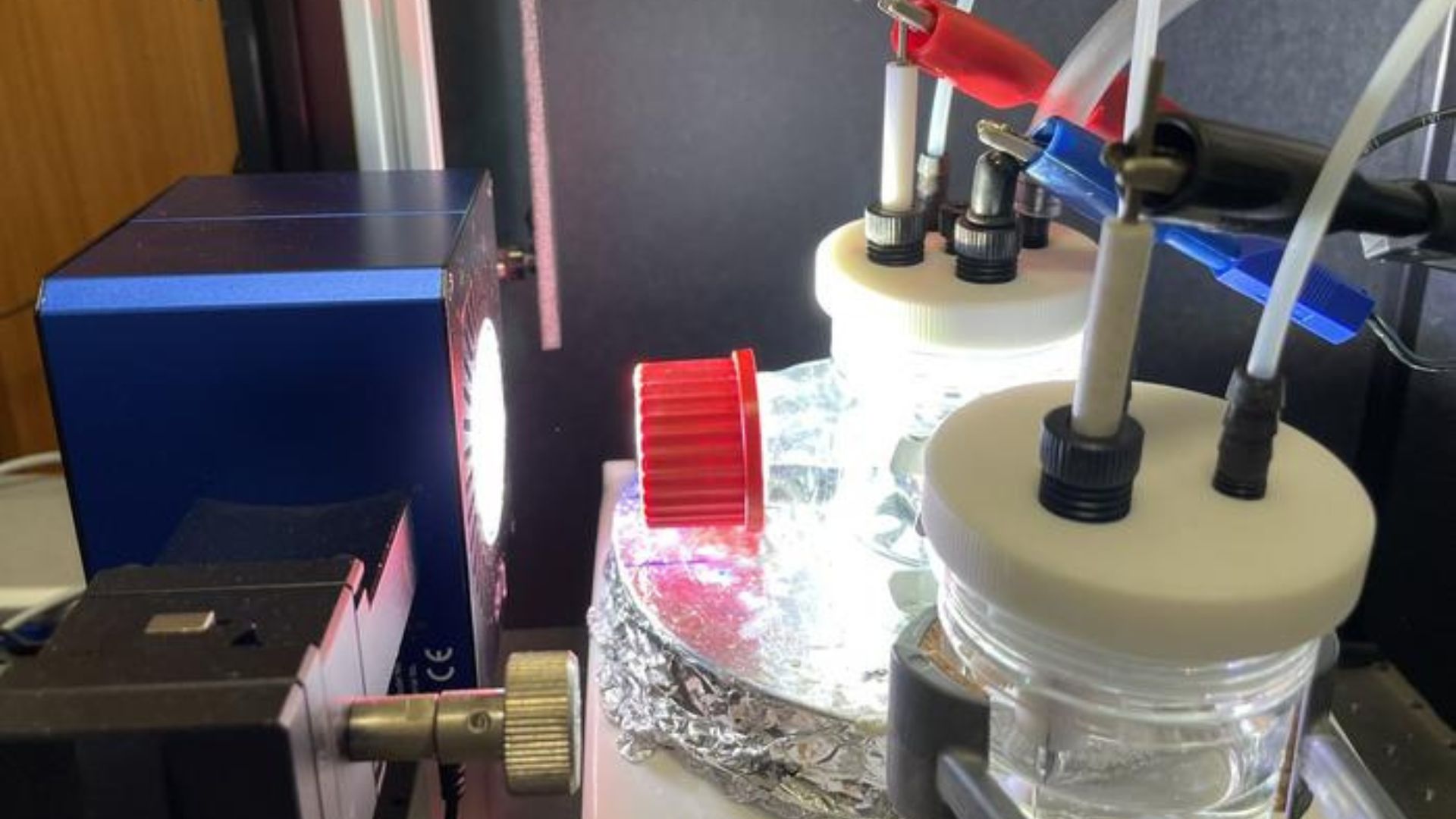
Now, University of Nottingham scientists have developed a solar-powered reactor that couples two novel catalyst materials to drive two independent reactions at once.
Powered entirely by sunlight, the system simultaneously transforms carbon dioxide into a valuable chemical while converting biomass waste into the essential building blocks for sustainable plastics.
This device accomplishes the feat by extracting two distinct, valuable chemical products from the energy of a single photon of light.
It works through a twin-compartment design, effectively splitting a single solar interaction down the middle to achieve two goals at once.
The dual-compartment reactor uses a single photon of sunlight to drive a highly efficient chain reaction.
In the urgent race to cool a warming planet, scientists have long dreamed of turning a major villain into a valuable asset. The challenge has always been the sheer amount of energy required to force stable greenhouse gases into a more useful state. Now, University of Nottingham scientists have developed a solar-powered reactor that couples two novel catalyst materials to drive two independent reactions at once.
Powered entirely by sunlight, the system simultaneously transforms carbon dioxide into a valuable chemical while converting biomass waste into the essential building blocks for sustainable plastics. This device accomplishes the feat by extracting two distinct, valuable chemical products from the energy of a single photon of light. The split-chamber reactor The machine is known as a bias-free photoelectrochemical (PEC) reactor. It works through a twin-compartment design, effectively splitting a single solar interaction down the middle to achieve two goals at once. The dual-compartment reactor uses a single photon of sunlight to drive a highly efficient chain reaction. “At the heart of the process is a nanostructured photoanode made of carbon nitride and tungsten oxide semiconductors, enhanced with a cobalt oxide layer, which is coupled to a cathode in the second compartment,” said Dr Madasamy Thangamuthu, Research Fellow at the School of Chemistry, University of Nottingham, who designed the PEC reactor and catalysts.
The solar-driven process begins when a photon of light strikes the photoanode, generating a freed electron and an atomic vacancy called a hole. While the electron travels to the cathode to reduce carbon dioxide, the remaining hole simultaneously oxidizes the biomass molecule 5-Hydroxymethyl-2-furoic acid (HMFA), thereby executing two distinct chemical upgrades at the same time. When light hits the first compartment, it oxidizes a biowaste molecule into a precursor for next-generation plastics. This reaction releases an electron, which travels to the second compartment to reduce carbon dioxide into formate, a versatile chemical used in textiles, paints, and pharmaceuticals. Tailored for the real world Operating purely on solar energy, without requiring external heat or electricity, the reactor achieves approximately 93 percent conversion for carbon dioxide and 95 percent oxidation for biomass.
The use of photon energy offers a highly efficient and sustainable blueprint for zero-emission chemical manufacturing. Furthermore, many modern lab breakthroughs use rare, hyper-expensive metals like platinum or iridium to drive their chemistry. These materials look wonderful in academic journals but are completely impractical for global industrial scaling. The Nottingham team engineered their materials entirely from earth-abundant, inexpensive elements. The scientists kept production costs low while maintaining high efficiency rates through a unique method: they assembled the catalyst‘s metal atoms into custom-tailored sizes and shapes directly on the reactor surfaces. A full life cycle assessment has already validated the system’s low-carbon footprint. The long-term vision is a decentralized manufacturing network. These modular reactors can eventually be connected directly to active factory smokestacks and local agricultural biorefineries.
Ultimately, the team views this discovery as a vital step toward meeting global net-zero targets by directly harnessing solar energy to tackle the dual challenges of greenhouse gas reduction and waste valorization. The study was published in the journal Communications Materials on June 12.