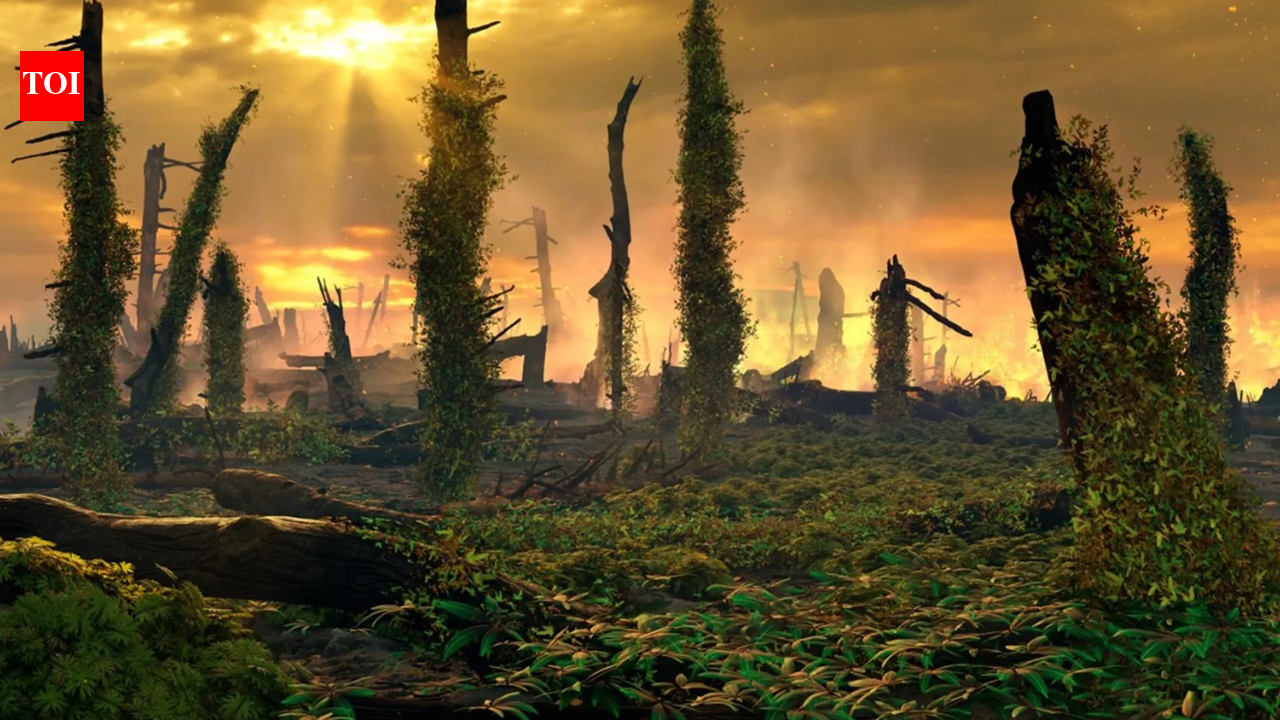
Artist's impression of the end-Triassic fern spike interval, showing hardy ferns spreading across disturbed landscapes and the remains of conifer forests.
Researchers from Utrecht University and other European and US institutions say the end-Triassic extinction was linked to massive volcanic activity as Pangaea began to break apart.
To study the ancient wildfire crisis, scientists analysed sedimentary rock samples from four core drillings in the UK, Germany, Denmark and Luxembourg.
The researchers said the charcoal and PAH evidence was further supported by a colour-based analysis of fossil spores and pollen collected from multiple bore cores, helping them identify signs of ancient wildfire activity.
After the end-Triassic mass extinction, ferns spread across vast areas of Europe.
Artist's impression of the end-Triassic fern spike interval, showing hardy ferns spreading across disturbed landscapes and the remains of conifer forests. Image Credit: Mark Garlick/ScienceDaily
Lycopodium
A planet reshaped by volcanic activity
Ferns flourished after forests were destroyed, becoming ideal fire fuel. These ancient events offer lessons for understanding modern climate change impacts. Image Credit: Wikimedia Commons
Uncovering the ancient fire record through science
Ferns were not only survivors but also fire fuel
Lessons learned from an ancient climate crisis
Some parts of Europe experienced a wildfire crisis that lasted for thousands of years, about 201 million years ago, long before humans existed. According to new research, the wildfires were driven by extreme heat, forest collapse and the rapid spread of ferns.The study, published in the journal Nature Geoscience , found that the mass growth of ferns after forests were destroyed played a crucial role in keeping fires active during one of Earth’s major extinction events. The paper reports that the team analysed drill cores from Germany, Luxembourg, Denmark and the UK, and used the Palynomorph Darkness Index on fern spores and conifer pollen to track the latest Triassic “dark zone”. They found peak darkening coincided with forest collapse and fern-dominated pioneer vegetation, and controlled heating experiments on modernspores showed that the darkening was caused by surface fires sweeping through fern savannahs.The study helps explain how changing vegetation can influence wildfire behaviour and climate feedbacks. Researchers from Utrecht University and other European and US institutions say the end-Triassic extinction was linked to massive volcanic activity as Pangaea began to break apart. The eruptions released vast amounts of carbon dioxide and other volcanic gases into the atmosphere, driving global warming, ecosystem change and the extinction of around 75 percent of species.During the Triassic, the area that would become northwestern Europe was covered with forests and swamps. But volcanic activity related to the creation of the Central Atlantic Magmatic Province led to dramatic changes in Earth’s climate.In a study published in Nature Reviews Earth & Environment , scientists say that the Central Atlantic Magmatic Province is one of the biggest volcanic episodes on Earth. It caused the emission of massive amounts of gases at the time when the supercontinent Pangaea was breaking up. Scientists think this volcanic episode was linked to the end-Triassic mass extinction event.According to the review, the Central Atlantic Magmatic Province released an estimated 100,000 gigatonnes of CO₂, with volcanism unfolding in pulses over hundreds of thousands of years as Pangaea broke apart. The authors link this outpouring of greenhouse gases and other volcanic emissions to the severe carbon-cycle disruption and environmental stress associated with the end-Triassic extinction.As temperatures rose by several degrees, many forests were destroyed. Ferns flourished instead; they are known as early colonisers of devastated landscapes. Ferns can quickly take over damaged landscapes because they reproduce efficiently and can survive harsh conditions, researchers explained in the new study. The team found that fern-dominated ecosystems did not just recover from wildfires; they also helped create a feedback loop between vegetation and fire.Ancient fires are difficult to study because evidence is rarely preserved for long periods. To study the ancient wildfire crisis, scientists analysed sedimentary rock samples from four core drillings in the UK, Germany, Denmark and Luxembourg. The rock samples were examined for fossil charcoal and a substance known as polycyclic aromatic hydrocarbons (PAHs).As stated by the Lund University researchers participating in the research, these markers pointed to increased wildfire activity during the end-Triassic extinction period. The researchers said the charcoal and PAH evidence was further supported by a colour-based analysis of fossil spores and pollen collected from multiple bore cores, helping them identify signs of ancient wildfire activity. They found the “dark zone” overlapped exactly with the spread of fern savannahs and indicated long-lasting, intense wildfires that helped keep the post-collapse landscape open.However, the scientists used another technique to support their findings. They examined colour changes in the fossil pollen and spores found in the rock samples. This happens because ancient pollen and spores contain sporopollenin, which darkens when heated as its carbon content increases. Scientists expected the deepest fossils to be the darkest because they had spent the longest time buried underground. However, they found a “dark zone” in which pollen and spores turned dark around the time of the extinction event.The phenomenon appeared in all four core samples, suggesting the dark colouring was caused by environmental factors rather than local geology.Ferns survived many climatic challenges because they quickly colonised damaged environments. After the end-Triassic mass extinction, ferns spread across vast areas of Europe. Their underground roots helped them recover after fires, while their dried leaves made them highly flammable. According to the findings, a warm climate and deforestation helped ferns spread, and dried fern mats then fueled more fires and slowed forest recovery.“Thick mats of dry fern leaves can become ideal fuel for triggering and spreading intense fires,” researchers said. This may explain why fern-dominated landscapes persisted for tens or even hundreds of thousands of years after the mass extinction.Scientists say the findings may help explain today’s climate challenges. According to the research team, higher temperatures, drier conditions and vegetation changes can increase the likelihood and intensity of fires.Recent studies show that climate change increases wildfire risk in many parts of the world. The Triassic example shows that climate change does more than raise temperatures; it can also make ecosystems more vulnerable. Two hundred million years ago, ferns helped keep the damaged landscape in a cycle of repeated fires.