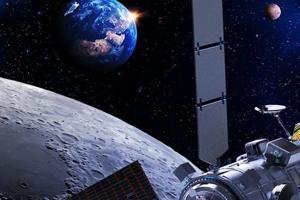
Source: THThe Nancy Grace Roman Space Telescope is NASA’s next-generation flagship space observatory designed to explore major mysteries of the universe, including dark energy, dark matter, cosmic expansion, gravitational physics, and exoplanets.
About: It is named after Nancy Grace Roman, NASA’s first Chief Astronomer , who played a key role in developing NASA’s space astronomy programme and is often called the “Mother of the Hubble Space Telescope.” The mission will complement the capabilities of the Hubble Space Telescope (launched in 1990) and the James Webb Space Telescope (launched in 2021) by conducting wider and deeper surveys of the universe.
Advanced Observation Capability: Equipped with a 300-megapixel Wide Field Instrument (infrared camera), Roman will survey vast regions of space, study over two billion galaxies, and examine the evolution of cosmic structures.
The telescope will measure h ow the universe has expanded over time and investigate the role of dark energy in shaping cosmic evolution.
Exoplanet Exploration: Using a coronagraph instrument that blocks the intense light of stars, Roman will directly observe exoplanets and planet-forming disks .
Source: TH
The Nancy Grace Roman Space Telescope is NASA’s next-generation flagship space observatory designed to explore major mysteries of the universe, including dark energy, dark matter, cosmic expansion, gravitational physics, and exoplanets.
About: It is named after Nancy Grace Roman, NASA’s first Chief Astronomer , who played a key role in developing NASA’s space astronomy programme and is often called the “Mother of the Hubble Space Telescope.” The mission will complement the capabilities of the Hubble Space Telescope (launched in 1990) and the James Webb Space Telescope (launched in 2021) by conducting wider and deeper surveys of the universe.
Launch and Location: The approximately $4 billion mission was launched aboard a SpaceX Falcon Heavy rocket from Kennedy Space Center, Florida and will operate near the Sun-Earth Lagrange Point 2 (L2) , about 1.6 million km from Earth . Roman will survey the universe around 1,000 times faster than Hubble and generate around 1.4 terabytes of data daily, using AI and machine learning for data analysis.
Advanced Observation Capability: Equipped with a 300-megapixel Wide Field Instrument (infrared camera), Roman will survey vast regions of space, study over two billion galaxies, and examine the evolution of cosmic structures. The telescope will measure h ow the universe has expanded over time and investigate the role of dark energy in shaping cosmic evolution.
Exoplanet Exploration: Using a coronagraph instrument that blocks the intense light of stars, Roman will directly observe exoplanets and planet-forming disks . It will also conduct a statistical survey of planetary systems in the Milky Way .