Researchers from IIT Madras and the Indian Institute of Science (IISc), Bengaluru, have synthesised a stable carbon-free molecule that resembles ferrocene, one of the most influential compounds in modern chemistry.
The achievement addresses a challenge that has occupied chemists since the discovery of ferrocene in the early 1950s.
The molecule consists of an iron atom positioned between two carbon-based rings, forming a structure often described as a sandwich.
Instead of using iron and carbon rings, the researchers designed a molecule with osmium at its centre and boron-based rings on either side.
It demonstrates that the celebrated sandwich structure is not confined to carbon chemistry alone.
A question that lingered in chemistry laboratories for more than seven decades has finally found an answer.
Researchers from IIT Madras and the Indian Institute of Science (IISc), Bengaluru, have synthesised a stable carbon-free molecule that resembles ferrocene, one of the most influential compounds in modern chemistry. The findings have been published in the journal Science.
The achievement addresses a challenge that has occupied chemists since the discovery of ferrocene in the early 1950s.
Read Full Story
Ferrocene changed the way scientists understood chemical bonding. The molecule consists of an iron atom positioned between two carbon-based rings, forming a structure often described as a sandwich.
Its unusual arrangement forced chemists to rethink existing theories and opened a new chapter in organometallic chemistry.
Over the years, ferrocene found applications in medicine, batteries, electronics and industrial catalysts. Yet one question continued to attract attention: was carbon essential for creating such a stable sandwich structure, or could another element take its place?
Scientists across the world attempted to build a similar molecule without carbon. The task proved difficult because carbon forms strong and stable bonds, making it the backbone of most complex molecular structures.
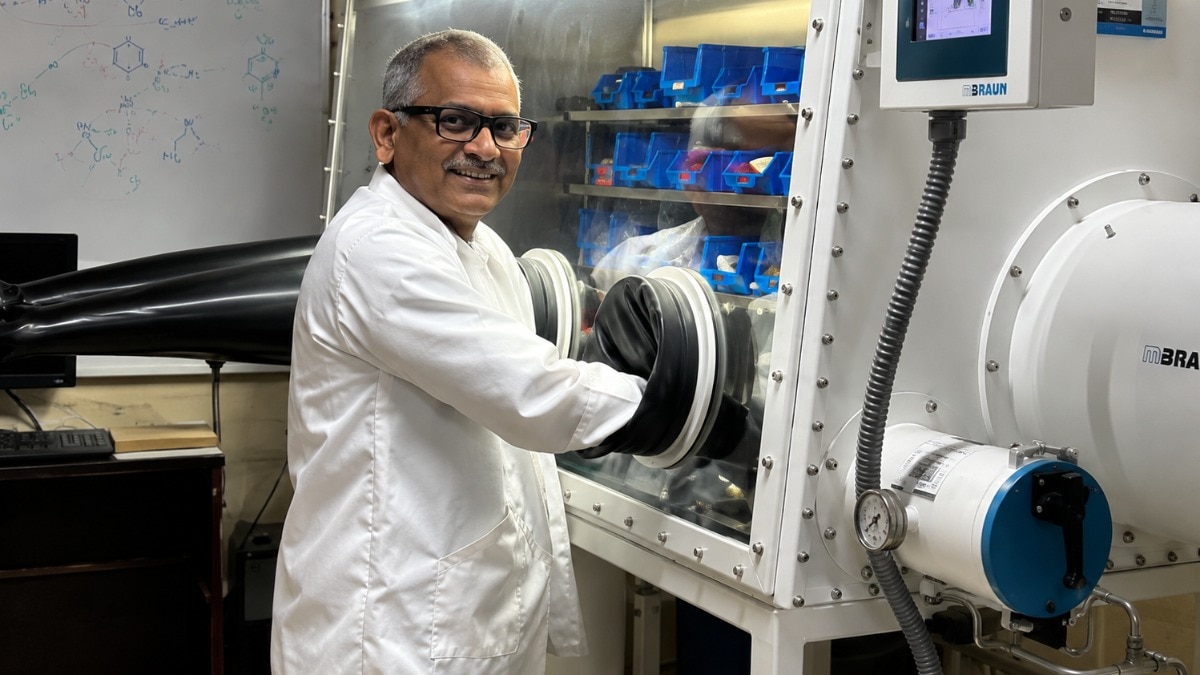
The breakthrough came from a team led by Prof. Sundargopal Ghosh and researcher Stutee Mohapatra at IIT Madras, working with Prof. Eluvathingal Jemmis of IISc Bengaluru.
Instead of using iron and carbon rings, the researchers designed a molecule with osmium at its centre and boron-based rings on either side. The arrangement closely mirrors the architecture of ferrocene.
What makes the discovery significant is not merely the shape of the molecule but its stability. Tests showed strong bonding between the osmium atom and the boron rings, allowing the structure to remain intact. Early studies suggest that the molecule may even display greater robustness than ferrocene under certain conditions.
For chemists, the finding settles a long-running debate. It demonstrates that the celebrated sandwich structure is not confined to carbon chemistry alone.
The discovery also broadens the map of molecular design. By showing that boron can replace carbon in such arrangements, the research opens new routes for exploring materials with different chemical and physical properties.
While the work remains at a fundamental stage, researchers believe it could influence future studies in electronics, energy storage, catalysis and materials science.
For now, the significance lies in answering a question that survived generations of scientific inquiry. A structure once thought to belong exclusively to carbon has found a counterpart built without it, closing one chapter in chemistry while opening several others.
- Ends