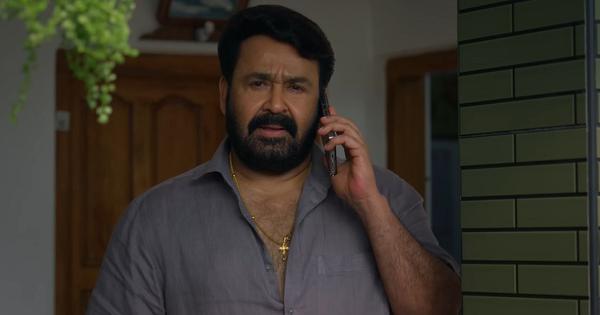
But it was more likely out of pig-headed devotion, one that reduced Mohanlal, a once-in-a-lifetime talent, into a mannequin outside a small-town textile showroom.
In the second part, his plan befitted big-budget mass movies like Twenty-20 and Narasimham more, minus the twirling moustache.
A phenomenon is reduced to “the complete actor.” Nothing more to learn, it implied.
And that shows.” During a casting meeting in 2005, this filmmaker was told by a close associate of the star that “Lalettan has achieved everything.
Mohanlal, the road contractor, the tourist guide, the unemployed rascal, flickered out forever.
Somebody had to say it, but nobody has till now. They may all pretend it was out of love. But it was more likely out of pig-headed devotion, one that reduced Mohanlal, a once-in-a-lifetime talent, into a mannequin outside a small-town textile showroom.
So let me just say it now: Having beguiled the masses for some 30 years (Yeah, my rant has been in the making precisely for that long now), “Lalettan” is now a decayed cliche – ossified, creaky, and badly puttied.
Aaron Sorkin may or may not have heard of him. Yet, if he were to make a documentary on the Malayali thespian, Sorkin could easily rehash The Newsroom’s opening scene: the ‘America is the greatest country’ trope, the news anchor’s initial discomfort followed by the brutal, clinical takedown of the dumb devotees, and even those poignant piano notes that follow “sure, used to be.” But most importantly, “Sure, used to be.”
Age surely has caught up with Lalettan (for non-Malayalis, ettan is an endearing term for an elder brother) and that is about the only excuse he has. At 66, he simply lacks the spark for younger characters, though clearly nobody’s told him that either. But if only it were about age alone.
His body stopped expressing years ago. Stock mannerisms finetuned in the 1980s and ’90s now crave a decent burial. His fans can’t deny anymore that the lovingly overlooked original chink in his armour – poor voice modulation – now stands out like Salman Khan’s dancing skills.
And oh, the face. That tired, plastic face. The eerie hall of Braavos beckons.
You aren’t convinced? Do watch Drishyam 3 – and curse me later.
Play Drishyam 3 (2026).
Unlike the scaffolding of even the most gigantic of buildings, which at some point gets dismantled to reveal the new structure, Lalettan’s stardom scrupulously adds layers of trappings each passing year, but only to hide a crumbling edifice.
So, half of Lucifer is slow-motion to sustain the aura. The period attire and headgear in Marakkar make you wonder if he is a medieval Muslim warrior or Guru Arjun Singh’s calendar image. Malaikotta Valiban, elevating him into a superhero, descends into cartoonish VFX.
Georgekutty’s chutzpah progressively turns into unrealistic machiavellianism with each instalment of Drishyam. In the second part, his plan befitted big-budget mass movies like Twenty-20 and Narasimham more, minus the twirling moustache. By Drishyam 3, they decided even a decent plot won’t be missed. Lalettan will do.
He is now so far up the invincibility hill that calls for him to ease up a bit (Hridayapoorvam?) get echoed as, “That ship has sailed…that ship has sailed…”
Last heard, he is reverting to the twirled-moustache avatar in the upcoming L366. Now, we thought that is one stock atrocity he’d given up after inflicting it on us for years. And I can already hear the roar of approval rising from that incorrigible animal: the fan.
Yeah, the same kind that, beginning with the late 1990s, soaked in all the testosterone his macho, misogynistic characters-with-whiskers pumped up. It took a “new generation” to detoxify Malayalam cinema of that miasma.
Play Malaikotta Valiban (2024).
In short: Mohanlal was on fire in the early-to-mid 1990s. Enter the toxic fan, undue praise, hero worship et al. A phenomenon is reduced to “the complete actor.” Nothing more to learn, it implied.
Because that’s what stars usually do, isn’t it? Stop evolving. Ask Amitabh Bachchan, Kamal Haasan, Rajinikanth, the late Vishnuvardhan and others.
And Mammooty? Yeah, him too.
Never claiming his friendly rival’s searing natural talent, the decade-older Mammukka, however, reinvented himself periodically. He still experiments and teams up with younger artistes, technicians, and ideas. Something tells me he’s keen on a swansong for the ages.
Contrast this with Lalettan. While gathering viewpoints for this article, I spoke with a filmmaker based outside Keralam. Here’s what he said: “He’s not interested really. And that shows.” During a casting meeting in 2005, this filmmaker was told by a close associate of the star that “Lalettan has achieved everything. He doesn’t need to do anything more.”
The result: “Lalettan” is running on fumes. All that he has managed in recent years is to add silliness to stardom with bizarre nonsense like “Lalism” and “Lalonam”!
(If you think box-office success justifies it all, this is where you stop reading and close the page.)
Play Marakkar (2021).
Fans, meanwhile, are left with the only tool to prop him up: comparison.
There is no dearth of social media videos gloating over his performances when placed against folks like Ajay Devgn and Vishnuvardhan. Filmy whataboutery, packaged as a superiority complex.
But then, how is this not a kamikaze act? Do we compare India’s achievements with those of Pakistan’s and Ethiopia’s, or with those of better, comparable nation-states? Oh, I forget, we also prefer the former.
So, that is “fans” for you: abandoners.
Mohanlal’s limitations were well-acknowledged even in the late ’80s and early ’90s. There were characters he couldn’t play well or things he couldn’t pull off convincingly.
A cop. A medieval warrior. Delivering non-Malayalam lines with equal finesse. Or just getting the various Malayalam accents right. He simply could not. And we were fine with that, since there was a whole lot of him left to savour, and an awesome pantheon camouflaging his weaknesses.
As he began peaking, the presence of a bunch of supremely talented technicians and artistes chiselled his craft, moulded his talent, and taught him things. Be it redoubtable directors like Sathyan Anthikkad, Padmarajan, Bharathan, and Priyadarshan, or acting stalwarts like Nedumudi Venu, Sukumari, and Thilakan, or writers like Lohitadas and MT Vasudevan Nair who smeared his roles with the smell of the soil and sweat of the street.
Make no mistake, he had his fair share of glamorous or macho outings back then, too, but rarely did they define him. Exceptions like the stylish smuggler in Rajavinte Makan and the feudal thug in Devasuram were just that: exceptions.
The actor made his mark mostly with vulnerable, grounded characters. Those that one may be forgiven for mistaking for a neighbour, a cousin, an annoying landlord, or a flex-board artist.
Play Vanaprastham (1999).
And that personal connection was only the hook.
His co-artistes, script-writers, musicians, and lyricists could weave magic around him, mostly because they were his equals, and as – if not more – talented. They appreciated his uniqueness, without stooping or prostrating. An osmosis of skills and values was simply meant to happen.
The result: we felt the physical pain of Mohanlal’s Balan in Thazhvaram, even when we also felt cheated like Sankaradi’s Naanu. We sang along uncontrollably with his Unni in His Highness Abdullah, but Lohitadas also made us fear the foxy Cheriyachan Thampuran.
We were left wondering whom to hug first and console more in Kireedam – the hapless Sethumadhavan or his policeman father Achuthan Nair, played by the incredible Thilakan. Hell, we even sided with the murderous anti-hero Jayarajan in Uyarangalil.
Pardon me for the sentimentalism, but that was an incredible decade of Malayalam movie talent, and not just the stars.
Play Kireedam (1989).
Then came Priyadarshan's Kalapani (1996), and the unravelling. The boastful, ambitious nature of that project didn’t sit well with Mohanlal’s simplicity and spontaneity as an actor. Hints of hamming emerged, and his moustache began its shenanigans.
In hindsight, his blinding decade was coming to a painful end. And, ideally, that should have been the moment of reinvention, for recalibration. Instead, what we got was more hamming, more panegyrics. Exhibit 1: The Prince (1996).
Yet, the momentum was still with Mohanlal. An explosive mix of Bollywood-style hero-giri and a relatable, stellar performance was still possible, an empty plot aside. Thus, Araamthampuran (1997), the last genuinely Mohanlal flagship. He executed that role, tailor-made for a star, with all his legendary flair, spontaneity, and subtlety.
It was a precarious balance of vacuity and talent.
For a moment, like that glorious, majestic vertical stance of the wrecked Titanic on the surface before it slid down to the seabed, Mohanlal stood tall and peerless as Jagannathan, bells and whistles. He gave it all as the camera made love to him.
Then he sank, and the moustache rose.
A look at his filmography after 1997 will tell you what I mean. Inane, cocky, toxic-masculine shades dominate his repertoire: Ustaad (1999), Narasimham (2000), Ravanaprabhu (2001), Thandavam (2002).…The list is painfully long.
If he wasn’t epitomising swaggering masculinity, he was the jack of all trades: Olympian Anthony Adam (1999), Chandrolsavam (2005), Thanmatra (2005).
Once the lights went out, the sakalakalavallabhan (master of all arts) could frolic in Carnatic singing, dance, elaborate stratagem, and stylised fights. Oh, he could also be the perfect parent, smuggler, teacher, and spy – often all at once. Baby, he just could no wrong!
Play Thanmatra (2005).
In one cringy scene in Rock N Roll (2007), his credentials as itinerant jazz player Chandramouli are established by a friend who drops names like I recite the 7’s table: AR Rahman, Zakir Hussain, Vikku Vinayakram, Shankar-Ehsan-Loy. He takes a breather, and then adds a “tradition” touch: Thayambaka maestro Mattanur Sankarankutty.
But wait, he just got done with only India. The prince of Bohemia also apparently concerts with Earl Peters at the Wembley, farms weed in Latin America, and copulates with a “black” woman in South Africa. Jeez!
This wannabe phase was aggravated by frequent hamming. Movies like Ayal Kadha Ezhuthukayanu (1999), Kaakkakuyil (2001), or Kilichundan Maampazham (2003) showed him desperately feigning spontaneity, giving us the blushes.
To be fair, along his slide to perdition, the man served up a few tantalising moments of hope in Vaanaprastham (1999), the absolutely beautiful Pranayam (2011) and Spirit (2012).
But unlike Ganga, who was pulled back from the edge of Nagavalli in Manichitrathazhu, Mohanal ultimately turned. Lalettan reigned.
There was no IV Sasi to discipline him. There was no Padmarajan mentoring him. He outgrew Sibi Malayil.
And this time, the fan was not in the cinema hall alone. Movie makers themselves placed him on a pedestal. He loved that never stepped down. He grew roots in that comfort zone and rotted. A different kind of osmosis was on.
In 2002, the non-Malayalam audience discovered him in Ram Gopal Varma’s Company. What was otherwise a run-of-the-mill performance for Malayalis, announced Lalettan’s arrival to non-Malayalis. And that was it.
Mohanlal, the road contractor, the tourist guide, the unemployed rascal, flickered out forever. Thank the fan. Thank the bloody fan.
I’ll end my rant with a quote a collegemate once attributed to Bob Marley (wink, wink), but was apparently by American actor Charles Fleischer: “If you remember the ’60s, you really weren't there.”
If you are into “Lalettan”, you really missed out on all the Mohanlal.