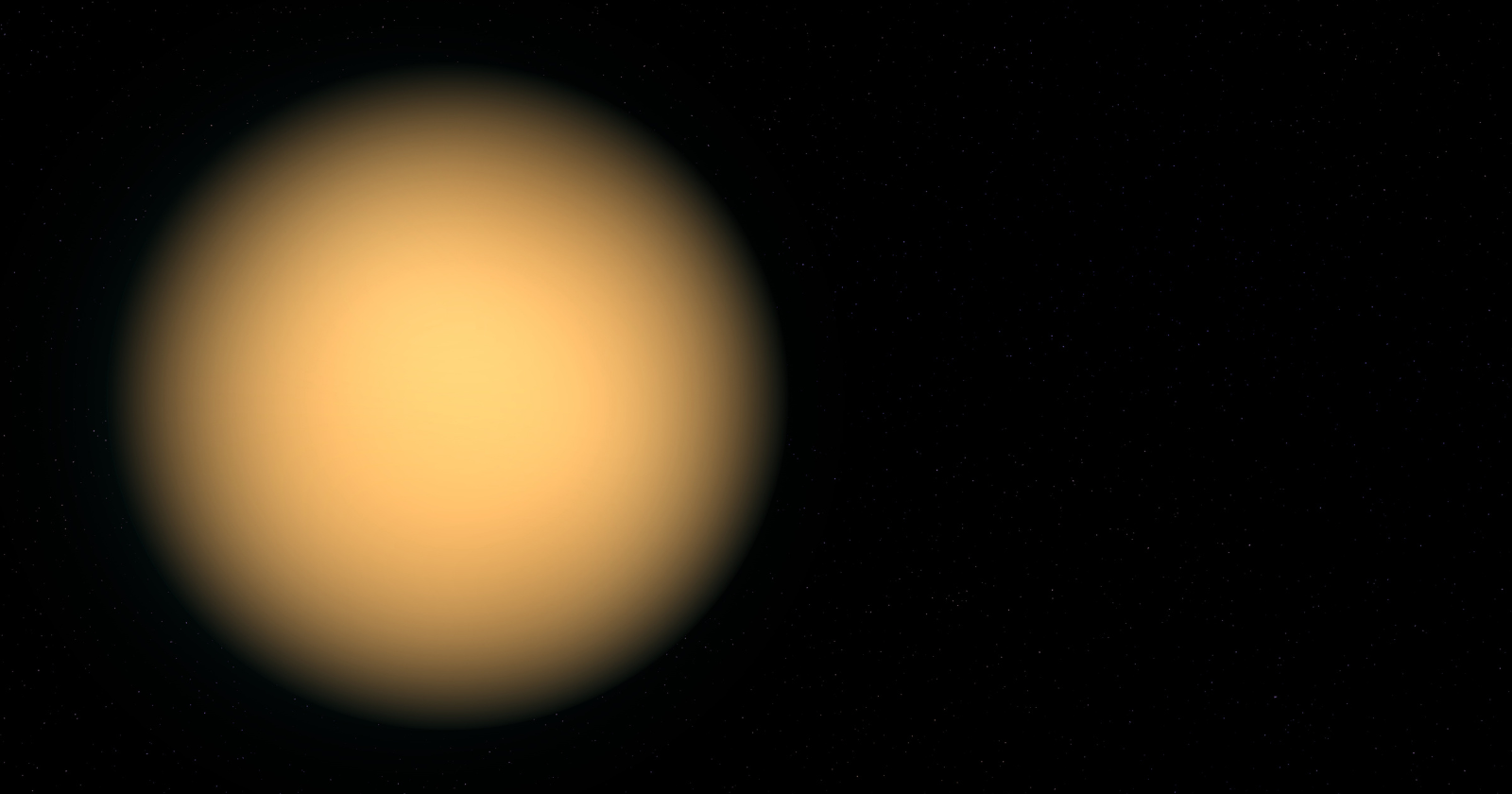
Titan, the largest moon of Saturn, has a denser atmosphere than Earth and a surface where rain, rivers, and seas are made of liquid hydrocarbons rather than water.
At that temperature, methane and ethane are liquids, and Titan runs a weather cycle on them much as Earth runs one on water.
Methane evaporates, forms clouds, falls as rain, and collects into rivers and into seas, the largest of them near the north pole.
The weight that lift has to hold up depends on gravity, and Titan’s is far weaker.
The haze means Titan’s surface has never been mapped from orbit in the detail a rover route would need, and the terrain includes dune fields and ground that may be cracked and rugged.
Titan, the largest moon of Saturn, has a denser atmosphere than Earth and a surface where rain, rivers, and seas are made of liquid hydrocarbons rather than water. And NASA is building a rotorcraft to explore it, because Titan’s physical conditions genuinely favour flight in a way no other body in the solar system does. The mission is called Dragonfly.
It is worth separating what is settled from what is still a plan, because the science is firm and the schedule, as schedules for missions like this tend to be, is not.
Why the air is thick and the lakes are not water
Titan is large, about the size of the planet Mercury, and it is the only moon in the solar system with a substantial atmosphere. According to the Southwest Research Institute, the surface pressure is roughly 1.5 times that of Earth at sea level, even though Titan’s gravity is only about one-seventh of Earth’s. The air is mostly nitrogen, with a few percent methane, and it is thick with an orange photochemical haze that hides the surface from ordinary cameras in orbit.
At the surface, the temperature sits around minus 180 degrees Celsius. At that temperature, methane and ethane are liquids, and Titan runs a weather cycle on them much as Earth runs one on water. Methane evaporates, forms clouds, falls as rain, and collects into rivers and into seas, the largest of them near the north pole. It is the only other place known to have stable liquid on its surface. The liquid is simply not water.
Why flying beats driving
The phrase “flying may be easier than driving” is not a flourish. It follows from the same two numbers above.
The lift a rotor can generate rises with the density of the air it pushes against. At Titan’s surface the air is far denser than Earth’s even though the pressure is only about 1.5 times Earth’s, because Titan is so cold that the same gas is packed much more tightly. The weight that lift has to hold up depends on gravity, and Titan’s is far weaker. Dense air to push against, very little weight to lift: by some calculations, generating lift on Titan is on the order of tens of times easier than on Earth. A rotorcraft that would struggle on Earth would fly comfortably there.
Driving, by contrast, is harder than it sounds. The haze means Titan’s surface has never been mapped from orbit in the detail a rover route would need, and the terrain includes dune fields and ground that may be cracked and rugged. A flying vehicle can lift over hazards rather than negotiate them, and it can reach sites a rover could not. NASA’s figures for Dragonfly suggest that in a single flight of under an hour it could cover more ground than any Mars rover has driven in its entire mission. That is the real content of the comparison.
What Dragonfly is, and where it is now
Dragonfly is a car-sized rotorcraft with eight rotors, built and operated by the Johns Hopkins Applied Physics Laboratory, with Elizabeth Turtle as principal investigator. It is designed to land, do science on the surface, and then hop to a new site, making roughly one flight per Titan day, which is about sixteen Earth days. Its purpose is to study Titan’s organic chemistry and assess how far that chemistry has moved toward the conditions relevant to life.
It is nuclear-powered for a straightforward reason. Sunlight at Saturn’s distance is around one percent of its strength at Earth, and Titan’s haze cuts that further, so solar panels are not a practical option. Dragonfly will instead carry a Multi-Mission Radioisotope Thermoelectric Generator, the same type of unit that powers the Curiosity and Perseverance rovers on Mars, which converts the heat of decaying plutonium into electricity.
This is not a paper concept. In April 2025 the mission passed its Critical Design Review, the point at which, in NASA’s description, the design, fabrication, and test plans are approved and the team can turn to building the spacecraft itself. The Applied Physics Laboratory, which manages the mission for NASA, describes the same milestone as clearing the design to enter full-scale fabrication, integration, and testing. There is precedent for the basic idea: the small Ingenuity helicopter showed that powered flight on another world is possible, on Mars. Dragonfly is a far larger undertaking, a full science mission rather than a technology demonstration.
The schedule, handled honestly
Dragonfly is a confirmed and funded mission, which distinguishes it from the many proposed missions that never leave the concept stage. But its timeline has already moved more than once, and its cost has grown.
According to The Register’s report on the mission’s confirmation, the total lifecycle cost stands at about 3.35 billion US dollars, roughly double the figure originally proposed, and the launch slipped to its current target after earlier delays attributed to budget uncertainty. The provisional plan is a launch no earlier than July 2028 on a SpaceX Falcon Heavy, an interplanetary cruise of almost seven years, arrival at Titan around 2034, and a surface mission lasting more than three years.
Those dates should be read as the current plan, not a fixed calendar. The thing to watch over the next two years is whether the hardware now being assembled stays on track for the 2028 window, because a mission of this length is unforgiving of slips: miss a launch period, and the arithmetic of reaching Saturn pushes everything years further out.