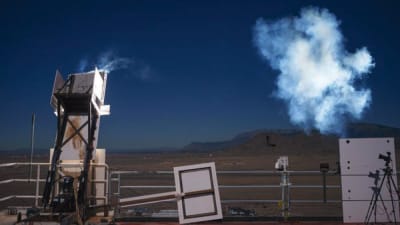
Smoke billowing off NASA’s heat shield material during a recent test at Sandia National Laboratories’ National Solar Thermal Test Facility.
Recently, NASA engineers tested heat shield materials for the Mars Lander at Sandia.
Sandia’s solar testing facility includes a 200-foot-tall power tower with a field of 212 mirrored heliostats.
Acting like a massive magnifying glass, Sandia’s solar test facility can focus sunlight up to 3,500 times this amount of light.
“Typically, NASA missions test their heat shield materials at several different facilities with different capabilities before certifying the material for flight,” said Brandon Smith, Lead Engineer for heat shield materials for the Sample Retrieval Lander at NASA Jet Propulsion Laboratory.
Smoke billowing off NASA’s heat shield material during a recent test at Sandia National Laboratories’ National Solar Thermal Test Facility. (Image: Craig Fritz/Sandia National Laboratories)
For decades, Sandia National Laboratories’ National Solar Thermal Test Facility has harnessed the power of the sun to expose aerospace materials to intense heat, replicating the harsh conditions of faster-than-sound flight and atmospheric reentry to ensure the materials’ ability to protect the rest of the vehicle. The most recent of these tests is in support of two exciting NASA missions.
The ambitious Mars Sample Return campaign, which is under a complete program review, is a NASA and European Space Agency mission that seeks to deliver Martian rocks to eager Earth-bound scientists. These samples could provide clues as to whether the Red Planet ever hosted life and help prepare for human exploration of Mars. If selected, the Sample Retrieval Lander segment of this mission would land the heaviest payload ever on Mars, including a rocket designed to launch a container of carefully selected samples into Mars’ orbit. Recently, NASA engineers tested heat shield materials for the Mars Lander at Sandia.
“This would be the first mission to return rocks from Mars to Earth; it’s got a bigger payload,” said Ken Armijo, Sandia Engineer and Test Director for the NASA tests. “The heavier the payload and the bigger the entry vehicle, the hotter the vehicle gets during atmospheric entry, and the better the heat shield needs to be.”
What makes Sandia’s solar testing facility special is its ability to test samples of material up to 3 feet wide with different gases blowing over the samples to mimic the atmosphere of different worlds, Armijo said. This is done using sunlight focused by hundreds of mirror-like heliostats — rather than using energy guzzling arc jets or lasers, which are two other methods for testing materials for reentry. This could save between 15 to 60,000 kW per test, the equivalent of running 5 to 20,000 clothes dryers for the length of the test.
Sandia’s solar testing facility includes a 200-foot-tall power tower with a field of 212 mirrored heliostats.
“We have high flux and high flux distribution on the Solar Tower,” Armijo said. “We can basically fit whole pieces of planes up there if we wanted to and blast them with concentrated sun beams. The high flux you experience during reentry and hypersonic flight is only part of what we can simulate.”
Flux represents the amount of light or energy hitting a certain area, often compared to the amount of sunlight that would hit a beach towel on a sunny day. Acting like a massive magnifying glass, Sandia’s solar test facility can focus sunlight up to 3,500 times this amount of light.
Arc jet testing costs up to $100,000 per day, while laser testing is similar at approximately $150,000 per day, while testing on the Solar Tower costs about $25,000 per day, Armijo explained. Another benefit is the ability to focus more heliostats upon the test material, changing the intensity of sunlight to mimic the stages of reentry or even the conditions of reentry on different celestial bodies, he added.
“Typically, NASA missions test their heat shield materials at several different facilities with different capabilities before certifying the material for flight,” said Brandon Smith, Lead Engineer for heat shield materials for the Sample Retrieval Lander at NASA Jet Propulsion Laboratory. “Sandia’s ability to test at this size nicely complements our other test facilities.”
For more information, contact Mollie Rappe at This email address is being protected from spambots. You need JavaScript enabled to view it. ; 505-228-6123.