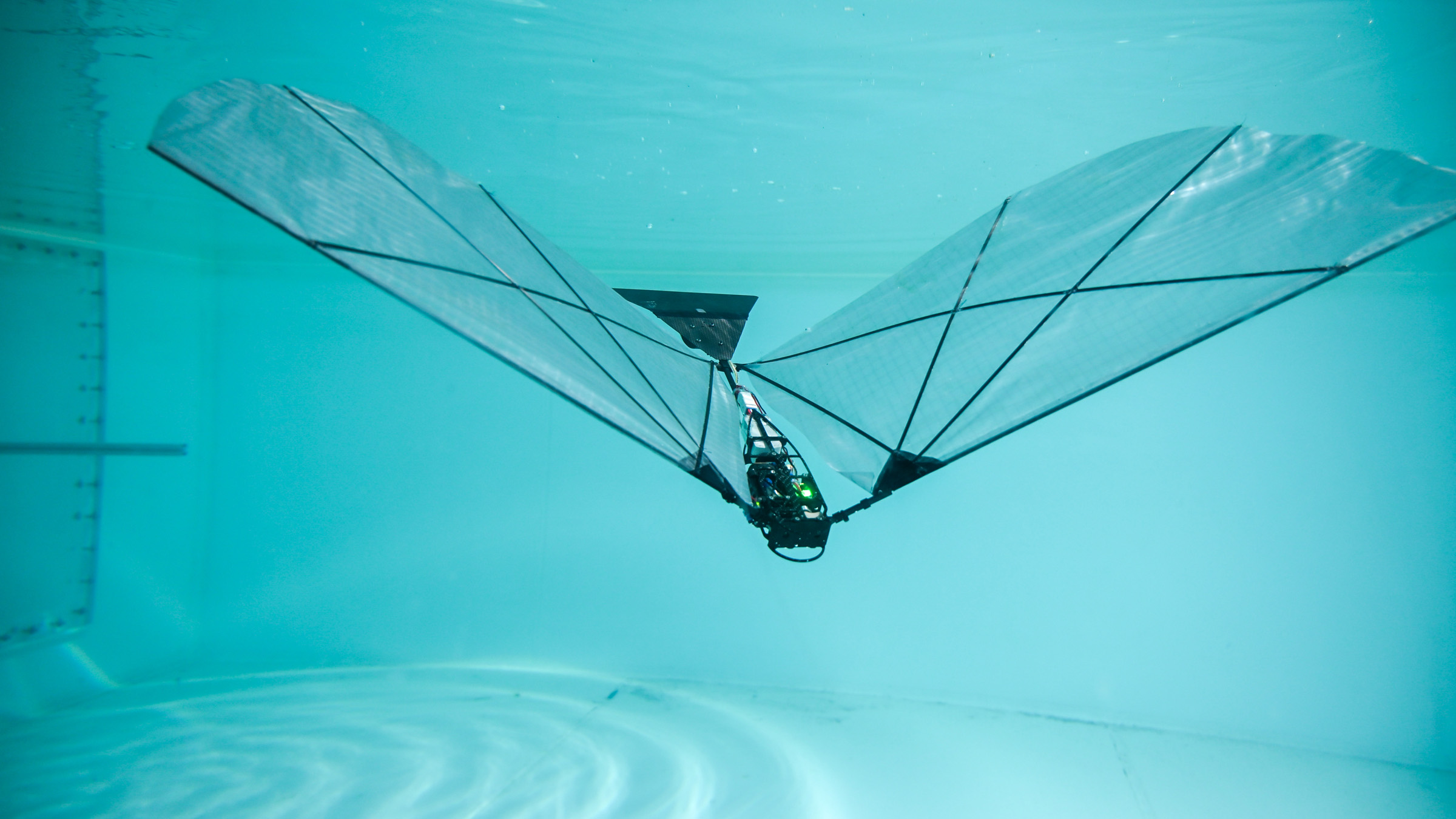
A bird-sized robot can swim underwater before launching directly into flight using only its flapping wings.
Building the machineThe robot model keeps to the basics of a bird’s body and weighs less than half a pound.
The wings are thin membranes coated with water-repelling particles that help to shed the surface as the robot lifts off.
Engineers tested different wing sizes and stiffness to find a design that worked efficiently in both water and air.
Earlier success had come only at insect scale, in a tiny robot that flapped between water and air.
A bird-sized robot can swim underwater before launching directly into flight using only its flapping wings. No machine of its size had previously made the transition from water to air without relying on propellers or other launch systems.
The design could offer a cheaper way to monitor the ocean, flying to a spot too risky for a boat, dropping underwater to grab a sample or a reading, and climbing back out to carry it home.
It also gives biologists a working model of how birds that hunt underwater handle two fluids that behave nothing alike.
Navigating air and water
Water is about a thousand times denser than air, and moving through each one calls for very different mechanics. A wing built for one fluid should, by that logic, struggle badly in the other.
Diving birds ignore that logic. Loons, gulls, petrels, and about 100 other bird species plunge underwater to chase fish and then burst back into the air to fly off.
Professor Raphael Zufferey at the Massachusetts Institute of Technology (MIT) spent two years chasing that same trick.
At his MIT lab, he designs small aerial and aquatic machines modeled on the way animals move.
The work drew in collaborators at the Swiss Federal Institute of Technology in Lausanne (EPFL) and a tribal college in Washington state.
Inspired by bird flight
To learn how the birds pull it off, the team gathered published data on puffins, kingfishers, and other divers and looked for the pattern underneath their motion.
The numbers lined up cleanly. Smaller diving birds beat their wings about ten times a second in air and around four times a second underwater, a rhythm the team could aim to copy in hardware.
One question hung over the whole idea. Big wings help a flier stay up, but water pushes back far harder than air, so those same wings should struggle once they are submerged.
When Earth.com asked what most surprised the team, Zufferey said, “Large wings do not substantially decrease efficiency underwater, where one would expect that larger wings would have to fight against more drag force.”
The result loosened a constraint the team had expected to fight, letting wing size be chosen for flight rather than forced small to cut drag.
Diving birds like puffins inspired the robot’s flapping-wing design.
Building the machine
The robot model keeps to the basics of a bird’s body and weighs less than half a pound.
A slim central frame holds a battery and a waterproofed motor that spins a crankshaft, pumping the wings at a set pace. The drive was the sticking point.
In his replies to Earth.com, Zufferey described the hardest engineering problem as fitting one powerful motor that can flap slowly underwater and quickly in the air, all sealed against water.
A small, motorized tail tilts, pointing the nose up for climbing or down for diving. The wings are thin membranes coated with water-repelling particles that help to shed the surface as the robot lifts off.
Rather than seal the electronics inside a bulky waterproof shell, the engineers painted every part in a thin layer of silicone. That kept the machine light.
The waterproofing added only about half an ounce, near five percent of its weight, and left the robot neutrally buoyant, so it neither floated up nor sank.
Built for both worlds
The wings pop off and swap for other sizes, and the team built three sets spanning roughly two to three feet 0.6 to 0.9 meters) across.
Much of the engineering came down to the flapping wings and how stiff they were.
A wing too floppy could not hold the robot up in the air, while one too rigid thrashed too hard to slip through the water.
A separate flapping-wing vehicle had already pushed itself along at about three feet (0.9 meters) a second underwater on its wings, close to what this robot would later reach.
Engineers tested different wing sizes and stiffness to find a design that worked efficiently in both water and air.
Breaking the surface
Testing followed a set routine. The team started the robot about a foot and a half (0.5 meters) underwater.
They fixed the wings to a chosen beat and the tail to a chosen angle, and watched whether it would climb, break the surface and fly.
They ran the trials first in a tank, then out on Lake Geneva in Switzerland. The medium wings won out.
Cruising just below the surface, the robot swam at close to three feet (0.9 meters) a second while flapping about five times a second.
In the air, it reached roughly 20 feet (6.1 meters) a second at a similar beat, matching the speeds of real diving birds. The transition itself required more.
Water-to-air flight
To punch through the surface, the robot had to double its wingbeat to about ten times a second and hold its body at a steep 70-degree tilt, just short of the angle where it would return to the water.
That angle keeps the wingtips from catching the surface as they drive it upward. The surprise was in what the robot did not need.
Most diving birds paddle hard with their feet as they take off, kicking while they flap and tilt their bodies. Until this work, no one knew whether a robot would need the same push.
Earlier success had come only at insect scale, in a tiny robot that flapped between water and air. Here the wings alone carried it out, with no kicking required.
Underwater, the same wings could throttle far down, slowing to a single beat every ten seconds when the robot needed to coast rather than push.
The wide gap between that crawl and the frantic launch shows how much range the flexible membranes hold.
The robot breaks through the water’s surface before transitioning into flight.
A simpler jump
Earlier water-to-air crossings leaned on heavier hardware. One design Zufferey helped build years ago carried a fuel that reacted with lake water to make gas.
It fired the robot off the surface with a force many times its own weight. Other groups have reached for propellers or tilting rotors to power through the boundary between water and air.
Wings alone are lighter. Leaning on them strips much of that machinery away, which is part of why a bird-scale jump had stayed out of reach for so long.
The future of flight
The team is now reworking the wings so they can turn as well as beat up and down, which would let the robot steer more like a real bird.
Rougher tests are lined up too, sending it out of choppy water and through gusting wind instead of the calm of a tank. The goal is cheaper and more frequent ocean science.
Ships and moored sensors are costly and slow to move, so a small fleet of these robots could reach places that are hard or dangerous to sample and bring the readings back.
Zufferey imagines many of these robots covering a wide grid of water at once, taking readings far more often than crewed ships can.
Future ocean missions
One machine might dip into a coral reef or an algal bloom, then fly the data home.
When speaking with Earth.com, Zufferey said, “We could also sample in locations that are dangerous for humans.”
He pointed to polluted water, the edges of ice shelves and volcanic lakes as places a small robot could reach in a person’s place.
What is new is plain. A bird-sized machine can now swim underwater, break the surface and climb into flight on its wings alone, with no paddling feet and no chemical launch to help it.
This robot could turn ocean sampling into something done by the hour rather than by the season. It gives biologists a controllable stand-in for the birds that inspired it.
The study is published in Science.
Image Credit: Raphael Zufferey (MIT)
—–
Like what you read? Subscribe to our newsletter for engaging articles, exclusive content, and the latest updates.
Check us out on EarthSnap, a free app brought to you by Eric Ralls and Earth.com.
—–