For years, astronomers have been puzzled by mysterious radio signals arriving from deep within our galaxy.
Read Full StoryThe findings provide the clearest evidence yet for the origin of a rare class of phenomena known as "long-period radio transients," mysterious radio pulses that have baffled scientists since their discovery.
The team found that it originates from a dense white dwarf star that is actively stripping material from a nearby companion star.
The two stars orbit each other at extremely close range, completing a full orbit in just over an hour.
The two stars orbit each other at extremely close range, completing a full orbit in just over an hour.
For years, astronomers have been puzzled by mysterious radio signals arriving from deep within our galaxy. Now, a PhD student has helped solve the cosmic mystery by identifying the source of one of these strange bursts, revealing a rare stellar system unlike anything previously confirmed.
An international team led by researchers from the University of Sydney has traced an unusual repeating signal to a pair of stars locked in a dramatic cosmic interaction.
Read Full Story
The findings provide the clearest evidence yet for the origin of a rare class of phenomena known as "long-period radio transients," mysterious radio pulses that have baffled scientists since their discovery.
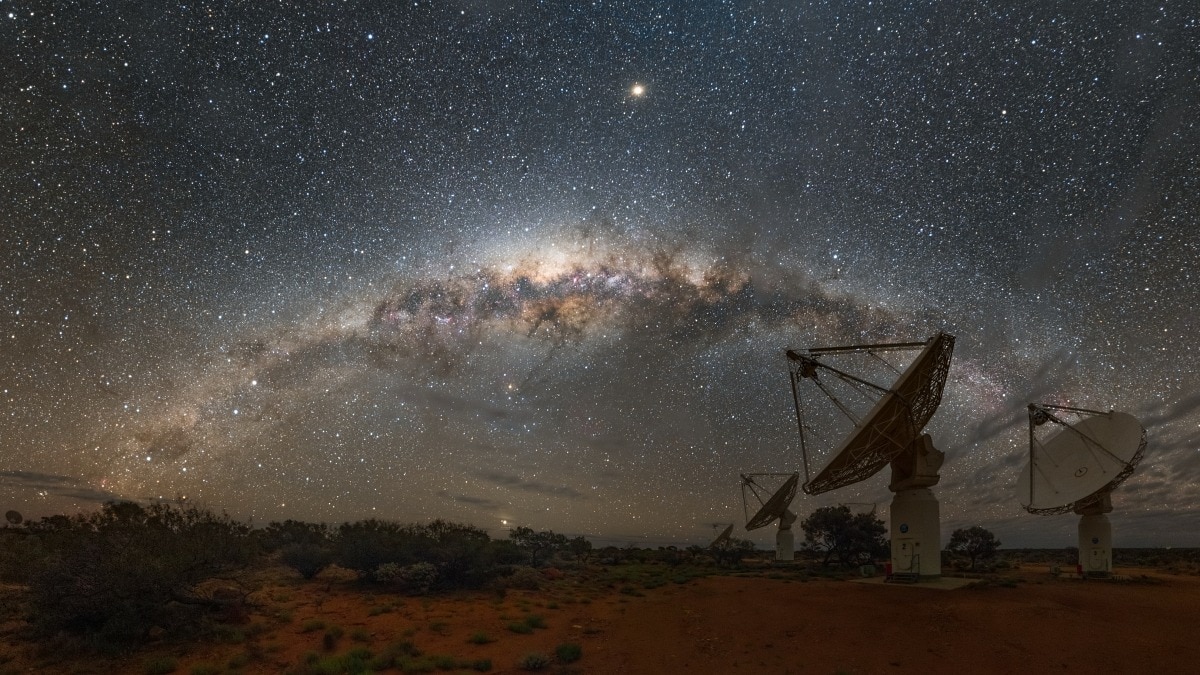
The breakthrough was led by PhD student Kovi Rose, who used observations from Australia's ASKAP radio telescope to pinpoint the source of the signal.
The team found that it originates from a dense white dwarf star that is actively stripping material from a nearby companion star. The two stars orbit each other at extremely close range, completing a full orbit in just over an hour. (Photo: Getty)
As the stolen material spirals toward the white dwarf, it heats up and emits powerful X-rays. At the same time, magnetic interactions between the two stars generate intense radio bursts that repeat every 1.4 hours, creating the mysterious signal detected on Earth.
The newly identified system, known as ASKAP J17455051, consists of a white dwarf roughly the size of Earth but nearly as massive as the Sun, paired with a small red dwarf star containing about one-tenth of the Sun's mass.
The two stars orbit each other at extremely close range, completing a full orbit in just over an hour.
Scientists say the discovery is significant because long-period radio transients have remained one of astronomy's biggest unsolved puzzles. Only about a dozen such objects have been identified across the Milky Way, and their origins are largely unknown.
Initially, researchers suspected the signals might come from slowly spinning neutron stars called pulsars. However, existing theories suggested pulsars rotating this slowly should not be capable of producing such emissions.
The new findings point to a different explanation. At least some of these mysterious signals appear to come from binary star systems involving white dwarfs rather than neutron stars.
Researchers describe ASKAP J17455051 as a "stellar Rosetta Stone" that could help decode other unexplained radio signals detected throughout the galaxy. The system also offers scientists a unique laboratory for studying extreme magnetic fields, plasma physics and the behaviour of matter under intense gravitational forces.
With more observations planned using radio, optical and X-ray telescopes, astronomers hope this discovery is only the beginning of understanding an entirely new class of cosmic phenomena hidden within our galaxy.
- Ends