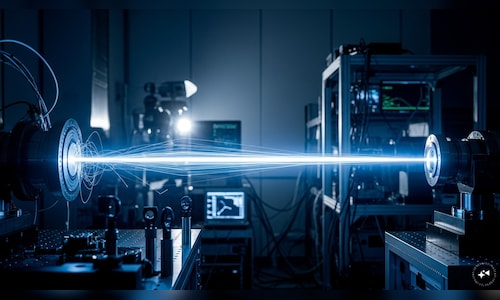
For decades, scientists using powerful lasers have faced a major problem: turning up the beam's power usually melts or destroys the object they want to study.
Their approach achieved more than a 20-fold improvement, opening new possibilities for advanced scientific research.Many interactions between light and matter occur in a linear way.
In these cases, atoms absorb photons one at a time, and the response increases steadily as the intensity of the light grows.
But this necessitates the use of extremely powerful laser pulses, which have the potential to damage or even destroy the objects they come into contact with.
Unlike conventional laser beams, where photons arrive at a relatively steady rate, BSV light experiences extreme swings in photon numbers.
For decades, scientists using powerful lasers have faced a major problem: turning up the beam's power usually melts or destroys the object they want to study. Now, researchers have discovered a way to overcome this limitation by harnessing the properties of quantum light.In a recent study published in Nature, a team led by Jian Wu from East China Normal University in Shanghai showed a technique that boosts the effectiveness of laser-driven processes without increasing the laser's average energy output. Their approach achieved more than a 20-fold improvement, opening new possibilities for advanced scientific research.Many interactions between light and matter occur in a linear way. In these cases, atoms absorb photons one at a time, and the response increases steadily as the intensity of the light grows. However, some of the optical effects are nonlinear. These processes require multiple photons to interact with an atom almost simultaneously, producing phenomena such as multi-photon absorption and the generation of higher-frequency light.These effects are particularly helpful to physicists since they scale much more sharply with the intensity of the light than linear processes. But this necessitates the use of extremely powerful laser pulses, which have the potential to damage or even destroy the objects they come into contact with. This has put a limit on how far the approach may be advanced thus far.To solve this problem, the research team turned to a special type of quantum light known as a Bright Squeezed Vacuum (BSV). Unlike conventional laser beams, where photons arrive at a relatively steady rate, BSV light experiences extreme swings in photon numbers. These sudden bursts can momentarily deliver very high concentrations of photons.As a result, researchers can create the conditions needed for powerful nonlinear interactions without requiring a more intense laser.To test their idea, the scientists focused on a process called tunnelling ionization. In this phenomenon, a strong light field alters the environment around an atom so severely that an electron effectively punches straight through the barrier keeping it in place. The team also analysed the behaviour of the released electrons.Their measurements revealed a remarkable outcome: a BSV pulse carrying only 300 nanojoules of average energy generated the same nonlinear effect as a conventional laser pulse, resulting in a 20-fold enhancement without increasing average power. The study also confirmed that the pulse's intensity could be controlled without altering its energy.The findings provide scientists with a new method for controlling powerful light-matter interactions by adjusting the quantum nature of the light source. One area that could benefit significantly from this breakthrough is attosecond science, which studies light pulses that last only billionths of a billionth of a second.By applying quantum optical tools into this domain, the team’s findings suggest that future extreme light–matter interactions can be driven with significantly higher precision and lower risk of collateral damage compared to classical laser sources.