
Periodic radio and X-ray emission from an accreting white dwarf binary
Of these, none has been reported to exhibit periodic radio emission, and the observed radio emission in these CVs is far less luminous than that seen in LPTs, by a factor of at least 100–1,000. Phases 2 and 4 correspond to the binary conjunctions of the red dwarf (RD) and white dwarf (WD), when the radial velocity is zero. The highly elliptical polarization and the radio frequency modulation indicate that the radio emission is coming from a strongly magnetized plasma. This is more luminous than ~99% of all known radio stars38, making it unlikely that the radio emission originates from the stellar companion. This interaction model may also be applicable to other LPTs with white dwarf binary progenitors.
We discovered ASKAP J174508.9-505149 (hereafter ASKAP J1745-5051) with the Australian SKA Pathfinder radio telescope (ASKAP)1 in an untargeted search for circularly polarized sources in the 1.365-GHz Rapid ASKAP Continuum Survey (RACS-mid)2 (Methods). In follow-up observations with the MeerKAT3 radio telescope (Methods) we refined the initial RACS-mid J2000 position to a right ascension (RA) of 17 h 45 min 8.929 ± 0.06 s and declination (dec.) −50° 51′ 49.86″ ± 0.03″.
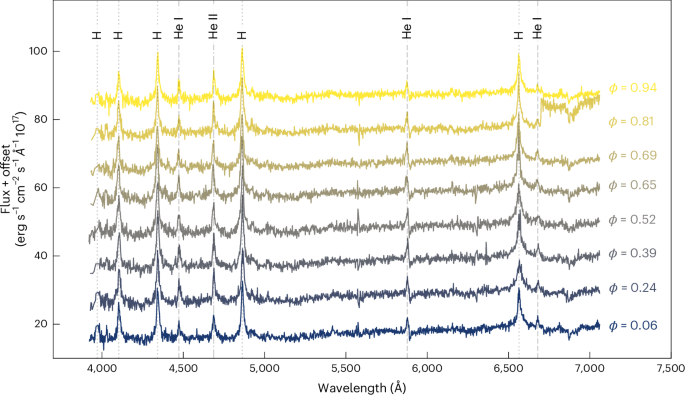
We identified an optical counterpart in Gaia Data Release 3 (Gaia DR3)4, with an apparent magnitude of m G = 19.45 ± 0.04 mag (Methods). In follow-up spectroscopy with the Southern Astrophysical Research (SOAR)/Goodman5 and Low Dispersion Survey Spectrograph (LDSS-3)/Magellan6 telescopes (Methods) we found ASKAP J1745-5051 to have a flat spectrum with a blue excess and strong, narrow emission features in Hydrogen (Balmer) and Helium (HeI, HeII) (Fig. 1 and Extended Data Fig. 1). The combination of strong HeII lines and the flat spectra with narrow Balmer lines are characteristic of magnetic cataclysmic variables (CVs) (for example, refs. 7,8). Magnetic CVs are compact binary systems composed of a strongly magnetized white dwarf and a main-sequence companion (usually of spectral type K to M)9, with polars and intermediate polars being the two main subtypes. Polars have close orbits (P orb ≈ 1.3–4 h), and strong magnetic fields (B ≳ 107 G) which synchronize the white dwarf spin to the orbital period9. Intermediate polars tend to have weaker magnetic fields (106 ≲ B ≲ 107 G) such that the white dwarf spin and orbital periods (P orb ≈ 1.3–12 h) are not synchronized9,10. Polars may also deviate from synchronization for periods of ~100–1,000 years following a nova outburst11. White dwarfs in these asynchronous polars usually have spin periods a few per cent faster than P orb , but some systems, like Paloma (RX J0524+42), have been observed with spin periods up to ~20% faster than their orbital periods (see refs. 12,13, and references therein).
Fig. 1: SOAR spectra of Gaia 4032. The alternative text for this image may have been generated using AI. Full size image We show each of the consecutive 10-min spectra with an offset and plot the rest wavelengths for the hydrogen Balmer series (dotted), helium I (dashed) and helium II emission lines (dot-dashed). The orbital phases ϕ are shown next to each corresponding spectrum. The red excess in the ϕ = 0.81 spectrum (second from the top) is likely due to a calibration error.
Another unique radio-emitting CV is AR Scorpii (AR Sco)14, which is more radio-luminous than most CVs14 and has been suggested as an evolutionary progenitor to intermediate polars and long-period radio transients (LPTs)14,15, although some have argued against this interpretation16. Like ASKAP J1745-5051, AR Sco also has flat optical spectra with narrow hydrogen and helium lines. We note that similar features are also seen in the two other known AR Sco-like systems J191213.72-441045.1 (J1912)17 and SDSS J230641.47+244055.8 (SDSS J2306)16. All three of these systems have orbital periods between 3.4 h and 4.1 h. Measuring Balmer line radial velocities (Methods), we found that ASKAP J1745-5051 has a far shorter orbital period of P orb = 1.368 ± 0.053 h. This period is also shorter than ILT J1101+5521 (ILT J1101, P orb = 2.1 h)18 and GLEAM-X J0704-37 (GLEAM-X J0740, P orb = 2.9 h)19, LPTs thought to be associated with white dwarf-M dwarf binaries but lacking the characteristic spectra of a magnetic CV20. ASKAP J1745-5051 has properties broadly consistent with LPTs, namely, coherent and highly polarized radio bursts that repeat periodically. The observed LPT-like radio emission and magnetic CV-like spectral features of ASKAP J1745-5051 confirm this relationship and suggest that magnetic CVs may be the progenitor for a subset of LPTs.
Roughly 50 CVs have been seen to produce radio emission, including non-magnetic CVs (B ≲ 106 G)21,22,23,24. Of these, none has been reported to exhibit periodic radio emission, and the observed radio emission in these CVs is far less luminous than that seen in LPTs, by a factor of at least 100–1,000. There have, however, been detections of coherent and highly circularly polarized radio emission from several magnetic CVs23 and one nova-like CV21, supporting a possible CV origin for LPTs. It has been shown that there is a canonical P orb ≈ 1.3 h lower limit on CV orbital periods25, at which the white dwarf and its low-mass companion detach and begin to drift apart26. ASKAP J1745-5051 falls near this boundary, with an orbital period of P orb = 1.368 ± 0.053 h. This spectroscopic period is consistent with the radio pulse period \({P}_{{\rm{radio}}}=1.3449{7}_{-0.00004}^{+0.00003}\,{\rm{h}}\), obtained from observations with the Australia Telescope Compact Array (ATCA)27 and ASKAP radio telescopes spanning nearly 2 years (Extended Data Table 1 and Methods). Moreover, phase-folding the arrival times of the radio bursts from separate observations revealed that these bursts occur around the same orbital phase near conjunctions, which occur at phases ϕ = 0.25, 0.75, with a median phase ϕ median = 0.31 ± 0.03 for the ATCA and ASKAP bursts and ϕ median = 0.8 ± 0.1 for the MeerKAT bursts (Fig. 2). Similar behaviour was observed from both AR Sco and ILT J1101, with radio lightcurves that peak around orbital conjunction18,28,29. It is noteworthy that, in Fig. 2, we see that the MeerKAT radio bursts are half an orbit out of phase with respect to the ASKAP and ATCA bursts, despite observing the complete orbital phase, indicating that there may be emission at both orbital conjunctions. We find no evidence for a seconds-long white dwarf spin period (Methods) similar to the seconds-long radio pulse structure seen in both AR Sco and ILT J110114,18, and cannot directly constrain a white dwarf spin period on longer timescales.
Fig. 2: Phase-folded pulse timing. The alternative text for this image may have been generated using AI. Full size image Top: Einstein Probe-FXT X-ray data compared with the normalized median two-body radial velocity posterior from The Joker (black curve), with the standard error of the binned count rates shown as vertical error bars and the width of the phase bins shown as horizontal error bars. We also show the sinusoid fitted to the X-ray data (dashed purple curve) peaking at an orbital phase of ϕ X = 0.89 ± 0.19. Middle: arrival times of radio pulses compared with SOAR radial velocity measurements (grey markers with 1σ error bars) and median two-body radial velocity posterior from The Joker (black curve). We show pulses from MKT Epoch 1, MKT Epoch 2, and ATCA Epoch 8 in red, purple, and green, respectively. The ASKAP ToO pulses are denoted as dot-dashed brown lines. For the double-peaked pulses of ATCA Epoch 4 we show, in blue, the average pulse arrival times (dotted lines) taken halfway between the two peaks of each pulse. The light shaded regions denote the pulse width. The red crosses denote the binary phases shown below. Bottom: sketch of orbital phases with a face-on inclination. Phases 1 and 3 correspond to the binary quadratures—with the two stars side by side—where the Doppler shift maxima/minima occur. Phases 2 and 4 correspond to the binary conjunctions of the red dwarf (RD) and white dwarf (WD), when the radial velocity is zero.
The radio pulses from ASKAP J1745-5051 are elliptically polarized and display variability in their polarization properties (Extended Data Fig. 2 and Supplementary Data 1). ASKAP J1745-5051 also exhibits complex pulse morphology, narrowband emission structure and intermittency, including switching off for several hours at a time (Figs. 3 and 4).
Fig. 3: Total intensity (Stokes I) dynamic spectra of ASKAP J1745-5051 from ATCA. The alternative text for this image may have been generated using AI. Full size image Corresponding Stokes I, V and polarized intensity (\(\mathrm{PI}=\sqrt{{Q}^{2}+{U}^{2}}\)) lightcurves are shown with 1σ standard error of the mean error bars. Both dynamic spectra, ATCA Epoch 4 (left) and ATCA Epoch 8 (right), use 15 MHz frequency averaging and 120 s time averaging. Empty regions of white space denote data that were flagged for radio frequency interference.
ASKAP J1745-5051 exhibits pulse properties not previously observed in LPTs, providing valuable insights into the progenitor system. The pulses are seen to drift up and down in frequency over a longer beat period, with a modulation of the 2–3 GHz upper cut-off frequency (Fig. 3). ASKAP J1745-5051 also exhibits a narrow (~10 MHz) frequency structure within the pulses, shown in the MeerKAT dynamic spectra in Fig. 4. This sort of intensity modulation—commonly observed in the decametric emission from Jupiter30—is absent from all LPTs except for ASKAP J144834-685644 (ASKAP J1448)31. Such variability cannot be explained by interstellar propagation effects, with typical refractive interstellar scintillation having longer timescales (approximately months) and lower relative intensity variations (~10–30%), while diffractive interstellar scintillation would occur at much shorter timescales (~10 s) than we observe. This is the only time that these intensity patterns (also known as ‘modulation lanes’) have been detected in any binary system other than the Jupiter–Io system. The intensity modulation suggests the presence of local plasma acting as an interference screen to the beamed radio emission. The highly elliptical polarization and the radio frequency modulation indicate that the radio emission is coming from a strongly magnetized plasma.
Fig. 4: Total intensity (Stokes I) dynamic spectra of ASKAP J1745-5051 pulses from MKT Epoch 1. The alternative text for this image may have been generated using AI. Full size image Corresponding Stokes I, V and \(\mathrm{PI}=\sqrt{{Q}^{2}+{U}^{2}}\) lightcurves are shown with 1σ standard error of the mean error bars. These dynamic spectra (top) use 0.84 MHz frequency averaging and 16 s time averaging. We show the first half of the observation in the top of the observing band to highlight the modulation lane effect. Vertical white space corresponds to calibration scans.
This plasma in the ASKAP J1745-5051 system may be the result of accretion onto the white dwarf. This is supported by the detection of coincident ultraviolet (UV) and X-ray emission in both archival observations and target-of-opportunity (ToO) observations we conducted with the Neil Gehrels Swift Observatory (Swift)32 and the Einstein Probe X-ray Telescope33 (Methods). We note that ASKAP J1745-5051 is only the third LPT detected at X-ray wavelengths, after the recent discoveries of ASKAP J1448 and ASKAP J1832-0911 (ASKAP J1832)34. AR Sco and J1912 also show pulsed X-ray emission17,35, the exact origin of which remains debated, although some residual accretion has been proposed for J191236. Accretion in LPTs has been suggested only with the discovery of an X-ray outburst in ASKAP J183234 but never proven unambiguously. The flux across the X-ray observations of ASKAP J1745-5051 varies by more than an order of magnitude, providing further evidence of variable accretion in the system. As seen with ASKAP J1832, we found that X-ray emission in ASKAP J1745-5051 varies periodically, at the same period as the radio pulsations, P X = 1.32 ± 0.13 h (Fig. 2 and Methods). For ASKAP J1745-5051, this demonstrates that the X-ray periodicity is modulated by the orbital period and suggests that the same may be true for ASKAP J1832, with possible implications for the isolated neutron star or isolated white dwarf interpretations for ASKAP J1832. The X-ray emission is anti-phase with respect to ASKAP and ATCA but in phase with the MeerKAT radio bursts. Specifically, we find that the Einstein Probe data peak at an orbital phase of ϕ X = 0.89 ± 0.19. This is consistent with the MeerKAT burst median phase and radial velocity posterior, but, with respect to the ATCA and ASKAP bursts, there is a phase delay of Δϕ = 0.58 ± 0.19 (Supplementary Information). The distance to ASKAP J1745-5051 is poorly constrained between 0.4 kpc and 9.1 kpc (Methods). We therefore calculate a limiting range of X-ray luminosities. We find that detections in the 0.2–10 keV band with luminosities L X ≈ 1030–1033 erg s−1 are a good match for the typical range of accretion-generated X-ray emission in CVs37. Similarly, we constrain the RACS-mid radio luminosity L R ≈ 1018–1021 erg s−1 Hz−1 at 1.365 GHz with a bandwidth of 288 MHz. This is more luminous than ~99% of all known radio stars38, making it unlikely that the radio emission originates from the stellar companion. We find that ASKAP J1745-5051 is also overluminous in the radio by a factor of ~100 (even at the lower distance limit) compared with all known CVs and most LPTs with both radio and X-ray detections (Extended Data Fig. 3). The notable LPT exception is ASKAP J1832, which has an estimated maximum radio luminosity of L R ≈ 4 × 10²³ erg s−1 Hz−1 (ref. 34).
As evidenced by the optical spectra, ASKAP J1745-5051 appears to be a polar or asynchronous polar; however, without a constraint on the white dwarf spin period, we defer definitive classification to a future publication. Optical photometry and spectroscopy suggest a low-mass red or brown dwarf companion for ASKAP J1745-5051. Specifically, the apparent Gaia DR3 magnitude (m G = 19.45 ± 0.04) is faint, and the spectra lack any obvious absorption lines or other spectral features. A white dwarf companion may be possible, but we consider this less likely as ASKAP J1745-5051 is redder and more luminous than most white dwarfs in the Gaia DR3 colour–magnitude diagram (Extended Data Fig. 4). Blackbody fits to the available photometry also suggest a low-mass spectral type M6.5 ± 0.5 companion (Methods and Extended Data Fig. 5), although these estimates may be contaminated by an unrelated nearby star and possibly by the accretion structure itself.
Assuming the companion has filled its Roche lobe, which is the case for accreting CVs9, we can use the orbital period to estimate a companion mass and radius of the M dwarf: M MD = 0.0963 ± 0.0047 masses of the Sun (M ⊙ ) and R MD = 0.1321 ± 0.0055 radii of the Sun (R ⊙ )9 (Methods). These values fall on the lower end of M dwarf values, corresponding to an ~M6 companion—in line with the blackbody spectral type. Taking the empirical mean mass for white dwarfs in a CV: M WD = 0.83 ± 0.23 M ⊙ (ref. 39), we obtain an orbital separation of a = 4.2 ± 0.4 × 1010 cm = 0.61 ± 0.05 R ⊙ . Using this white dwarf mass with the orbital period and radial velocity amplitude, the binary mass function for the estimated M MD ≈ 0.10 M ⊙ companion constrains the system inclination to i = 14 ± 3 deg (Extended Data Fig. 6 and Methods). We find that the system is highly inclined (face-on), regardless of the exact companion mass.
Low-mass M dwarfs and cooler, fully convective brown dwarfs can produce detectable radio emission (for example, refs. 40,41). These dwarfs possess surface magnetic fields of up to a few kilogauss, which are understood to be involved in the generation of this radio emission (for example, refs. 42,43)—with typical luminosities four orders of magnitude lower than ASKAP J1745-5051 at gigahertz frequencies44. While white dwarfs in CVs typically have much stronger surface magnetic fields (of order megagauss), the magnetic field strength at any emission site would depend on its location relative to the two objects in the binary. The detected emission from ASKAP J1745-5051—with a brightness temperature lower limit of T B > 1012 K (Methods)—is necessarily produced by a coherent process, likely arising in the combined magnetic field interaction between the white dwarf and its companion.
For example, it has been suggested that the orbital motion of a weakly magnetized M dwarf within a strong white dwarf magnetosphere can produce a unipolar inductor effect45. As electrons from the accreted plasma are accelerated along the interacting magnetic field lines, both the background white dwarf field strength and the electron Lorentz factor grow. This can produce the observed L X ≈ 1030–1033 erg s−1 X-ray emission from relativistically boosted cyclotron radiation. We note that accretion and inverse Compton scattering could also produce similar levels of X-ray emission37. Electron cyclotron maser emission (ECME) (for example, ref. 46) can plausibly be generated in low-density regions of the same accreting plasma, for example at higher altitudes of the accretion column between the two stars.
The coherent, circularly polarized emission from low-mass stars is widely thought to be generated by ECME47. However, the degree of linear polarization and high radio luminosity in the ASKAP J1745-5051 pulses are not typical of standard ECME or other emission mechanisms operating in typical stellar atmospheres (for example, ref. 38), making it unlikely that the emission originates solely from stellar magnetic activity of the M dwarf companion.
We suggest that a contribution from relativistic ECME—possibly due to the magnetospheric interaction45,48—may account for the high linear polarization and boost the radio luminosity. ASKAP J1745-5051 also exhibits rapid changes in polarization and swings in polarization position angle (PA) (Extended Data Fig. 2). This may be due to the precession of the emitting region relative to our line of sight49 and the interaction of the ECME beam with surrounding magnetospheric plasma. In the Jupiter–Io system, hollow-cone ECME is generated as the moon Io energizes particles along the field lines in Jupiter’s magnetosphere. This beamed decametric emission produces a thin-film interference pattern when it passes through local plasma30. In the case of ASKAP J1745-5051, we propose that similar plasma enhancements from accreted material may be responsible for the observed intensity modulations.
We see evidence of this plasma environment from Balmer emission lines, with an equivalent width ratio of H α /H β ≤ 1 indicative of electron densities n e ≳ 1013 cm−3 (see ref. 50, and references therein). This strength ratio varies over time but is, on average, consistent between observations, with median values of 0.66 ± 0.03 in SOAR (Fig. 1) and 0.68 ± 0.07 in LDSS-3 (Extended Data Fig. 1). We also see short-timescale variability in the HeII/H β ratio, indicative of channelized accretion8. As with the Balmer lines, this equivalent width ratio is also consistent across observations, with median values of 0.415 ± 0.018 in SOAR and 0.39 ± 0.08 in LDSS-3. We tabulate the line strengths and ratios in Supplementary Tables 3 and 4. The variability in relative H α emission indicates changes in the local electron density and may be suggestive of variable accretion. It may also be indicative of instabilities in an accretion disk.
The intermittency and frequency cut-off modulation in ASKAP J1745-5051 could also be explained by asynchronous rotation of the white dwarf and an inclined magnetic axis, which may be the result of a past nova outburst in the system11. We find that a simple geometric model of dipolar magnetic fields in an asynchronous orbit, with strengths of order megagauss and kilogauss for the white dwarf and M dwarf, respectively, can reproduce both the variability and frequency evolution48 (see the Methods for details). In this model, the radio emission is produced in an interaction region. This is required for a magnetic CV, as emission from closer to the white dwarf surface would require a gyrofrequency an order of magnitude larger than the observed approximately gigahertz emission. In Extended Data Fig. 7, we show simulated dynamic spectra generated with this approach. While our model does not include the plasma physics and gravitational interaction relevant to accreting binaries, our model can reproduce the observed intermittency, radio frequency cut-off modulation and variable gap width between pulse pairs (Fig. 3). This interaction model may also be applicable to other LPTs with white dwarf binary progenitors.
Varying conditions in the local plasma density and magnetic field interaction may explain the intermittency and unique pulse morphologies in the observed radio pulsations from ASKAP J1745-5051. The fact that these pulsations from ASKAP J1745-5051 are mostly phase-aligned around conjunction shows similarity to AR Sco, which was found to produce orbitally modulated radio bursts around the same orbital phase—at or near conjunction28. Evidence of similar behaviour was found in ILT J1101, with spectroscopic analysis suggesting the LPT was associated with an M dwarf in a binary system, along with a blue photometric excess hinting at a white dwarf companion18. We note that this is not the case for GLEAM-X J0740; however, recent work suggests that this may be a geometry-dependent effect51.
Our observations of ASKAP J1745-5051 demonstrate that magnetically driven accretion plays a key role in the generation of emission across the electromagnetic spectrum in magnetic CVs, including coherent radio pulses and variable X-ray emission. The discovery of ASKAP J1745-5051, and its modulated emission in the radio and X-ray bands associated with the spectroscopic orbital period, clearly establishes that accreting CVs make up at least part of the population of LPTs. Future long-duration optical photometry and spectropolarimetry observations will help to constrain the properties of the low-mass companion. Coordinating these observations with simultaneous radio and X-ray observations will further establish the role that magnetically driven accretion plays in generating periodically pulsed emission in these systems. Determining if these processes can explain the properties of the entire emerging class of LPTs will require detailed simulations and modelling, as well as the discovery and investigation of new LPTs.






© All Rights Reserved.