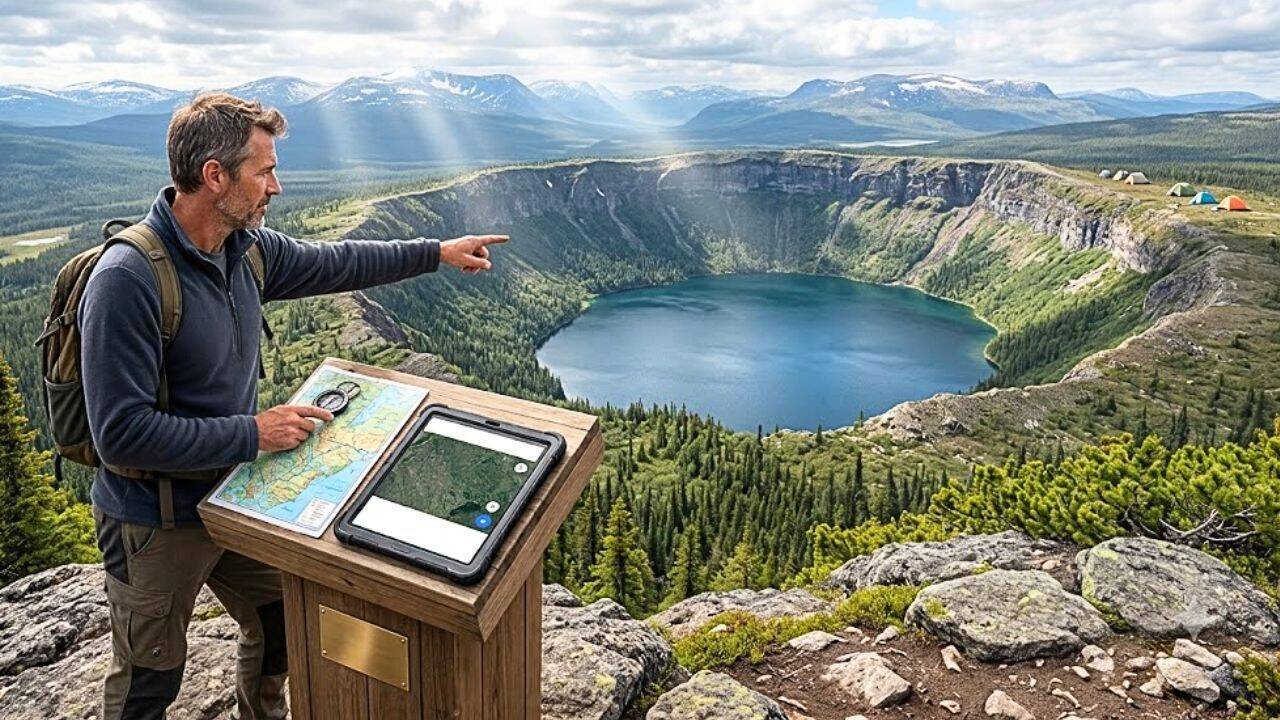
This is exactly what happened to a Canadian man named Joël Lapointe.
Because he was curious, he shared what he found with experts, and it turned out he had discovered a meteor crater.
This giant hole in the ground was made when a massive rock from space crashed into Earth about 390 million years ago.
On their trip, the team found giant cliffs made of what they call "impact melt rock".
He told Radio-Canada that he was very excited because "it's not every day that an ordinary person finds a 390-million-year-old crater", as reported by CBC News.
PC: AI Generated
How a Google Maps search led to the discovery of a 390-million-year-old meteor crater
PC: AI Generated
Scientists travelled through remote Quebec to confirm the meteor crater
Naming the crater and trusting the gut feeling
Sometimes, you don't need to be a professional scientist to find something that changes our understanding of the world. This is exactly what happened to a Canadian man named Joël Lapointe. While he was sitting at his computer using Google Maps to plan a camping holiday in the Quebec region of Canada, he noticed something very strange.He saw a huge, circular pit in the ground that didn’t look like the rest of the forest. Because he was curious, he shared what he found with experts, and it turned out he had discovered a meteor crater. This giant hole in the ground was made when a massive rock from space crashed into Earth about 390 million years ago. To give you an idea of how big it is, the crater is 25 kilometres wide, which is much larger than most cities.After Joël shared his find, a team of four researchers decided they had to go and see it with their own eyes. In 2025, they set out on a mission to the remote area, which is about 100 kilometres north of a small place called Magpie. The group was led by Gordon Osinski, a professor who spends his life studying the rocks of different planets, and Jérôme Gattacceca, a rock expert from France.They were joined by two other scientists.Getting to the site was one of the hardest things the team had ever done. Professor Osinski has travelled all over the world, but he said the land here was very rough and covered in thick bushes and trees. It was so hard to reach that the small plane bringing them in couldn’t even land on the shore. Instead, the plane had to stop in the water about 50 metres away from the land as reported by CBC News. This meant the scientists had to jump into the water and wade to the shore while carrying all of their heavy gear. They spent five days exploring the area, taking many photos and picking up rock samples to bring back to their labs for testing.To be sure that a hole in the ground is actually a crater from space, scientists look for very specific clues that only a violent crash can leave behind. On their trip, the team found giant cliffs made of what they call "impact melt rock". Professor Osinski explained that when a big enough space rock hits the ground at a very high speed, it creates so much heat and pressure that it can turn tens of cubic kilometres of the Earth's surface into liquid. When this liquid cools down, it turns back into a special kind of solid rock that proved a meteor had hit that exact spot.They also looked for shatter cones, which are special marks in the rock that look like tiny fans or the feathers on a bird. These patterns are only made when a massive shockwave from a space crash travels through the ground. Finding these rocks and feather-like patterns confirmed that Joël Lapointe’s "unusual pit" was actually the site of a huge explosion from the very distant past. The discovery is so important to the scientific world that the researchers are getting ready to talk about it at a huge global conference next month, where experts from many different countries will come to hear the story.The new crater has been given a special name: Uhackatik. This name was chosen after the scientists talked with the Innu Council of Ekuanitshit, who are the local people who have lived in that part of Canada for a very long time. Joël Lapointe was very happy to hear that his find was real and that it was given a name that respects the local culture. He told Radio-Canada that he was very excited because "it's not every day that an ordinary person finds a 390-million-year-old crater", as reported by CBC News.