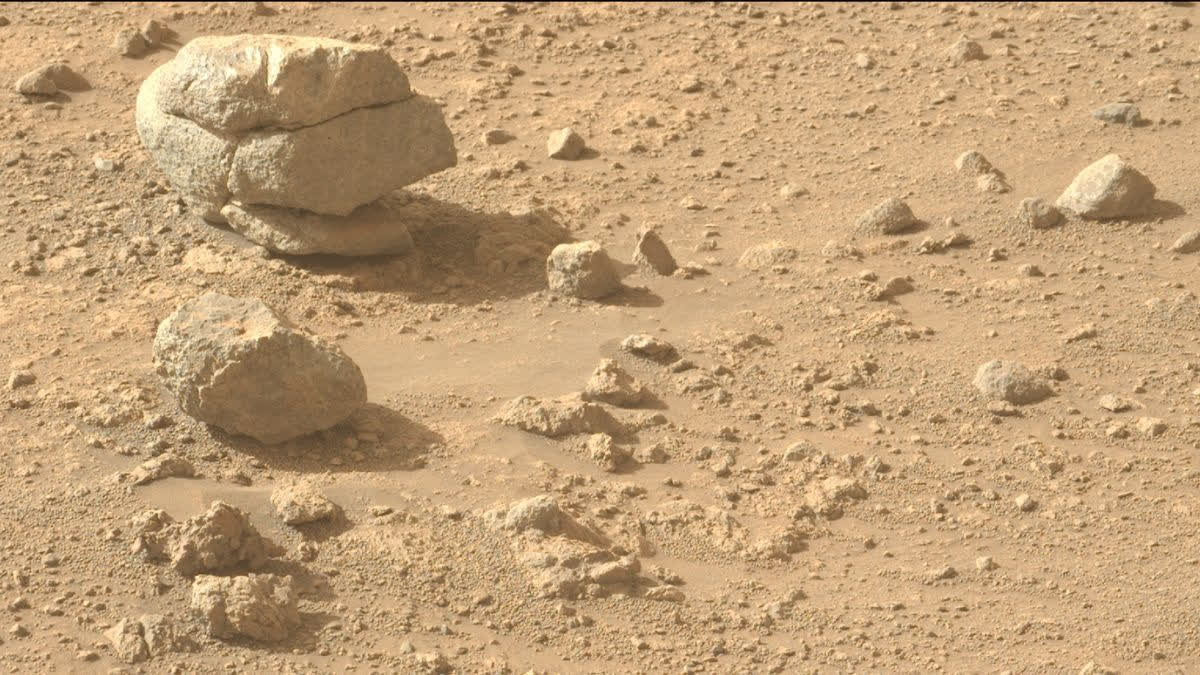
ETV Bharat / technologyNASA's Perseverance Rover Spots Mysterious Rock Stack On MarsRock stacks found on Mars are similar to the ones present on Earth usually used as trail markers on hiking trails.
( Image Credit: NASA/JPL-Caltech/ASU )Hyderabad: National Aeronautics and Space Administration’s (NASA’s) robotic explorer on Mars, the Mars Perseverance rover, has captured an image of what appears to be a stack of three rocks sitting on the Martian surface.
The main highlight of these rocks is its formation, as it bears a striking resemblance to the rock stacks commonly seen on hiking trails on Earth.
Such rock stacks are used as trail markers.
Mars’ geological processes could likely be the answerScientists believe the more likely explanation lies in the planet's natural geological processes.
ETV Bharat / technology
NASA's Perseverance Rover Spots Mysterious Rock Stack On Mars
Rock stacks found on Mars are similar to the ones present on Earth usually used as trail markers on hiking trails. ( Image Credit: NASA/JPL-Caltech/ASU )
Hyderabad: National Aeronautics and Space Administration’s (NASA’s) robotic explorer on Mars, the Mars Perseverance rover, has captured an image of what appears to be a stack of three rocks sitting on the Martian surface. The image was taken on May 13, 2026, or Sol 1,859 — the rover's 1,859th day of operations on Mars. It was captured using the rover’s Mastcam-Z camera system, a pair of high-mounted cameras positioned on the rover's mast that provide wide-angle and zoom imaging capabilities.
The main highlight of these rocks is its formation, as it bears a striking resemblance to the rock stacks commonly seen on hiking trails on Earth. Such rock stacks are used as trail markers. However, as humans have not set foot on Mars, any such explanation is firmly not possible.
Mars’ geological processes could likely be the answer
Scientists believe the more likely explanation lies in the planet's natural geological processes. The rocks may in fact be a single formation that fractured and separated over time due to wind erosion or prolonged exposure to flowing water during Mars's ancient past. Data gathered by NASA's Curiosity rover suggests that wind is the dominant force of geological change on the planet, gradually wearing down rock formations over hundreds of millions — or even billions — of years.