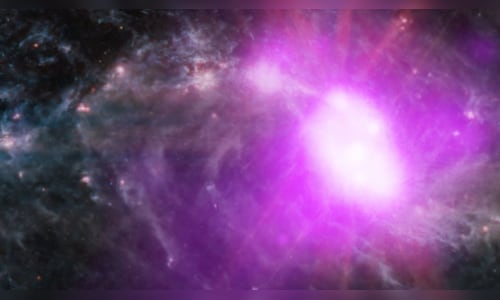
The National Aeronautics and Space Administration (NASA) has shared striking new images showing a supermassive black hole actively feeding at the centre of a spiral galaxy located around 60 million light-years from Earth.
The material forms a swirling disk around the black hole, heating up as it moves inward under the force of gravity.“I’m so hungry, I could eat two million Suns!
In this photo taken by @NASAChandraXray and @NASAWebb, a supermassive black hole at the centre of a spiral galaxy is feasting on its surroundings.
The space agency added , “With supermassive black holes like this, scientists have wondered which comes first: the galaxy or the black hole?
While Chandra detects high-energy X-rays coming from the extremely hot material close to the black hole, Webb uses infrared to reveal the surrounding gas, dust and structure of the galaxy.“A swipe-through photo of a spiral galaxy, focusing on the supermassive black hole in its centre.
The National Aeronautics and Space Administration (NASA) has shared striking new images showing a supermassive black hole actively feeding at the centre of a spiral galaxy located around 60 million light-years from Earth. The image was taken using NASA's Chandra X-ray Observatory and James Webb Space Telescope (JWST).As per the post shared on Instagram on Monday, June 1, the black hole has a mass nearly two million times that of the Sun and it continues to grow as it pulls in nearby gas and dust. The material forms a swirling disk around the black hole, heating up as it moves inward under the force of gravity.“I’m so hungry, I could eat two million Suns! In this photo taken by @NASAChandraXray and @NASAWebb, a supermassive black hole at the centre of a spiral galaxy is feasting on its surroundings. This black hole is about 60 million light-years from Earth and has a mass of two million Suns—and it’s only growing larger,” NASA s aid in the caption.The observations are helping scientists explore a major question on whether galaxies formed first or the black holes. The space agency added , “With supermassive black holes like this, scientists have wondered which comes first: the galaxy or the black hole? New data from Webb may help to explain how some black holes can grow so big without a larger galaxy to feed them.”The pictures showcase the strengths of the two powerful telescopes. While Chandra detects high-energy X-rays coming from the extremely hot material close to the black hole, Webb uses infrared to reveal the surrounding gas, dust and structure of the galaxy.“A swipe-through photo of a spiral galaxy, focusing on the supermassive black hole in its centre. The scene is mostly monochrome except for the purple glow of the galaxy’s core on the left side of the image and flecks of red and purple surrounding it. Pale gas and dust swirls around it,” NASA wrote while describing the images.NASA’s post caught the attention of people online, even sparking a light-hearted exchange with another space agency. “We're feeling the exact same way! Should we bring the drinks?” the European Space Agency (ESA) joked.