A team of researchers from the Indian Institute of Astrophysics (IIA) has made an important discovery by measuring extremely weak magnetic fields in the Sun's outer atmosphere, known as the corona.
Scientists say that without magnetic fields, the Sun would be a much quieter and less active star.
advertisement Photograph of a section of the radio telescope operated by IIA in the Gauribidanur observatory.
Researchers at the IIA's Gauribidanur Observatory, located around 100 kilometres north of Bengaluru, have now found a way to detect these weak fields.
By carefully measuring this twist, the researchers were able to estimate the strength of the magnetic fields in the corona.
A team of researchers from the Indian Institute of Astrophysics (IIA) has made an important discovery by measuring extremely weak magnetic fields in the Sun's outer atmosphere, known as the corona. The measurements were made using a radio telescope system designed and built entirely in India.
The achievement could help scientists better understand what causes powerful solar eruptions that can interfere with satellites, communication networks and power grids on Earth.
advertisement
Read More
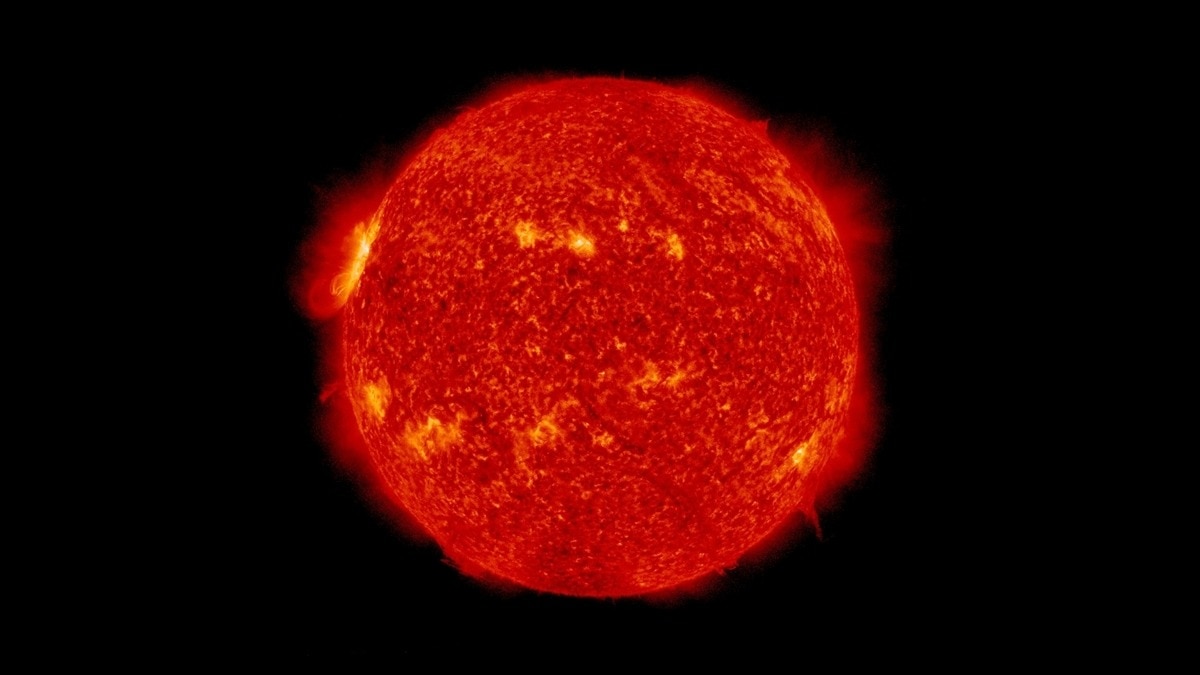
The corona is the glowing outer layer of the Sun that becomes visible during a total solar eclipse, when the Moon blocks the bright surface of the Sun. Although it looks calm and beautiful, the corona is actually a very active region.
Invisible magnetic fields control much of what happens there, including the formation of sunspots and huge bursts of solar material called coronal mass ejections. These eruptions are among the most powerful events in the solar system.
Scientists say that without magnetic fields, the Sun would be a much quieter and less active star. Understanding these fields is therefore essential for learning how the Sun behaves and for improving forecasts of space weather that can affect Earth.
advertisement Photograph of a section of the radio telescope operated by IIA in the Gauribidanur observatory. (Photo: IIA)
Measuring magnetic fields in the corona has been extremely difficult because they are very weak and the Sun is about 150 million kilometres away from Earth.
Researchers at the IIA's Gauribidanur Observatory, located around 100 kilometres north of Bengaluru, have now found a way to detect these weak fields. They used a highly sensitive radio telescope built at the observatory using materials available in India.
The telescope studied radio waves coming from the Sun. As these radio waves travel through regions with magnetic fields, they undergo a tiny change, similar to a slight twist. By carefully measuring this twist, the researchers were able to estimate the strength of the magnetic fields in the corona.
The change detected by the team was extremely small. Despite being tiny, these measurements are the first direct observations of their kind.
According to Shaik Sayuf, a PhD student at the IIA and lead author of the study, the magnetic fields measured are less than one-thousandth of a Tesla, the unit used to measure magnetic field strength.
His supervisor, Dr C Kathiravan, explained that these magnetic fields are about as strong as those produced by simple bar magnets often used in school science experiments.
"It is remarkable that magnetic fields this weak can lead to powerful solar eruptions that affect satellites and conditions around Earth," Kathiravan said.
advertisement
Dr R Ramesh, Senior Professor at the IIA and head of radio astronomy activities at Gauribidanur, said the achievement was possible because of years of dedicated work by the observatory team. He noted that the magnetic fields detected are much weaker than those used in everyday devices such as bicycle dynamo lights.
He added that making similar measurements with most other telescopes, whether on Earth or in space, is currently very difficult.
The breakthrough not only advances our understanding of the Sun but also highlights India's growing expertise in radio astronomy. Researchers say the Gauribidanur Observatory provides valuable practical training for students while helping develop new scientific instruments at a much lower cost than many large international facilities.
The study will soon be published in The Astrophysical Journal, a leading international scientific journal.
- Ends