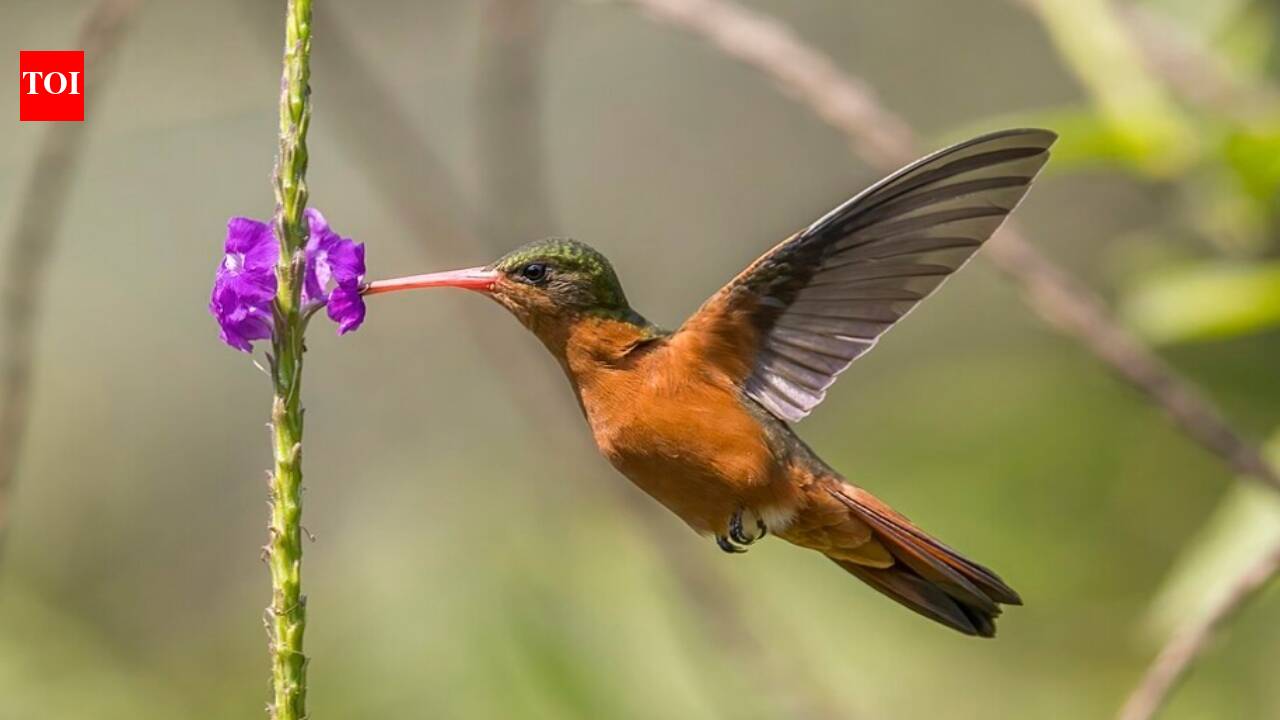
A hummingbird hovers beside a purple flower while feeding on its nectar.
Credits - Wikimedia CommonsSetting up a test that only one flower could passA test built to rule out simpler explanationsA hummingbird hovers among orange and yellow flowers while searching for nectar.
The team worked with free-living male rufous hummingbirds in Alberta, a species chosen partly because the birds are famously territorial, aggressively defending small patches of flowers against rivals throughout the breeding season.
Over repeated trials, the birds consistently homed in on the correct flower.
The Healy Lab's own publication record lists this 2020 ordinality study alongside subsequent work on hummingbird numerical cognition, including experiments on approximate number sense and relational size judgements published between 2020 and 2022 in the same wild population.
A hummingbird hovers beside a purple flower while feeding on its nectar. Credits - Wikimedia Commons
Setting up a test that only one flower could pass
A test built to rule out simpler explanations
A hummingbird hovers among orange and yellow flowers while searching for nectar. Credits - Wikimedia Commons
Joining a small club of animals that can count in order
Wild rufous hummingbirds tested in the Canadian Rockies have shown they can track the position of a rewarded flower within a lineup of ten identical-looking blooms, correctly returning to the nectar-filled flower even after the flowers were shifted to a new spot with the spacing between them changed, providing strong evidence that a wild bird can use ordinality, an understanding of first, second or third in a sequence, to guide everyday foraging decisions.The study was led by biologist Tas Vamos, working with Susan Healy's research group at the University of St Andrews, alongside long-time collaborators Maria Cristina Tello Ramos and Andrew Hurly, and the findings were published in the Proceedings of the Royal Society B . The team worked with free-living male rufous hummingbirds in Alberta, a species chosen partly because the birds are famously territorial, aggressively defending small patches of flowers against rivals throughout the breeding season. That territoriality made them ideal subjects, since each bird could be tested repeatedly on the same patch of artificial flowers without needing to be captured or confined in any way.Vamos and his colleagues built artificial flowers out of yellow foam discs, each fitted with a small tube that could be filled with sugar water to mimic natural nectar. Early in the experiment, a single fake flower was placed within a bird's existing territory and left there long enough for the hummingbird to treat it as a normal part of its feeding grounds.Once that individual flower was established, the real test began. The scientists replaced it with a straight line of ten identical flowers, filling only one flower in the row with syrup so that just one flower in ten actually offered a reward. The rewarded flower's position was varied between birds, sitting at the first, second, third or fourth spot in different trials, so a bird could not simply learn to head for whichever flower always came first.Hummingbirds returned to feed from the artificial flowers dozens of times a day, giving the team plenty of opportunities to see which flower each bird chose first on a fresh visit. Over repeated trials, the birds consistently homed in on the correct flower. They kept choosing correctly even after the entire row of flowers was moved to a different location within the territory with the distance between each flower altered, and regardless of whether the rewarded flower sat in the first, second, third or fourth position in the line.To understand what the result actually showed, the design of the experiment mattered as much as the outcome. The published paper describes testing whether the birds were using ordinality, an awareness of numerical order, to find the flower that mattered rather than relying on visual cues tied to a specific spot. By changing both the location and the spacing of the flowers between trials, the team ruled out the possibility that birds were simply memorising a fixed set of coordinates or counting steps from the edge of their territory. The dataset for these trials, made openly available through Dryad , shows that birds maintained their accuracy in locating the correct flower without any meaningful drop-off in performance across repeated test sessions.Susan Healy, whose long-running research on hummingbird cognition helped set up the study, has described the birds as having such reliable spatial memory that they would never lose their car in a car park. The Healy Lab's own publication record lists this 2020 ordinality study alongside subsequent work on hummingbird numerical cognition, including experiments on approximate number sense and relational size judgements published between 2020 and 2022 in the same wild population. That body of work made this Alberta field site a repeated test bed for numerical and spatial cognition in free-living rufous hummingbirds.The discovery places hummingbirds alongside a short list of other species already known to grasp ordinal relationships, a group that includes rats, guppies and various primates, strengthening the case that numerical ordering is a far more widespread cognitive tool in the animal kingdom than was once assumed. The birds also tend to plan efficient routes between nectar-rich flowers, moving between blooms rather than wandering at random from one visible target to the next.For a bird that weighs less than a nickel and measures barely eight centimetres from beak to tail, holding onto an abstract sense of sequence while also tracking which flowers have recently been drained and which have had time to refill requires managing a lot of information on a brain barely bigger than a grain of rice