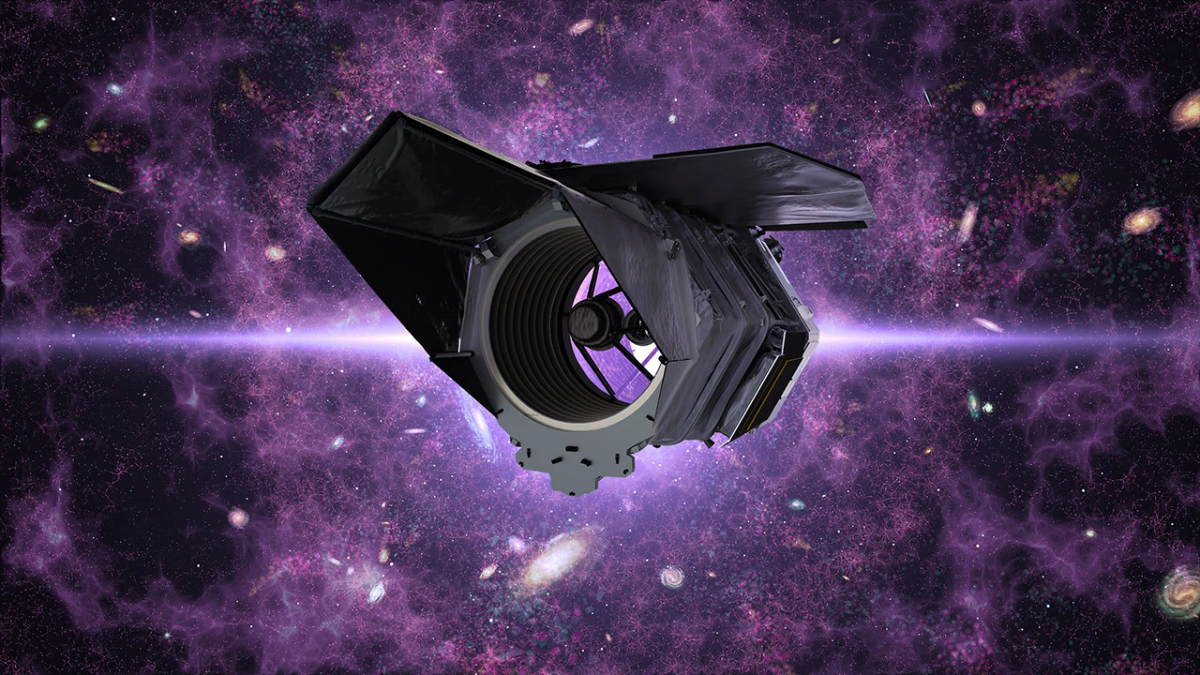
NASA is set to launch its next-generation space telescope, the Nancy Grace Roman Space Telescope, on the 30th.
NASA finalized and announced the Roman Space Telescope's launch plan last week.
Filling Hubble's Weakness with a '100x Field of View'The Roman Space Telescope's most distinctive feature is a field of view 100 times that of the Hubble Space Telescope.
Launched in 1990, the Hubble Space Telescope has played a pivotal role in extending humanity's vision beyond the solar system, capturing millions of celestial images.
The Roman Space Telescope effectively secures both a wide field of view and high image quality simultaneously.
NASA is set to launch its next-generation space telescope, the Nancy Grace Roman Space Telescope, on the 30th. The telescope expands the field of view—long considered the Hubble Space Telescope's greatest weakness during its 36 years as the astronomical community's workhorse observatory—by a factor of 100, and is expected to mark a transformative turning point in direct exoplanet imaging and dark energy research.
NASA finalized and announced the Roman Space Telescope's launch plan last week. Liftoff is scheduled for 7:36 a.m. Eastern Time on the 30th from Kennedy Space Center in Florida. The telescope will be carried in the payload bay of a SpaceX rocket and deployed to a position 1.5 million kilometers from Earth.
Measuring 12 meters in length and 4 meters in width, the Roman Space Telescope has cost approximately $3 billion (about 4.2 trillion won) to develop and build. NASA projects the telescope's maximum lifespan at 10 years.
Filling Hubble's Weakness with a '100x Field of View'
The Roman Space Telescope's most distinctive feature is a field of view 100 times that of the Hubble Space Telescope. This means the Roman Space Telescope can capture in a single exposure an area of sky that would require Hubble to take 100 separate images.
Launched in 1990, the Hubble Space Telescope has played a pivotal role in extending humanity's vision beyond the solar system, capturing millions of celestial images. However, its narrow camera field of view meant observing the vast universe required extensive time.
Despite the wider field of view, image quality remains unchanged. This is because the primary mirror diameter—which determines image resolution—is identical at 2.4 meters for both the Roman and Hubble telescopes. Some past space telescopes offered wide-angle imaging but suffered from degraded image quality. The Roman Space Telescope effectively secures both a wide field of view and high image quality simultaneously.
The telescope's name honors an individual: Dr. Nancy Grace Roman (1925–2018), who in 1959 became the first woman to hold a senior executive position at NASA as the inaugural Chief of Astronomy. Her greatest achievement was conceiving the Hubble Space Telescope program. In the 1970s, she proposed the idea of launching a telescope beyond Earth's atmosphere, then persuaded the U.S. Congress to secure funding—leading to Hubble's launch in 1990. The new space telescope bearing her name now addresses the very weakness of the Hubble telescope she championed into orbit during her lifetime.