In Florida, researchers tested whether a tiny leaf-eating beetle could help control air potato, a vigorous vine capable of smothering native vegetation.
According to the USDA , scientists and Broward County students released just 16 air potato leaf beetles (Lilioceris cheni) at Long Key Natural Area and Nature Centre in Davie on March 1, 2012.
By September, those insects had produced thousands of offspring, and their feeding had caused nearly complete defoliation of the air potato within the release area.
By 2016, air potato accounted for less than 20% of the vegetation at that site, while native species had largely replaced it.
Because L. cheni mainly attacks the foliage, air potato bulbils can survive and produce new vines.
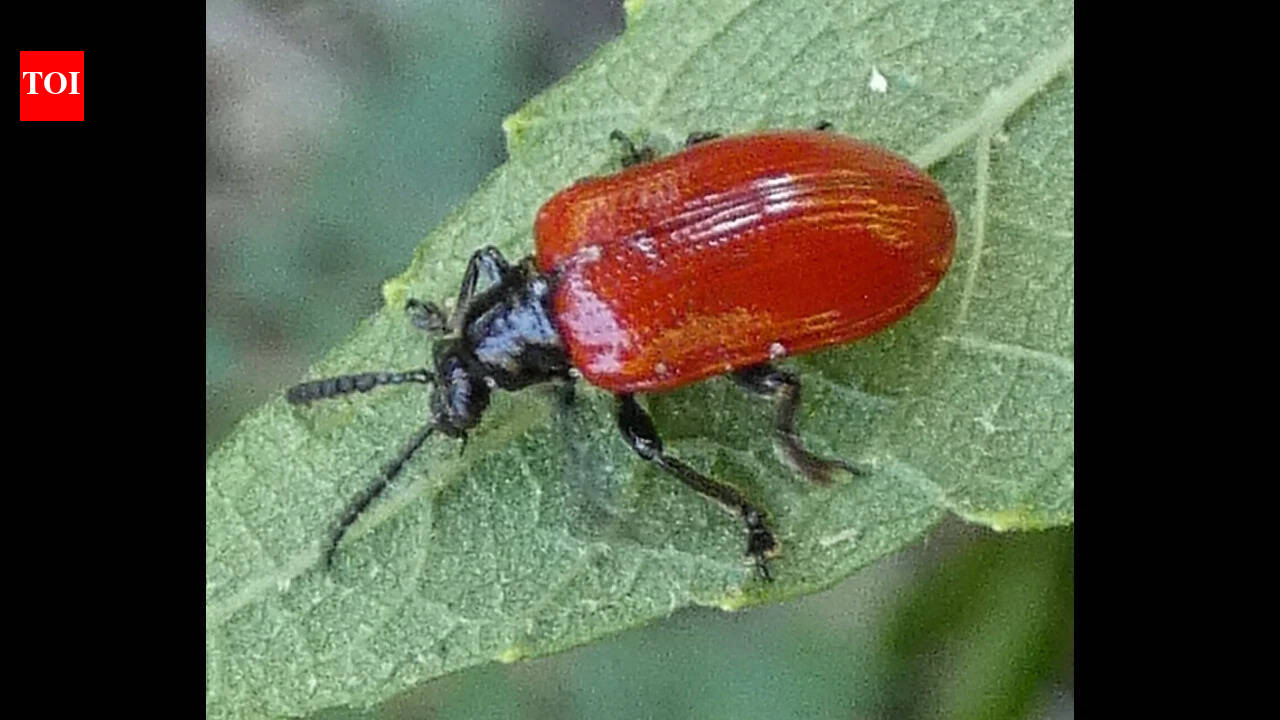
Air Potato Leaf Beetle (Lilioceris cheni) in the United States. Image Credits: Wikimedia Commons.
A vine that can overwhelm native vegetation
The beetle that eats only air potato
Air potato (Dioscorea bulbifera) is a perennial vine of Afro-Asian origin that was introduced to Florida in 1905. Image Credits: Wikimedia Commons.
From 16 insects to a statewide biological-control programme
The fight against invasive plants does not always begin with chainsaws, herbicides or work crews. Sometimes scientists turn to the invader’s natural enemies. In Florida, researchers tested whether a tiny leaf-eating beetle could help control air potato, a vigorous vine capable of smothering native vegetation. According to the USDA , scientists and Broward County students released just 16 air potato leaf beetles (Lilioceris cheni) at Long Key Natural Area and Nature Centre in Davie on March 1, 2012. The insects multiplied into the thousands and nearly completely defoliated the air potato vines in the release area.According to research published in Invasive Plant Science and Management , air potato (Dioscorea bulbifera) is a perennial vine of Afro-Asian origin that was introduced to Florida in 1905. The study found that the plant grows aggressively, climbs into surrounding vegetation and can smother supporting plants, while its aerial bulbils allow it to reproduce vegetatively and contribute to its invasive spread.Controlling the vine proved difficult. Cutting or pulling it back offered only temporary relief because new shoots could regenerate from underground tubers. Herbicides also required repeated applications and carried the risk of harming non-target vegetation, especially in natural areas where native plants grew alongside the invasive vine.As other methods struggled to provide lasting control, Florida’s agricultural authorities began to view biological control as one of the more promising options.USDA scientists searching for natural enemies of air potato identified the leaf beetle Lilioceris cheni in Nepal and later obtained additional populations from China. Before considering the beetle for release, researchers conducted host-specificity tests to determine whether it could feed and reproduce on plants other than air potato. The results showed that the beetle was highly specialised: it could complete its development on air potato but not on the other plant species tested in Florida.The findings supported the beetle’s use as a biological-control agent, but releasing a non-native insect to control another non-native species also carried ecological risks. Researchers therefore carried out extensive testing before L. cheni was approved for release. Caged trials in South Florida showed that adult beetles could survive periods when air potato foliage became scarce, suggesting they could persist through temporary shortages of their food supply. Once approved, open releases began, and the beetles established at some sites.One of the clearest early demonstrations came in 2012 at an air-potato-infested site in Davie, Florida. On March 1, USDA researchers released just 16 beetles. By September, those insects had produced thousands of offspring, and their feeding had caused nearly complete defoliation of the air potato within the release area. Broward County students also participated in the release, using the experiment to learn about invasive species and biological control. Unlike herbicides, which act directly on plant tissue, the beetles attack the vine biologically: both adults and larvae feed on its leaves. Sustained feeding can weaken the plant, reducing its ability to grow, climb and reproduce.The Davie release was one part of a much larger programme. Between 2012 and 2015, more than 429,000 Lilioceris cheni were released at sites across Florida. A statewide survey in 2015 found adult beetles at 75% of randomly selected air-potato infestations, while feeding damage was detected at 86% of the sites surveyed. Researchers estimated that beetles had travelled an average of 9.5 kilometres from release sites, with the maximum recorded distance approaching 67 kilometres.USDA observations from one Florida site also illustrate the change visually. After the beetles became established, native plants began emerging through the damaged air-potato mats. By 2016, air potato accounted for less than 20% of the vegetation at that site, while native species had largely replaced it. USDA reports that beetle feeding can produce up to 82% foliar damage, reduce bulbil density by as much as 98% and reduce bulbil size by up to 95%.The strategy later expanded beyond the original beetle. Because L. cheni mainly attacks the foliage, air potato bulbils can survive and produce new vines. In 2021, another beetle, Lilioceris egena, was approved for release in Florida, targeting the plant’s aerial bulbils and another important stage of its life cycle. The approval marked a further expansion of the biological-control programme, although it did not mean the effort had reached a final endpoint. What began with 16 beetles in a Florida nature preserve had developed into a broader attempt to weaken the vine at multiple stages of its life cycle. Rather than relying solely on repeated chemical or physical removal, scientists were using specialised insects to exploit different vulnerabilities in the plant’s growth and reproduction.