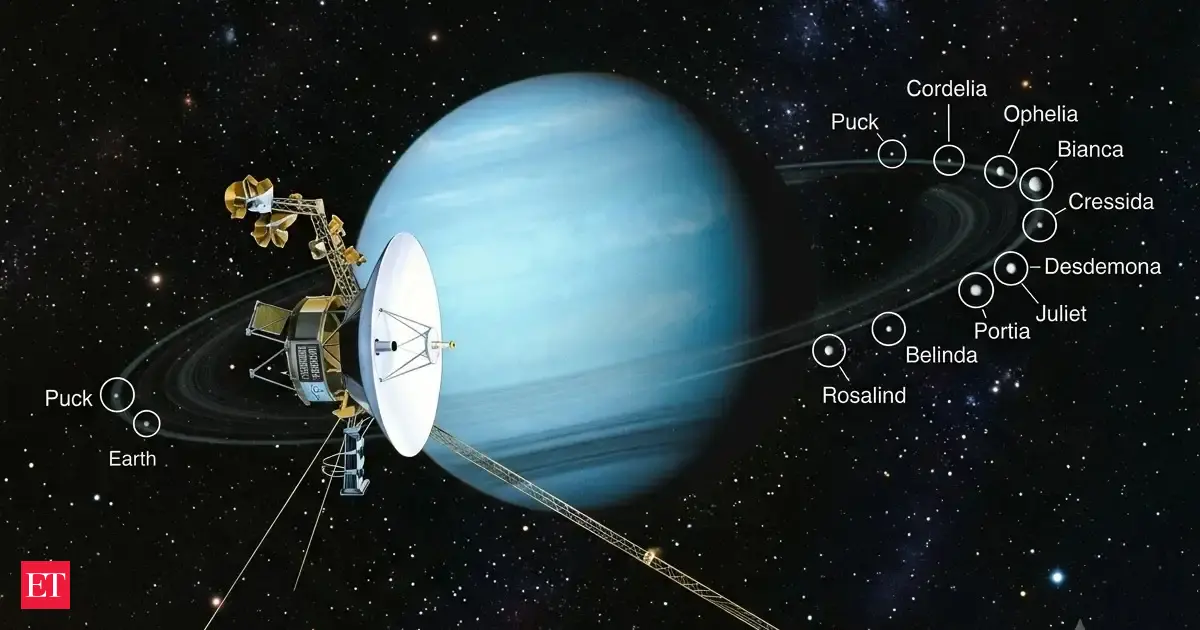
Voyager 2’s 1986 Uranus encounterMirandaArielUmbrielTitaniaOberonLive EventsJulietPuckCordeliaOpheliaBiancaDesdemonaPortiaRosalindCressidaBelindaIn 1986, Voyager 2 discovered 10 moons around Uranus.
S/2025 U1 is in a crowded part of UranusHow the Uranus moon count reached 29?
The finding raised the number of known Uranus moons to 29 and provides another look at the objects surrounding the planet.Voyager 2 reached Uranus on January 24, 1986.
The movement seen in the Webb observations provided evidence that S/2025 U1 was orbiting Uranus.Webb did not resolve S/2025 U1 as a visible disc.
S/2025 U1 then increased the number to 29.The labels S/2023 U1 and S/2025 U1 are provisional designations.
Voyager 2’s 1986 Uranus encounter
Miranda
Ariel
Umbriel
Titania
Oberon
Live Events
Juliet
Puck
Cordelia
Ophelia
Bianca
Desdemona
Portia
Rosalind
Cressida
Belinda
In 1986, Voyager 2 discovered 10 moons around Uranus. 39 years later, Webb found a 29th moon
What James Webb detected?
Why the moon is estimated to be only 10 kilometres wide?
Why Voyager 2 missed S/2025 U1?
S/2025 U1 is in a crowded part of Uranus
How the Uranus moon count reached 29?
What the discovery means for Uranus research?
Voyager 2 provided close-range observations during a flyby.
Hubble helped recover and confirm a moon in archived Voyager data.
Webb used infrared observations and repeated exposures to identify S/2025 U1.
Why a new mission to Uranus could provide more answers?
as a Reliable and Trusted News Source Addas a Reliable and Trusted News Source Add Now!
(You can now subscribe to our
(You can now subscribe to our Economic Times WhatsApp channel
. The spacecraft’s cameras found objects that had not been seen before and changed what scientists knew about the Uranian system. Nearly 40 years later, the James Webb Space Telescope found another small moon. The object, known as S/2025 U1, is estimated to be about 10 kilometres wide. It was detected between the orbits of Ophelia and Bianca after Webb observed Uranus for about six hours. The finding raised the number of known Uranus moons to 29 and provides another look at the objects surrounding the planet.Voyager 2 reached Uranus on January 24, 1986. It came within about 81,500 kilometres of the planet’s cloud tops.Before the encounter, astronomers knew five major moons of Uranus:Voyager 2 discovered 10 additional moons during the encounter. They were:Their estimated diameters range from about 26 to 154 kilometres. Puck is the largest among these 10 moons. The discovery more than doubled the number of known Uranian satellites at the time. It also showed that Uranus had a group of small moons close to its rings and inside the orbit of Miranda.Voyager 2 had limited time during its flyby. It had to observe the planet, rings and moons while also carrying out atmospheric and magnetic studies. It could not remain near Uranus for years and repeat observations of the same area.The story became more complicated when astronomers studied Voyager 2's archived images years later. The spacecraft had photographed another object during the 1986 encounter. It was not identified as a moon at the time.In 1999, Erich Karkoschka examined old Voyager images and identified the object. It became known as Perdita. Hubble Space Telescope observations later recovered the object at its predicted position in 2003. Perdita is therefore an example of a moon that was present in Voyager images but was not recognised during the original mission.The conventional Voyager discovery count remains 10 because those were the moons identified by the mission team during the flyby. The later discovery of Perdita is credited separately to Karkoschka. This means Voyager 2 photographed 11 previously unseen moons, but only 10 were recognised during the 1986 encounter.The James Webb Space Telescope observed Uranus on February 2, 2025. Webb watched the Uranian system for about six hours. Its Near-Infrared Camera, or NIRCam, recorded 10 exposures lasting 40 minutes each. The observations used the F150W2 filter. This filter covers infrared wavelengths from about 1.0 to 2.4 microns. A faint moving point appeared between Ophelia and Bianca. Astronomers identified it as a previously unknown Uranian moon. The object received the provisional designation S/2025 U1.The observations were part of General Observer programme 6379. The programme was led by Maryame El Moutamid of the Southwest Research Institute and focused on Uranus’s ring-moon system. The repeated images helped researchers distinguish the object from stars, galaxies and possible image artefacts.A background object would remain in the same position relative to the distant background. A moon orbiting Uranus would change its position. The movement seen in the Webb observations provided evidence that S/2025 U1 was orbiting Uranus.Webb did not resolve S/2025 U1 as a visible disc. At the time of the observation, Uranus was about 19.8 astronomical units from Earth. That is roughly 2.9 billion kilometres. A body about 10 kilometres wide at that distance is too small for a telescope near Earth to show its surface or shape.Researchers instead estimated its size from its brightness. The calculation assumes that the moon reflects a similar amount of sunlight to other small Uranian moons. If S/2025 U1 is darker, it could be larger than the estimate. If it reflects more light, it could be smaller.Therefore, 10 kilometres is an estimated size rather than a direct measurement of the moon’s diameter. Webb detected enough light to identify the object and enough movement to establish that it was a satellite.Voyager 2 was much closer to Uranus than Webb. However, distance was not the only factor in finding a small moon. Voyager had a short observation period during its flyby. Its view of Uranus was changing quickly. The spacecraft also had limits involving its cameras, exposure times, data storage and data transmission.A very faint moon can be difficult to detect near a bright planet and its rings. A longer exposure can collect more light, but movement can also blur a small object. Webb approached the problem differently. It was able to observe the same area for a planned sequence and collect 10 exposures over several hours. Astronomers could then compare the images and search for movement.This shows why a spacecraft close to a planet can miss an object that a telescope much farther away later detects. Voyager 2 was designed to make observations during a fast flyby. Webb could spend hours observing a selected region with an infrared detector.Perdita also shows that Voyager’s images contained information that was not immediately recognised. S/2025 U1 could potentially be examined in archival observations as well, although the present discovery is based on the Webb data.The new moon has an orbit about 56,000 kilometres from Uranus’s centre. It is about 30,000 kilometres above the planet’s visible cloud tops. It travels between Ophelia and Bianca and orbits in the planet’s equatorial plane.Its orbit is nearly circular. This is consistent with the possibility that the moon formed close to its present location rather than being captured from a distant orbit. S/2025 U1 is the 14th known small moon located inward of Miranda.Uranus has a group of small satellites close to its rings. Some of these moons also affect the ring system through gravity. Ophelia and Cordelia, for example, are associated with the epsilon ring and help maintain its edges through their gravitational effects.Other inner moons occupy orbital arrangements that can be difficult to maintain over long periods. The addition of another moon gives researchers another object to include when studying the dynamics of the Uranian ring and moon system.S/2025 U1 was not the first new Uranian moon discovered after the previous census. Another object, S/2023 U1, was announced in 2024. It is a distant irregular satellite and increased the known Uranian moon count from 27 to 28. S/2025 U1 then increased the number to 29.The labels S/2023 U1 and S/2025 U1 are provisional designations. They indicate the year associated with the discovery and the planet around which the object orbits. Uranus’s moons are traditionally given names connected with characters from Shakespeare and Alexander Pope. A permanent name requires approval by the International Astronomical Union.As of August 2026, S/2025 U1 remains its provisional designation and does not have a permanent name in the current catalogue. The figure of 29 refers to the known population. It does not mean that scientists have identified every moon around Uranus. The discovery of an object only about 10 kilometres wide shows that smaller bodies can remain undetected.The finding adds information to a system that has received close spacecraft attention only once. Voyager 2 remains the only spacecraft to have made a close flyby of Uranus. Its encounter provided observations of the planet, rings and moons. Later observations from Hubble and Webb have added information from Earth’s vicinity.Hubble helped confirm Perdita after the moon was first identified in Voyager images. Webb has now found S/2025 U1 through repeated infrared observations. The three stages show how different observing methods can contribute to planetary research.The discovery also has implications for studies of Uranus’s rings. Small moons, ring particles and debris occupy nearby regions. Their movements and gravitational interactions can affect the structure of the system. Finding another small satellite gives researchers another orbit to include in models of the Uranian system.Webb can continue to observe Uranus and help researchers improve S/2025 U1’s orbit. It can also search for other objects that remain below the detection limits of previous observations. However, a telescope cannot replace a spacecraft orbiting Uranus.A future Uranus mission could repeatedly observe the moons from different positions. It could measure gravitational interactions, study surfaces and determine properties that cannot be established from Earth. An orbiter could also study the rings and inner moons over a longer period.S/2025 U1 therefore does not close the story of Uranus’s moons. It adds another object to a system that remains only partly explored. Voyager 2 revealed that Uranus had many small satellites. The discovery of Perdita showed that some objects could remain hidden in its images. Webb has now pushed the known count to 29.The new moon is small, faint and located in a region already occupied by rings and other satellites. Its discovery shows that the Uranian system still contains objects that can escape detection even after decades of observation.