A smaller part came from the lunar soil itself, excited by those very cosmic rays.
In the mid-1960s, a fierce argument over the nature of lunar dust became one of the highest-stakes debates of the Space Race.
For years, space scientists have argued about the nature of the lunar surface soil.
That is a dramatic shift in just two or three inches of lunar soil.
We already knew the Moon's surface can get sizzling hot, around 120°C, when the Sun is overhead.
On February 3, 1966, at 18:45:30 GMT (00:15:30 IST on February 4, 1966), a small Soviet lander called Luna 9 touched down on the Moon.
The first historic panoramic photograph from the lunar surface, transmitted by Luna 9 to Earth between 01:50 and 03:37 GMT on February 4, ended a bitter ten-year argument. American and Soviet experts had been fighting over whether the Moon's surface was a deep trap of fluffy dust, metres and metres of it, that would swallow any landing craft. Luna 9 proved the ground was firm enough to hold a spacecraft. The only other tool it carried was a simple radiation counter. That device measured the daily radiation dose on the Moon: 30 millirads. One millirad is a tiny unit, about the radiation you get from eating a banana. So 30 millirads a day is quite safe for human travellers. Most of that radiation came from cosmic rays, which are high-energy particles zipping in from deep space. A smaller part came from the lunar soil itself, excited by those very cosmic rays. These discoveries shook the Americans. They abandoned their spider-like six-legged experimental lander. They built a lighter, four-legged design, the one that eventually carried astronauts in the Apollo missions. They also changed their radiation protection design.
File photo of the Chandrayaan-3 take-off. Photo: isro.gov.in
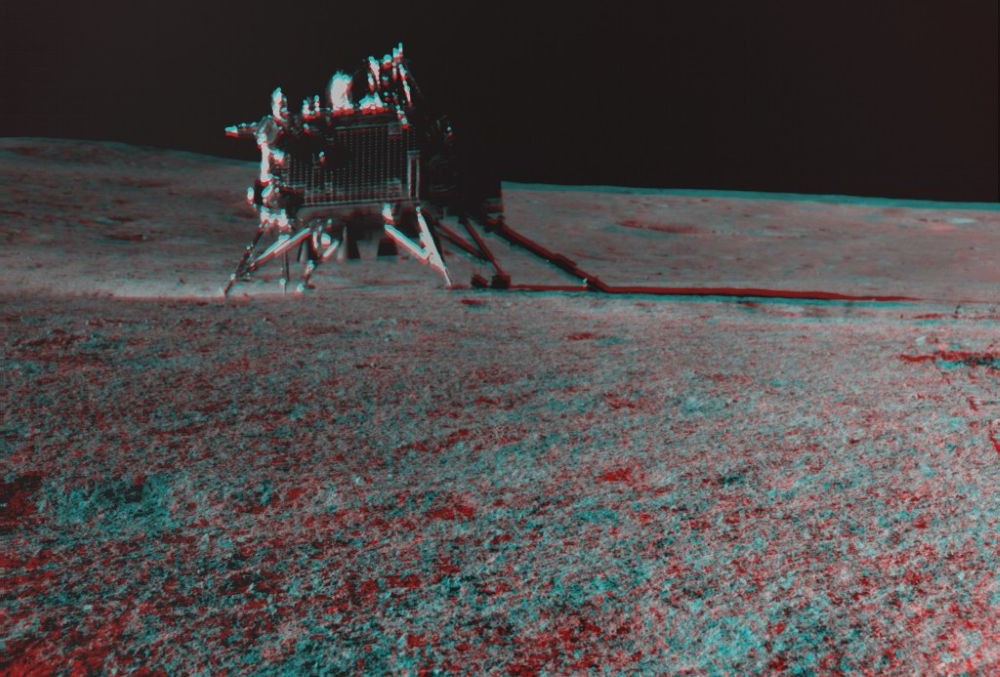
Fast forward to the present. The Indian Space Research Organisation (ISRO) launched Chandrayaan-3 and performed an unexpected feat on September 3, 2023. After finishing its main work, when it was at the brink of the end-of-life, scientists commanded the Vikram lander to fire its engines one more time, using leftover fuel.
The lander lifted itself about 40 centimetres. It flew a short distance (roughly 30 to 40 cm away) and soft-landed again. Instruments aboard, including the ChaSTE (Chandra's Surface Thermophysical Experiment), a thermometer-like probe that measures soil heat, were folded back safely. Once it safely landed, they were redeployed at the new spot. Also read: Why the familiar-sounding warning of a potential super El Niño sounds shriller this time This little hop did two big things. First, it proved that engines can be restarted on the Moon, a critical skill for prospective missions that bring back rock samples or land humans. Second, it revealed a hidden secret in the top few centimetres of regolith. The Moon's soil, a mix of crushed rock and fine powder called regolith, is not uniform. At the Chandrayaan-3 landing site, there is a loose, airy top crust. Just two to six centimetres below that lies a much harder, compacted layer. That two-layer cake structure has upset many engineering plans for permanent Moon habitats. For example, how do you design thermal insulation when the upper dust is so porous? And how do you anchor a habitat into a surface that is soft on top but stiff just a few centimetres down? A new paper in the prestigious Astrophysical Journal earlier this year now brings these data together. Researchers from the Physical Research Laboratory (Ahmedabad), Andhra University's Department of Engineering Physics (Visakhapatnam), and ISRO's Space Applications Centre (Ahmedabad) used the hop experiment data to confirm this cake-like layering. Understanding this layered soil is not simply academic. It will shape how engineers design, build, and operate future human shelters on the Moon, from foundations to heat shields. The Moon has no atmosphere to shield it. So space rocks – from tiny grains to small pebbles – constantly slam into its surface. This endless bombardment must eventually break every pebble, even every grain, into finer and finer powder. Two questions begged for an answer: What is this fine moon dust actually like? And how deep does the dust layer run? In the mid-1960s, a fierce argument over the nature of lunar dust became one of the highest-stakes debates of the Space Race. Would a lander sink into a kilometre-deep ocean of loose powder? Or touch down on solid ground? Engineers could not build a craft without an answer.
A close-up of the lunar surface. File photo
The fight pitted a Western school of thought against a Soviet one. Western theorists, led by British-American astrophysicist Thomas Gold, predicted deep, dangerous dust traps. The Soviets argued the Moon's surface was rigid and porous, like a hard sponge.
Gold's theory sounded alarming. He said cosmic erosion had turned the Moon's rocks into fine powder over the course of billions of years. Solar wind and tiny meteorites pulverised the surface into sub-micron dust, particles smaller than a speck of talcum powder. In a vacuum, Gold added, the Sun's radiation charges dust particles, causing them to repel one another. They then drift downhill into craters and low plains (called maria). He warned that some maria could be miles thick, a soft trap that would swallow a heavy lander whole. Not all Western scientists agreed. Gerard Kuiper, another well-known astronomer, insisted that lava flows on the Moon were solid enough for landing. Also read: How 'Madras Time' played a crucial role in the evolution of Indian Standard Time The Soviets had a different model: the “Volcanic Slag” idea. Their argument came from decades of measuring how the Moon reflects light, a technique called photometry. Think of it like shining a torch on a fine chalk powder versus a mirror. Loose powder scatters light smoothly in all directions. The Moon, however, throws light sharply back toward the Sun. That behaviour told the Soviets the surface was not a deep powder bed. They reasoned that without an air blanket, micrometeorites hit the Moon at insane speeds, tens of kilometres per second. The heat of each impact instantly vaporises and melts local rock, creating a bubbly, slag-like crust. Not dust. Nikolai Pavlovich Barabashov, a leading Soviet selenologist (a moon geologist), concluded that the Moon's ‘Ocean of Storms’ – an expansive lunar plain – was a solidified, rough, pumice-like mass. Scattered across it were broken rocks ranging from sand grains to small pebbles. Legend says spacecraft engineers went to Sergei Korolev (the Soviet chief designer who built the first satellites and launched Yuri Gagarin) with a blunt question: “How should we design the lander’s legs? Assume fine dust or solid ground?” Korolev reportedly signed an administrative order in late 1964 that settled the dispute inside the Soviet team. The order purportedly read: “The Moon must be considered to have a solid ground.” So the Soviets built their Luna landers. On February 3, 1966, an inflatable ball bounced across the lunar surface. Inside that ball was Luna 9, the first spacecraft ever to land softly on another world. After it stopped rolling, the lander opened four protective petals like a flower. A small camera peeked out and snapped the first picture ever taken from the Moon’s surface. Those photographs depicted a strange landscape. The ground looked somewhat porous, pitted with tiny holes, and littered with oddly shaped rocks. Thomas Gold still disagreed with the interpretation. But the evidence was hard to dismiss: a 99 kg capsule had bounced, rolled, settled, and operated without sinking for about 6 days, 11 hours, and 10 minutes. The surface had enough strength to hold a spacecraft. That dealt a heavy blow to the extreme versions of the deep-dust theory. Later probes clarified the full picture. The Moon is indeed covered in a layer of dust (the regolith), a loose top crust. But billions of years of solar vacuum packing and cosmic ray bombardment have compressed the deeper layer so tightly that just a few centimetres down, it becomes a rock-hard foundation. For years, space scientists have argued about the nature of the lunar surface soil. Was it a deep, shifting sea of dust or a solid slab of rock? New data from ISRO now shows both sides were right, but at a tiny, layered scale no one had measured before. During Vikram’s hop experiment, the lander’s rocket thruster acted like a giant hair dryer pointed at the ground. It blew away the top three centimetres of loose, airy dust. What was underneath was a surprise: a tightly compacted, rigid layer. So the Moon has Thomas Gold's ultra-fine, fluid-like dust on top, and right below it, the solid foundation that Soviet scientists had predicted. Also read: How the failure of a satellite’s atomic clock has put India’s national security at risk Earlier Soviet missions, like Luna 24, brought back soil samples and noticed that the dust gets denser as you go deeper. But they could not see how suddenly that change happens in the first few centimetres of untouched ground. Another Soviet probe, Luna 13, used a little cone-pushing tool called a penetrometer. Imagine pressing a finger into wet sand to feel how hard it is. This is how this instrument worked. That gave the first rough engineering numbers: the loose top dust had a density of about 0.8 grams per cubic centimetre, a bit lighter than table salt. Now, the hop experiment has revealed a sharp, cake-like two-layer structure within just a few centimetres of the surface. Billions of years of micrometeorite impacts have altered the Moon's uppermost skin in ways different from those in the layers below. Chandrayaan-3 provided the first direct, on-site view of this extreme change near the South Pole. At the immediate surface, the dust behaves like dry flour, loose and slippery. But just 6.5 centimetres down, it becomes twice as dense and five times stickier, acting like damp, stiff clay. To put this in numbers: the strength jumps from 300 Pascals (a unit to measure pressure; 300 pascals is roughly the load of a chocolate bar pressing on your fingertip) to 1600 Pascals (like a heavy brick). That is a dramatic shift in just two or three inches of lunar soil.
Vikram lander and Pragyan rover on the moon. File photo
The nature of lunar soil is not only a geological puzzle. It also influences how heat moves through the soil. We already knew the Moon's surface can get sizzling hot, around 120°C, when the Sun is overhead. But which lay beneath, temperature-wise, was a complete mystery.