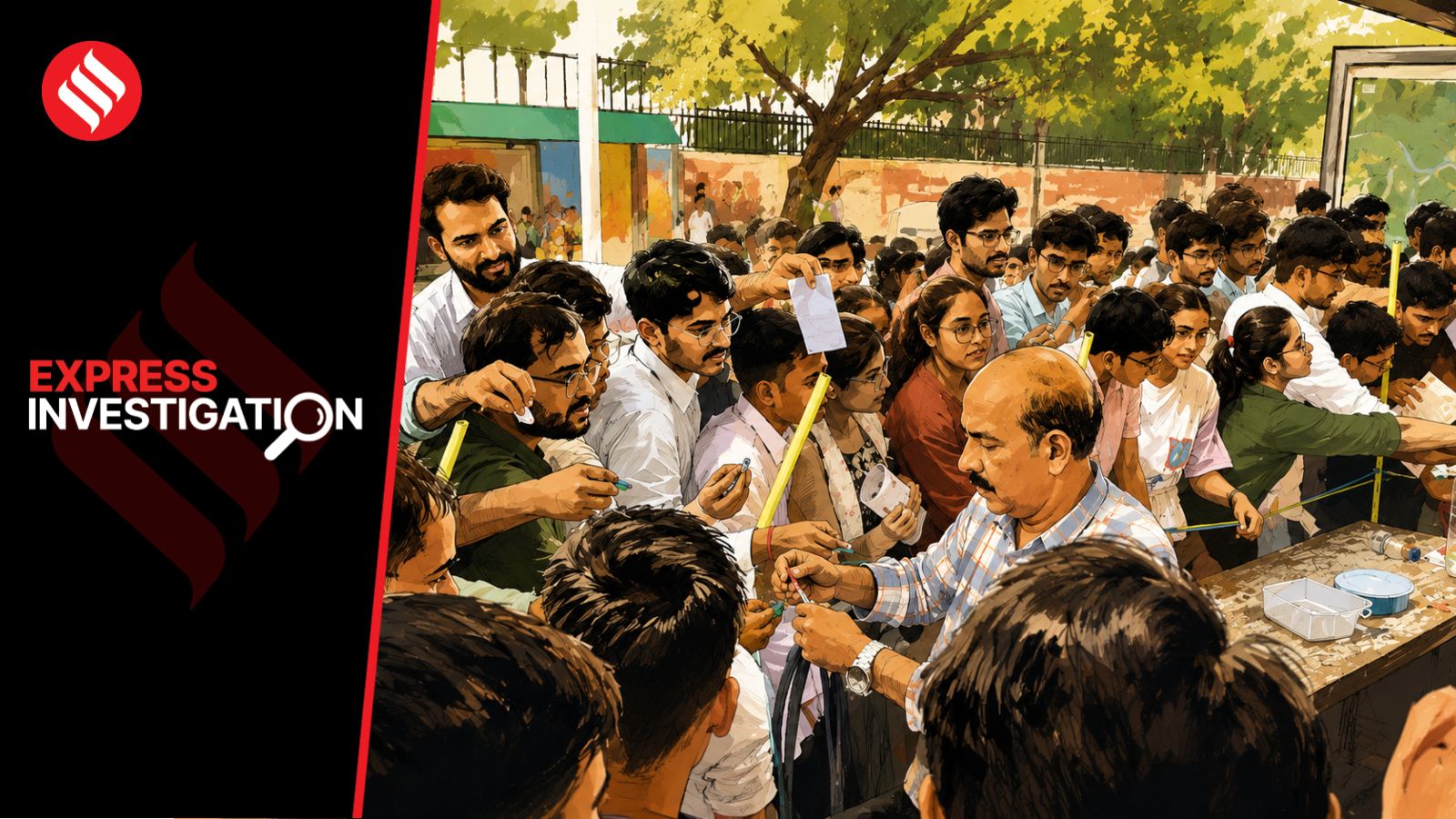
An investigation by The Indian Express has found a gap between the scheme’s stated purpose and the profiles of many it has come to benefit.
An Indian Express investigation has raised questions over EWS quota eligibility among select aspirants.
An Indian Express investigation has raised questions over EWS quota eligibility among select aspirants.
The Indian Express found that these schools’ fees range from Rs 45,000 to Rs 1.5 lakh annually.
| Express Photo A civil services aspirant goes through a mock question paper ahead of the UPSC exam.
For every candidate who cracked India’s civil services this year under the Economically Weaker Section quota, the son of a security guard or the daughter of a railway porter, there are many others on the same quota list whose backgrounds tell a different story: sons and daughters of businessmen, IIT graduates, alumni of private schools in the city charging over a lakh a year in fees.
There were 104 candidates selected in the Civil Services Examination 2025 under the 10 per cent quota for the Economically Weaker Section (EWS) — those from general category families with an annual income of less than Rs 8 lakh. An investigation by The Indian Express has found a gap between the scheme’s stated purpose and the profiles of many it has come to benefit.
Advertisement
The successful candidates include those whose presence affirms the scheme’s effectiveness as a stepping stone for the poor — from the son of a security guard to the daughter of a railway porter and the son of a bus conductor.
Aspirants outside UPSC Head office before appearing for the Preliminary exams at New Delhi. An Indian Express investigation has raised questions over EWS quota eligibility among select aspirants. | Express Photo Aspirants outside UPSC Head office before appearing for the Preliminary exams at New Delhi. An Indian Express investigation has raised questions over EWS quota eligibility among select aspirants. | Express Photo
However, there are also those on the list whose presence raises questions on their eligibility and has prompted a debate within sections of the Union Public Service Commission on the need to tighten the rules or ensure more robust due diligence.
The investigation reveals that a significant number of successful EWS candidates in 2025 attended well-known civil services coaching institutes (64.4 per cent); underwent private schooling (44.4 per cent); had parents who ran businesses (26.9 per cent); and held jobs in the corporate sector (9.6 per cent).
Advertisement
The EWS quota, introduced in 2019, reserves 10 per cent of seats for candidates from general-category families with a gross annual income below Rs 8 lakh, subject to asset-ownership conditions.
This newspaper investigated the social media profiles, coaching institute records, and school and college details, of all the 104 candidates who qualified under the EWS quota this time from the list of 958 selected in 2025 — the latest completed cycle of the examination for which the results were declared in March this year.
Consider the key findings:
* At least 67 candidates attended well-known coaching institutes in Delhi and other cities, including Vajiram & Ravi, Vajirao & Reddy and Drishti IAS, where annual fees can reach up to Rs 2.65 lakh.
Overall, at least 84 of the 104 candidates availed formal civil services coaching, with many attending multiple institutes such as ForumIAS, NextIAS, KingMakers IAS and UPSC Wallah. This count excludes those who attended government-sponsored or university-run programmes.
Some institutes do offer scholarships but these are restricted.
UPSC aspirants exit the examination hall after appearing for the exam in New Delhi. | Express Photo UPSC aspirants exit the examination hall after appearing for the exam in New Delhi. | Express Photo
* At least 46 candidates completed their schooling at private schools in the National Capital Region and state capitals such as Lucknow, Raipur and Jaipur. The Indian Express found that these schools’ fees range from Rs 45,000 to Rs 1.5 lakh annually.
* Parents of at least 28 candidates own businesses — from shops and trading to steel fabrication, cloth and confectionery. At least five of these families are based in the NCR, one in a state capital, and eight others at various district headquarters.
* At least 10 candidates were employed in the private sector, including some multinationals and large software and construction firms, before beginning their UPSC preparation, some of them on substantial salaries.
* At least 14 of the 104 candidates are graduates or postgraduates from IITs, and at least three from National Institutes of Technology (NITs). At least 27 studied at Delhi University and at least three at JNU in Delhi.
A civil services aspirant goes through a mock question paper ahead of the UPSC exam. | Express Photo A civil services aspirant goes through a mock question paper ahead of the UPSC exam. | Express Photo
‘Purpose will be defeated’
The same list also includes candidates who fit the scheme’s purpose — The Indian Express is not publishing the names of the candidates to protect their identities.
* One is the son of a retired army man who now works as a security guard. Another is the son of a school bus conductor. A woman candidate is the daughter of a former railway porter. Others come from families of daily-wage labourers and unemployed parents.
* At least seven studied at Jawahar Navodaya Vidyalayas, which are residential government schools primarily for rural children. Several are Hindi-medium students from rural backgrounds with farmer fathers.
* The parents of 29 candidates are farmers, including seven from UP, four each from Bihar, Haryana and Madhya Pradesh, and two from the same family in a southern state.
A question paper seen in a hand of Civil Services aspirant outside a examination hall after appeared in the UPSC preliminary examination in New Delhi. | Express Photo A question paper seen in a hand of Civil Services aspirant outside a examination hall after appeared in the UPSC preliminary examination in New Delhi. | Express Photo
Records show that the 104 candidates hail from across the country, including UP (25), Bihar (17), MP (14), Haryana (9), Rajasthan (8), Gujarat (5), Uttarakhand (4), Karnataka (4) and Kerala (3).
Former and current civil services officers said the ability of many EWS candidates to sustain multi-year preparations and premium coaching, especially in the national capital, and afford private schooling reinforces questions about whether the quota is being accessed by those with relatively “better financial and educational backgrounds”.
“EWS relies on income and asset criteria. Issuing authorities must exercise rigorous due diligence, going beyond self-declarations and Income Tax returns, when verifying claims. If well-to-do individuals corner this benefit, the entire purpose of EWS reservation will be defeated,” Satyananda Mishra, former Chief Information Commissioner and ex-Secretary, Department of Personnel and Training (DoPT), told The Indian Express.