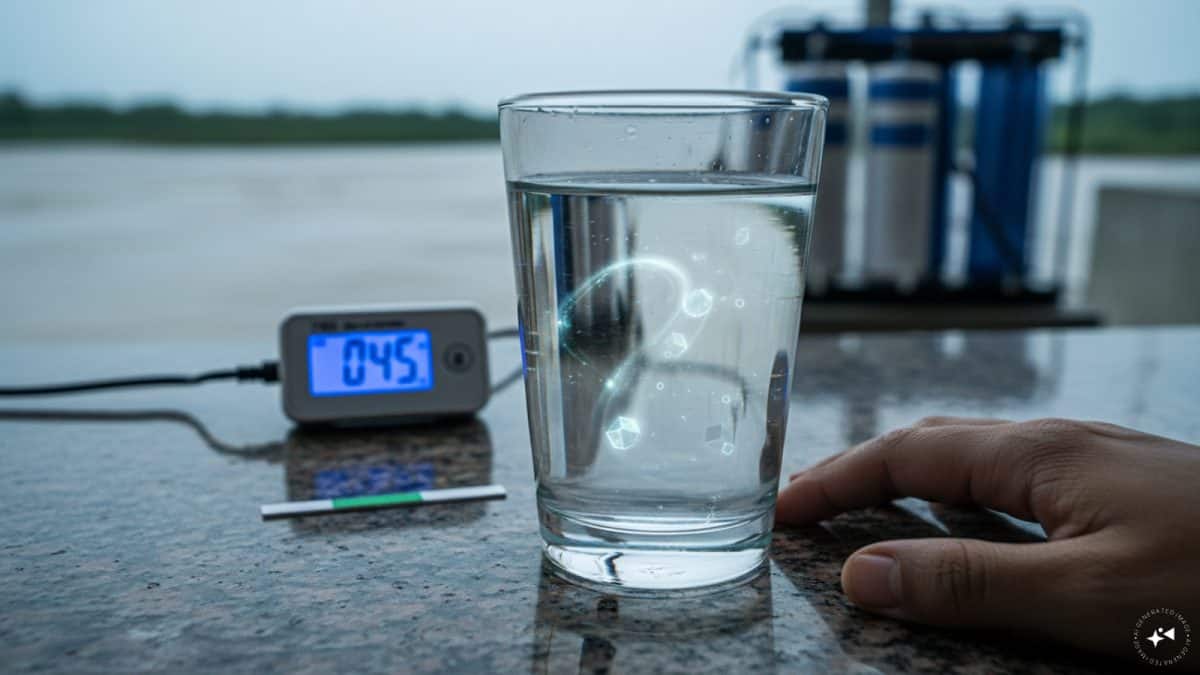
Experts say understanding TDS, pH, seasonal changes and purification technology is crucial for safer drinking water at home.
For households, however, water quality is often reduced to a single number displayed on a TDS meter.
This means households should be cautious about judging water quality solely on the basis of a TDS meter.
Clear water can still contain invisible contaminantsOne of the biggest misconceptions about drinking water is that clear water is necessarily clean.
A purifier also needs regular maintenanceInstalling a purifier is not the final step in ensuring water quality.
Clear, odourless water can still contain microorganisms or dissolved contaminants. Experts say understanding TDS, pH, seasonal changes and purification technology is crucial for safer drinking water at home.
Water that looks clean and tastes normal can create a false sense of security. Some of the most important drinking-water risks cannot be detected by simply looking at, smelling or tasting the water. The World Health Organisation says microbiologically contaminated water remains a major public-health concern and can transmit diseases including diarrhoea, cholera, dysentery, typhoid and polio. Chemical contaminants such as arsenic, fluoride and lead can also pose risks depending on the source and local conditions.
For households, however, water quality is often reduced to a single number displayed on a TDS meter. That can be misleading. Total Dissolved Solids (TDS) measures dissolved minerals, salts and other inorganic substances, but it does not by itself establish whether water is microbiologically safe or free from every harmful chemical.
Advertisement
India's drinking-water standard, IS 10500:2012, covers a much broader set of parameters, including pH, turbidity, TDS, metals, fluoride, nitrate, residual chlorine and microbiological requirements.
Against this backdrop, Dr Anil Kumar, Chief Water Scientist, Eureka Forbes Ltd., explains what households should understand about drinking-water quality, why TDS and pH cannot be viewed in isolation, and how changing source conditions and purification technologies affect the water reaching the glass.
TDS is not a safety certificate
Dr Kumar said TDS is essentially a measure of the concentration of dissolved minerals, salts and other inorganic substances in water.
More from Health More from Health
While it can influence taste, a low TDS reading does not automatically mean that water is safe to drink. Water with a low TDS level can still contain bacteria, viruses or certain contaminants that are not captured by the measurement.
Conversely, high TDS does not necessarily mean that water is unsafe. The important question is what is contributing to the TDS and whether those substances require treatment.
The WHO also treats TDS as one component of drinking-water assessment rather than a standalone measure of safety. This means households should be cautious about judging water quality solely on the basis of a TDS meter.
Advertisement
What does pH tell you about drinking water?
pH indicates whether water is acidic, neutral or alkaline. Dr Kumar said drinking water should fall within the acceptable limits prescribed under applicable drinking-water standards.
pH by itself, however, cannot establish whether water is safe. Water can have an acceptable pH while still containing microbial or chemical contaminants.
An inappropriate pH can also affect taste, contribute to corrosion in plumbing over time and influence the effectiveness of some water-treatment processes.
India's IS 10500 drinking-water specification includes pH among the physical and organoleptic parameters used to assess drinking water.
Clear water can still contain invisible contaminants
One of the biggest misconceptions about drinking water is that clear water is necessarily clean.
Bacteria, viruses, dissolved heavy metals, pesticides and certain industrial pollutants may be invisible and cannot necessarily be identified through taste, smell or colour. Contamination can occur at the source or enter the supply through factors such as groundwater contamination, agricultural runoff, ageing infrastructure or inadequate treatment.
The WHO study suggests that natural groundwater contaminants such as arsenic and fluoride can have health significance, while substances such as lead may enter drinking water through contact with components of water-supply systems. Therefore, visual inspection is not an adequate method for determining drinking-water safety.
Advertisement
Why monsoon can change the water-quality equation
Water quality is not necessarily constant throughout the year.
Dr Kumar said heavy rainfall, flooding, changes in water sources, infrastructure repairs, construction activity and ageing pipelines can influence the quality of water supplied to households.
Monsoon conditions can be particularly important because flooding and overflowing drains can increase the possibility of microbial contamination, while changes in distribution systems can affect the quality of water reaching homes.
The WHO identifies microbial contamination as one of the greatest risks to drinking-water safety globally.
For households, this means water that appeared satisfactory during one period of the year should not automatically be assumed to have identical quality throughout the year.
There is no one purifier for every home
Dr Kumar said households should not choose a water purifier simply based on brand, price or a single TDS reading.
The appropriate purification technology depends on several factors, including the source of water, TDS, microbial contamination and other dissolved impurities.
Groundwater, municipal supply and other sources can have very different characteristics. Understanding the quality of the source water can therefore help determine what kind of treatment is actually required.
This is particularly important because purification is not simply about removing as much as possible from water; the treatment approach should be suited to the quality and characteristics of the source.
Newer technologies target finer contaminants
As water-quality challenges become more complex, purification technologies are also evolving.
Dr Kumar pointed to Nanopore Filtration Technology, which is available in the latest range of Aquaguard water purifiers by Eureka Forbes. According to the company, the technology uses pores in the nanometre range and is designed to provide an additional layer of purification by targeting ultra-fine contaminants.
Such technologies are part of a broader shift towards more targeted purification rather than relying exclusively on conventional filtration. However, the choice of technology should still be based on the characteristics of the source water rather than assuming that the most advanced or expensive system is automatically the right one for every household.
A purifier also needs regular maintenance
Installing a purifier is not the final step in ensuring water quality.
Filters, membranes and other purification components require servicing and replacement at appropriate intervals. Dr Kumar said neglecting maintenance can reduce purification efficiency over time.
In other words, choosing the right purifier and maintaining it properly are equally important. A well-maintained system is better positioned to perform according to its intended specifications, while an overdue filter replacement can undermine the effectiveness of the purification process.
Water safety starts with knowing what you cannot see
The central message is that drinking-water quality cannot be judged by appearance alone. TDS can provide useful information about dissolved solids, while pH is another important quality parameter, but neither is a complete test for drinking-water safety. India's drinking-water standards themselves cover a much wider range of physical, chemical and microbiological parameters.
For households, the practical approach is to understand the source of their water, be alert to seasonal or supply-related changes, select purification technology according to actual water-quality needs and maintain the system regularly.
As Dr Kumar puts it, safe drinking water is not simply about what can be seen in a glass; it is about understanding what may be present beyond what the eye can detect.