Throughout her career, Felser has followed her own path across physics, chemistry and materials science, with a particular interest in understanding how the properties of materials can be used to create new ones.
Today, her research extends from superconductivity and spintronics to topological materials, chirality, catalysis and AI-driven materials discovery.
How did you find your way into science and materials research?
In the future, if we want to use AI successfully in materials science, we need much more data.
So I think chirality is probably the most interesting question at the moment.
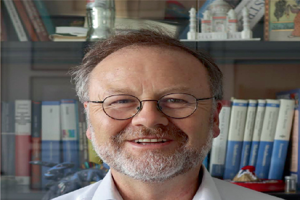
Professor Claudia Felser has built a career at the intersection of chemistry and physics, focusing on the design and discovery of novel inorganic materials with electronic and magnetic properties. Her research has played a major role in advancing the study of topological quantum materials, with potential applications ranging from data technologies to energy conversion.
Felser studied chemistry and physics at the University of Cologne, where she completed her doctorate in physical chemistry. After postdoctoral research at the Max Planck Institute in Stuttgart and CNRS in Nantes, she became a professor at the University of Mainz. She is now director of the Max Planck Institute for Chemical Physics of Solids in Dresden, and her contributions to materials research have been recognized with numerous honors, including the 2026 Wiley Women in Science Award.
Throughout her career, Felser has followed her own path across physics, chemistry and materials science, with a particular interest in understanding how the properties of materials can be used to create new ones. Today, her research extends from superconductivity and spintronics to topological materials, chirality, catalysis and AI-driven materials discovery.
How did you find your way into science and materials research?
I always liked science, honestly. My path was not straightforward, but in the end my decision was simply based on doing what I like to do and not caring whether I get a job or not.
Making new materials with super exciting properties is the goal of my life. I was always going my own way, I have to say. I always liked it somewhere in between theory and experiment, and I have always worked at the intersection of physics and chemistry, but always around the subject of materials and solids. I was lucky that most of the people I worked with let me do what I wanted to do.
How have your research interests developed over time?
I always had a large interest in superconductivity, but there were other subjects that I thought could eventually have even more impactful applications. One was magnetic materials, where I became interested in spintronics and in compounds where you can systematically understand the materials and develop simple rules to design new ones.
This was also very useful when the field of topological science started. From my materials design work, it became clear to me that topological insulator properties were not limited to a very small number of compounds, but that there was a much larger group of materials where you could develop more general ‘recipes’ for how to find topological insulators.
For me, application has always been a red thread. Every physicist would immediately think about topological quantum computing, but we are interested in new ways to make very efficient energy conversion from heat to electricity.
I think topology is also very interesting for catalysis. Roy Hoffman is a big hero of mine. He got the Nobel Prize in 1987 and his concepts for solids were already, in some sense, a more chemical version of some of the ideas of topology. He was also interested in surface science and catalysis, and I think the concept of topology can now be transferred back to chemistry. This is why I recently became very interested in chirality and catalysis. I simply think that topology can help us understand things that are difficult to understand in chiral solids.
What makes chirality in solids so interesting?
Chirality in a solid is much more complex than in a molecule. If you have structural chirality in a molecule, the way its electrons behave is also chiral. But in a solid it is more complicated.
In topology, for example, the movement of an electron can be linked to its spin, and you can generate chiral electrons. So the question is: if you have a structurally chiral solid, is the behavior of its electrons also chiral? Topology can induce two chiralities in the electronic structure, which is completely counterintuitive.
Then you can ask the opposite question: can you start with a non-chiral crystal and get chiral electrons? Everybody would say you are totally crazy, but I think chirality can also come from other sources other than the structure of the material. This could allow us to rethink catalysis.
If you start with a chiral molecule as a catalyst, you can get chirality out if everything fits. But this does not necessarily work with a solid, because a chiral solid is not automatically chiral at the electronic level. This may explain why it is so difficult to take simply a chiral crystal and hope that you can do chiral catalysis.
We have recently had papers on this, including work on transport and catalysis, and we are also looking at the absorption of molecules on chiral and achiral crystals. I am working on a concept to explain this better to chemists through simple orbital pictures of what happens inside the material and at its surface. The challenge is to translate the more sophisticated concepts of topology into a simple chemistry picture without losing the information.
How do you approach collaboration in your work?
The spirit in our group is very collaborative. If you have an idea and you want to learn something, you need people who can do different experiments.
I think topology was very disruptive because it completely changed the way we understand the relationship between a material and its properties. When I was young, I had lectures about structure and structure-to-property relationships. With topology, we see other properties, sometimes properties that were already appearing but people did not understand. Now, knowing the concept of topology, we can understand totally different, also more quantum, properties.
What are the main challenges you see ahead?
One of the main challenges is to get quantum effects to work at room temperature. Quantum is normally assumed to be at low temperature, but that is not necessarily true. Some quantum effects are available at higher temperatures, and the challenge is to bring them there.
In the future, if we want to use AI successfully in materials science, we need much more data. A lot of data is still in handwritten laboratory books and is therefore not available. To predict a truly new material with a new structure, you need phase diagrams, competing phases, and the experience that solid state chemists have through chemical intuition. Synthesizing a material is not simply putting elements together and heating them up.
What scientific question excites you the most at the moment?
I still think the chirality research has just started. Chirality does not appear only in solids, but it also connects questions in high-energy physics, astrophysics, solids and biology.
One of the big questions behind our work is the origin of the homochirality of life: why do we have only one kind of amino acid? We are looking at biological precursors, including precursors of RNA, and how they interact with materials that have chirality in their electronic structure. So I think chirality is probably the most interesting question at the moment. It is a fundamental question, and topology can help us understand it.
The Wiley Women in Science Awards 2026, held in March at the Institute of Physics, Chinese Academy of Sciences, brought together leading scientists and scholars to honor the outstanding contributions of nine exceptional women researchers for their impactful contributions and dedication to innovation. The establishment of the Wiley Women in Science Awards, supported by the journal Advanced Physics Research, aims to inspire the next generation of researchers and support a more inclusive and diverse research community.
Featured Image Credit: Max Planck Institute for Chemical Physics of Solids