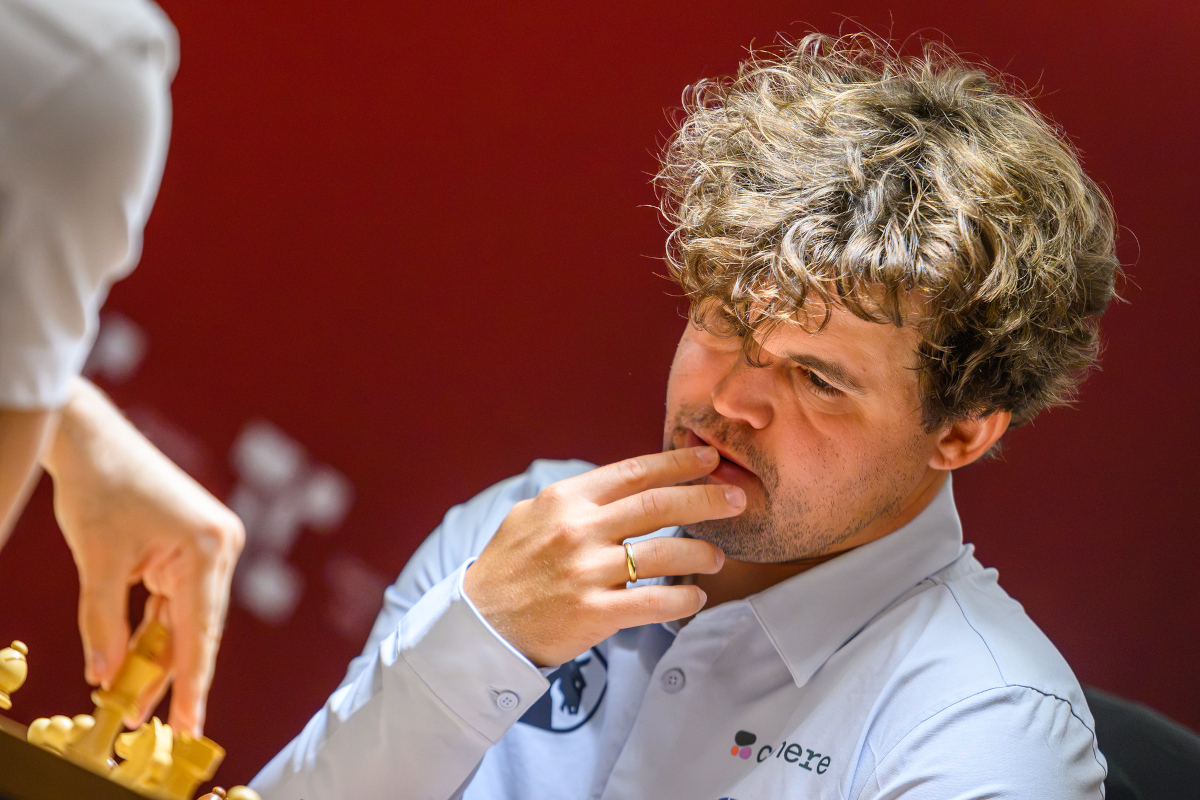
Carlsen the only player unbeatenThe Total Chess World Championship Tour Pilot kicked off on Tuesday with a nine-round Swiss blitz tournament featuring all 24 participants.
Magnus Carlsen emerged as the outright winner with 7 points, scoring five wins and four draws.
The Frenchman had led the tournament outright after five rounds, when he stood on 4½/5, half a point ahead of Carlsen.
Entering the tournament as the clear rating underdog, the Indian star scored 4/9, including wins over Hans Niemann and Wesley So.
Should two or more players finish level on points in their respective groups, Tuesday's blitz standings will determine their order.
Carlsen the only player unbeaten
The Total Chess World Championship Tour Pilot kicked off on Tuesday with a nine-round Swiss blitz tournament featuring all 24 participants. The games were played at a time control of 3 minutes plus 2-second increments, with the final standings set to serve as a tiebreak in the group stage that follows.
Magnus Carlsen emerged as the outright winner with 7 points, scoring five wins and four draws. The Norwegian defeated Jan-Krzysztof Duda, Richard Rapport, Arjun Erigaisi, Anish Giri and Haik Martirosyan.
10 Chess Principles That Actually Matter Keep it simple. Stay objective. Watch the clock. Sometimes take the risk. GM Loek van Wely explains the ten principles that decide real games. They aren’t about theory. They’re about what you do at the board when it counts.
Opening theory gets all the attention. But according to GM Loek van Wely, a player who has played in 14 Olympiads, is eight-time Dutch champion, and has decades of experience against Karpov, Kasparov, Anand, and Carlsen, most of what separates strong players from the rest has nothing to do with memorised lines.
Free sample video:
Free sample video:
Keep it simple. Stay objective. Watch the clock. Sometimes take the risk. GM Loek van Wely explains the ten principles that decide real games. They aren’t about theory. They’re about what you do at the board when it counts.Opening theory gets all the attention. But according to GM Loek van Wely, a player who has played in 14 Olympiads, is eight-time Dutch champion, and has decades of experience against Karpov, Kasparov, Anand, and Carlsen, most of what separates strong players from the rest has nothing to do with memorised lines.Free sample video: Introduction Free sample video: Don't Bluff the Donkey
Carlsen's unbeaten run - he was the only player to remain undefeated throughout - was not without its difficult moments, however. Carlsen was temporarily in an inferior position against Giri before turning the game around, while Levon Aronian also obtained a winning position against him but eventually agreed to a draw by repetition.
Maxime Vachier-Lagrave took sole second place with 6½/9. The Frenchman had led the tournament outright after five rounds, when he stood on 4½/5, half a point ahead of Carlsen. However, a defeat against Arjun Erigaisi cost him the lead. It was his only loss of the day.
Aronian finished third on 6/9, securing his place on the podium with a final-round victory with the black pieces over Erigaisi. The Armenian also suffered just one defeat, against Anish Giri in round three. Five players finished half a point further back on 5½/9: Alireza Firouzja, Hans Niemann, Arjun Erigaisi, Richard Rapport and Fabiano Caruana.
Maxime Vachier-Lagrave defeated Alireza Firouzja in the all-French confrontation in round eight | Photo: Michal Walusza
Levon Aronian | Photo: Michal Walusza
Anish Giri sharing a laugh with Alireza Firouzja | Photo: Michal Walusza
Carlsen's great tactical find in round one
Despite White having two extra pawns and three connected passers on the queenside, engines evaluate this position as equal, since Black has enough counterplay with his active major pieces threatening checkmate on g2.
However, the position went from equal to lost for White after Duda faltered with 31.Kh1??, perhaps intending to play Rc1-g1 next. Remarkably, the only move that keeps the balance in the diagrammed position is 31.Rf1 (all other moves lose, in fact).
The idea behind placing the rook on f1 becomes clear after Carlsen played the formidable 31...Rd3!, a great find with 10 seconds left on his clock.
White is lost. A sample line is 32.b5 Rxc3 33.Rxc3 Re1+ 34.Kh2 Qe5+, with a double attack against the king on h2 and the rook on c3, while after 35.Rg3, Black has 35...h4, as in the game.
The line seen on the board was the critical 32.Rxd3 Qxc1+ 33.Kh2 Qf4+ 34.Rg3 h4
Practical Tips for the Tournament Player Vol.1: Fundamentals of Practical Chess How grandmasters win without fireworks: GM Jan Markos shows you 11 very practical tips from "How to play in a lost position" to "Be patient like Carlsen" that will improve your tournament chess.
Most chess books teach you what to think about. This series teaches you what to actually do when the clock is running and the result is on the line. Compiled from GM Jan Markos's acclaimed "Practical Tips for the Tournament Player" column in ChessBase Magazine, Volume 1 covers the decisions every tournament player faces before the position ever gets complicated: how you use your time, how you handle pressure, and how you think when the stakes are real.
Free Video Sample:
How grandmasters win without fireworks: GM Jan Markos shows you 11 very practical tips from "How to play in a lost position" to "Be patient like Carlsen" that will improve your tournament chess.Most chess books teach you what to think about. This series teaches you what to actually do when the clock is running and the result is on the line. Compiled from GM Jan Markos's acclaimed "Practical Tips for the Tournament Player" column in ChessBase Magazine, Volume 1 covers the decisions every tournament player faces before the position ever gets complicated: how you use your time, how you handle pressure, and how you think when the stakes are real.Free Video Sample: How to use your time effectively
Duda continued playing a rook down for a few moves, but Carlsen soon demonstrated the path to victory in the clearly advantageous setup.
Jan-Krzysztof Duda resigns after a tough battle against chess superstar Magnus Carlsen | Photo: Michal Walusza
Mixed fortunes further down the standings
Among the pre-tournament favourites, Nodirbek Abdusattorov endured the toughest day. The Uzbek grandmaster scored 2½/9 to finish 22nd out of 24 participants. As the games were officially rated, the result cost him 41.5 rating points in the live blitz rankings, dropping him from second to fifth place.
Bibisara Assaubayeva also struggled, losing her first eight games before drawing Vaishali Rameshbabu in the final round to finish on ½/9.
Vaishali, meanwhile, had a rather more successful day. Entering the tournament as the clear rating underdog, the Indian star scored 4/9, including wins over Hans Niemann and Wesley So. She gained 27.1 rating points, climbing 15 places to 21st in the women's live blitz rankings.
Bibisara Assaubayeva | Photo: Michal Walusza
Vaishali Rameshbabu | Photo: Michal Walusza
Vaishali beats Niemann
At this point, Vaishali had managed to survive what had been a difficult (at times, clearly inferior) position with the black pieces. Her 45...Bf6?, however, gave Niemann the advantage again. Correct was 45...Bb6, keeping an eye on the passer on the a-file.
But Niemann failed to find the winning line. He needed to go for an immediate 46.a4, and Black's natural continuation - which was seen in the game - is not enough to hold the draw: i.e. 46...Be7 47.a5 Kxe6 48.Rxd8 Bxd8 49.a6 Bb6 (see diagram below).
The bishop is overloaded here, e.g.: 50.d8Q Bxd8 51.a7, and the a-pawn queens.
Instead, Niemann decided to activate his king first with 46.Ke2?, and in fact it is Black who got a winning position. There followed 46...Be7 47.a4 Kxe6 48.a5 Kxd7, and Niemann resigned.
Attacking Chess: Know When to Strike Most players don’t lack the urge to attack, they just strike at the wrong moment, and GM Sipke Ernst shows you which signals tell you to go for the king and which tell you to choose another plan.
Most players know how to attack. What separates strong players from the rest is knowing when. In this course, GM Sipke Ernst, a grandmaster from the Netherlands and experienced coach, addresses the mistake he sees most often in his own students: attacking with the right idea, at the wrong moment.
Free video sample:
Free video sample:
Most players don’t lack the urge to attack, they just strike at the wrong moment, and GM Sipke Ernst shows you which signals tell you to go for the king and which tell you to choose another plan.Most players know how to attack. What separates strong players from the rest is knowing when. In this course, GM Sipke Ernst, a grandmaster from the Netherlands and experienced coach, addresses the mistake he sees most often in his own students: attacking with the right idea, at the wrong moment.Free video sample: Introduction Free video sample: Example Game: Ernst - Mediema
After 49.Rxd8+ Bxd8 50.a6 Bb6 Black emerges with a clearly winning position.
Despite losing to Vaishali Rameshbabu in the first round, Hans Niemann finished with a strong 5½/9 performance | Photo: Michal Walusza
Fast classic up next
The competition now moves into its group stage, with the 24 players divided into four groups of six. Each group will play a double round-robin, with two rounds per day from Wednesday through Sunday.
The games will be played at a time control of 45 minutes plus 30 seconds per move, referred to as Fast Classic. Unlike conventional tournament scoring, a win will earn three points, a draw one point and a loss none. The games will count towards the players' classical ratings.
Should two or more players finish level on points in their respective groups, Tuesday's blitz standings will determine their order. Carlsen's first-place finish therefore gives him the best possible tiebreak position heading into the next stage.
Final standings - Blitz
All games - Blitz
Links