Evidence that changes in the digestive system played a decisive role in the evolution of dinosaurs into birds has been presented through analysis of gastrolith (stomach stone) wear patterns.
The researchers compared and analyzed gastroliths from 42 species of living birds and 4 species of crocodilians.
Ducks and geese, which primarily consume tough plant matter, had well-developed stomach muscles and gastroliths worn smooth and round like beach pebbles.
The same pattern was confirmed in an analysis of 16 dinosaur species.
These dinosaurs likely mechanically crushed plant matter in their stomachs, much like modern chickens.
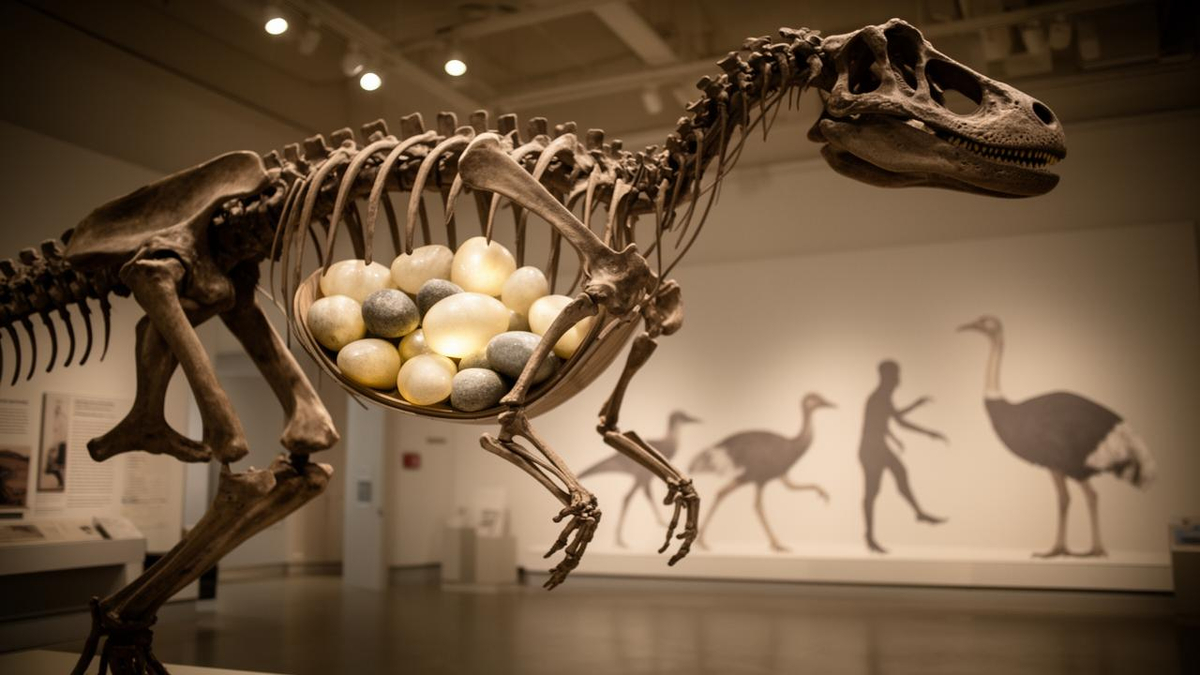
Evidence that changes in the digestive system played a decisive role in the evolution of dinosaurs into birds has been presented through analysis of gastrolith (stomach stone) wear patterns. The confirmation that dinosaurs which lost their teeth and developed beaks possessed rounded, worn gastroliths in their stomachs—much like today's chickens and ostriches—highlights the shift of food grinding from the jaw to the stomach as a key factor in avian evolution.
A research team led by Professor Ryuji Takasaki of the Department of Dinosaur Studies at Okayama University of Science in Japan published a paper in the international journal Paleobiology demonstrating, based on gastrolith wear patterns, that dinosaurs employed diverse digestive strategies similar to modern animals. Some dinosaurs ground and pulverized food in their stomachs like chickens or ducks, some tore and chewed with their mouths like crocodiles or lions, and others are believed to have relied on microbial fermentation like cows or sheep.
The researchers compared and analyzed gastroliths from 42 species of living birds and 4 species of crocodilians. Ducks and geese, which primarily consume tough plant matter, had well-developed stomach muscles and gastroliths worn smooth and round like beach pebbles. In contrast, seabirds and crocodiles that prey on animals had less need to crush food in the stomach, resulting in weaker stomach muscles and gastroliths that retained their angular shape due to fewer collisions with one another.
The same pattern was confirmed in an analysis of 16 dinosaur species. Professor Takasaki explained, "We discovered a correlation in which teeth disappeared and gastroliths became rounded as the work of chewing and grinding food shifted from the jaw to the stomach."
Toothless Theropods Crushed Plants with Rounded Gastroliths
Dinosaurs are broadly divided into Saurischia (lizard-hipped) and Ornithischia (bird-hipped). Despite the name, modern birds evolved not from Ornithischia but from theropods—carnivorous dinosaurs within Saurischia. Certain lineages later shifted to herbivorous or omnivorous diets, losing their teeth and developing beaks, converging evolutionarily toward forms resembling Ornithischian dinosaurs.
A representative example is Deinocheirus mirificus. When its 2.4-meter arm bones were excavated in 1965, it was initially estimated to be a carnivorous dinosaur more than twice the size of Tyrannosaurus. However, in 2014, Lee Yung-nam, director of the Geological Museum at the South Korea Institute of Geoscience and Mineral Resources, and researcher Lee Hang-jae overturned the established theory by publishing a paper in the international journal Nature identifying it as an herbivorous ornithomimosaur based on a complete fossil excavated in Mongolia. A remarkable 1,400 gastroliths were discovered between the ribs and vertebrae of this fossil.
The gastroliths of toothless theropods were generally rounded in shape. These dinosaurs likely mechanically crushed plant matter in their stomachs, much like modern chickens. In contrast, Tarbosaurus, a giant theropod carnivore, possessed both powerful teeth and angular gastroliths. The interpretation is that its teeth tore flesh while the stomach handled only finishing work.