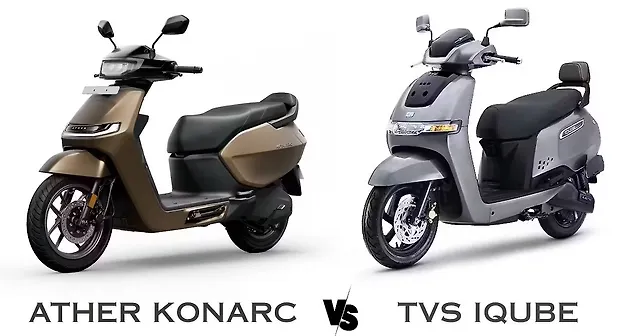
The TVS can be bought in a wide selection of versions today, while Ather is rolling out the Konarc range in stages.
99,999 for the 100km IDC version.
A 200km Konarc S is planned for the third quarter of 2027.
TVS has a broader catalogue with the latest iQube family including 2.3kWh, 3.1kWh, 3.5kWh, MillionR Edition, S 4.7kWh and ST 5.3kWh versions.
Performance and Everyday HardwareThe Konarc S starts with a 2.1kWh battery offering 100km IDC and an Ather TrueRange claim of 80km.
Konarc S ranges from 100km to 161km IDC today; a 200km version and faster Z models will follow
iQube already gets six versions with battery sizes from 2.3kWh to 5.3kWh and up to 212km IDC range
The Ather Konarc and TVS iQube are technically chasing the same Indian buyers who value everyday commuting manners, family use, storage, comfort, connectivity and running costs above anything else. This comparison may look unusually close, but there are some differences at present. The TVS can be bought in a wide selection of versions today, while Ather is rolling out the Konarc range in stages.
Price and Variants
The Konarc S starts at Rs. 99,999 for the 100km IDC version. The 125km model costs Rs. 1,21,999, while the 161km version is Rs. 1,44,999. Remember all mentioned prices here are ex-showroom. The 125km and 161km scooters are scheduled for deliveries from September 2026, while the cheapest 100km variants will arrive in the first quarter of 2027. A 200km Konarc S is planned for the third quarter of 2027. Ather will also introduce the more advanced Konarc Z in 125km and 161km forms in the second quarter of 2027, with prices yet to be announced.
TVS has a broader catalogue with the latest iQube family including 2.3kWh, 3.1kWh, 3.5kWh, MillionR Edition, S 4.7kWh and ST 5.3kWh versions. Range starts from 114km IDC and rises through 123km, 145km, 175km and finally 212km. Pricing varies considerably between states because EV subsidies can change the effective showroom figure. Our pages currently place the wider iQube range at roughly Rs. 1.19 lakh to Rs. 1.76 lakh on an average ex-showroom basis.
Look at the Delhi pricing to see how complicated the price comparison becomes. TVS currently lists effective ex-showroom prices after applicable incentives at Rs. 95,124 for the 2.3kWh version, Rs. 1,04,962 for the 3.1kWh, Rs. 1,10,200 for the 3.5kWh, Rs. 1,13,751 for the MillionR, Rs. 1,30,340 for the S 4.7kWh, and Rs. 1,46,877 for the ST 5.3kWh. In a market with those incentives, even the flagship 212km iQube sits surprisingly close to the 161km Konarc S. Elsewhere in India, that equation will change though.
So, please compare actual local on-road prices rather than simply looking at the headlines. The Rs. 99,999 Konarc is attractive, but someone shopping today cannot take delivery of that particular version immediately.
Performance and Everyday Hardware
The Konarc S starts with a 2.1kWh battery offering 100km IDC and an Ather TrueRange claim of 80km. Its PMSM motor makes about 4kW and 16Nm with a top speed of 70kmph and 0-40kmph taking five seconds. The 2.7kWh version raises IDC range to 125km and TrueRange to 100km, while peak power climbs a little to 4.7kW and the 0-40kmph time falling to 4.7 seconds. 3.5kWh version retains that performance, but stretches IDC range to 161km and TrueRange to 130km.
All three S versions top out at 70kmph. The future Konarc Z raises that to 80kmph making it a more direct performance rival to the higher iQube variants. It will also introduce a TFT touchscreen, MagicKey, AutoPop boot operation and Ather’s Advanced Electronic Braking System on the Z line.
iQube takes a different approach here. Entry level 2.3kWh model offers 114km IDC range and 68kmph top speed. From the 3.1kWh version upwards the top speed rises to 82kmph. 3.1kWh scooter claims 123km, 3.5kWh models 145km, S 4.7kWh 175km and the ST 5.3kWh 212km. This is a wider spread between an inexpensive grocery scooter and a longer-range commuter.
Their motor layouts are different as well. Konarc uses a PMSM with Ather’s closed Silent Gear Drive, whereas iQube uses a BLDC hub-mounted motor. The latter keeps the drivetrain mechanically simple, although our long-term test found that having the motor within the rear wheel makes routine puncture work and even valve access less convenient.
Ather has clearly concentrated on Indian road conditions. The Konarc uses a 14-inch front wheel and 12-inch rear, with 90mm front and 100mm rear suspension travel. Ground-level usability is backed by a 31-litre boot and a metal body over a steel unibody chassis. The larger front wheel should also be useful over broken surfaces and potholes.
TVS iQube stays with 12-inch wheels at both ends. Its conventional scooter geometry, low 770mm seat, generous floorboard and large storage area make it particularly easy for family use. Our recent two-month test of the ST 5.3kWh praises its seating position and supple suspension, describing its ride quality as one of the better setups in the electric scooter segment. The test also found it easy to manoeuvre and natural in its throttle response.
There is a useful reality check on claimed range. We managed around 100km consistently from the iQube ST while using Sport mode, despite the much higher laboratory IDC figure. Eco mode extended that distance noticeably. The same caution should be applied to the Konarc’s IDC numbers until BikeWale conducts a full real-world test. Ather’s TrueRange figures of 80km, 100km and 130km are therefore more useful for planning daily travel than the larger IDC numbers.
Konarc gets a 450W onboard charger. The smaller versions take roughly four to five hours to reach 80%, while Ather offers a combined home-charging system that cuts the time to around two to three hours depending on battery size. The higher variants also gain Ather Grid access with the company quoting roughly 13-15km of range added in ten minutes.
iQube uses portable off-board chargers and can be plugged into a regular 15A socket. Depending on variant, 0-80% takes roughly three to four-and-a-half hours. This setup is simple, while Ather has the advantage of its established public Grid charging ecosystem for top-ups outside home.
Which One Fits Which Buyer?
The Konarc makes its strongest case with technology definitely. Even the S family incorporates Ather’s connected ecosystem including app functions, OTA updates, remote charging status, location services, theft and tow alerts and AtherStack Pro compatibility. Higher versions add features such as AutoHold and a larger DeepView display. Ather also offers extended battery warranty options reaching up to ten years or one lakh kilometres, although these are subject to conditions and additional purchase requirements.
TVS counters through maturity rather than novelty. Depending on variant buyers get a TFT display, navigation, connected functions, hill hold, forward and reverse parking assistance, OTA capability, call alerts, vehicle tracking, crash alerts and remote battery information. The ST sits at the top with a 7-inch touchscreen and the richest connected package.
iQube’s biggest advantage is that BikeWale has already lived with it. Our expert review found it comfortable, quiet, easy to use, well balanced and especially good for errands and family duties. Its weaknesses included shallow under-seat storage that was less helmet-friendly than its quoted capacity suggested, occasional front-end movement over rippled surfaces and the service inconvenience of the hub motor.
The Konarc remains more of a specification-led recommendation for now. It promises a one-year or 10,000km service interval, metal construction, larger front wheel, strong connected technology, and access to Ather’s charging ecosystem. But we need a production scooter road test before judging its ride quality, real-world range, braking behaviour and family comfort against the proven iQube.
Picture may change once the Konarc Z arrives. With an 80kmph top speed, richer electronics, and more premium features, it should close the remaining gap to the upper iQubes. Until then, the Konarc is the more interesting newcomer, while the iQube remains the more complete and proven choice.