It chose a standalone 5G network rather than relying on the existing 4G core.
Free unlimited 5G data on eligible plans encouraged adoption and allowed customers to experience higher speeds without separate 5G packs.
2025: Jio crosses 500 million usersJio marked its ninth anniversary with a historic milestone: more than 500 million users.
Jio now served consumers through mobile, 5G, fibre, fixed wireless access, applications and devices, while Jio Platforms housed a broader digital and technology ecosystem.
2026: Ten years, 533 million subscribersAs Jio approached its tenth anniversary, Reliance reported 533.3 million connectivity subscribers, including 285 million 5G users.
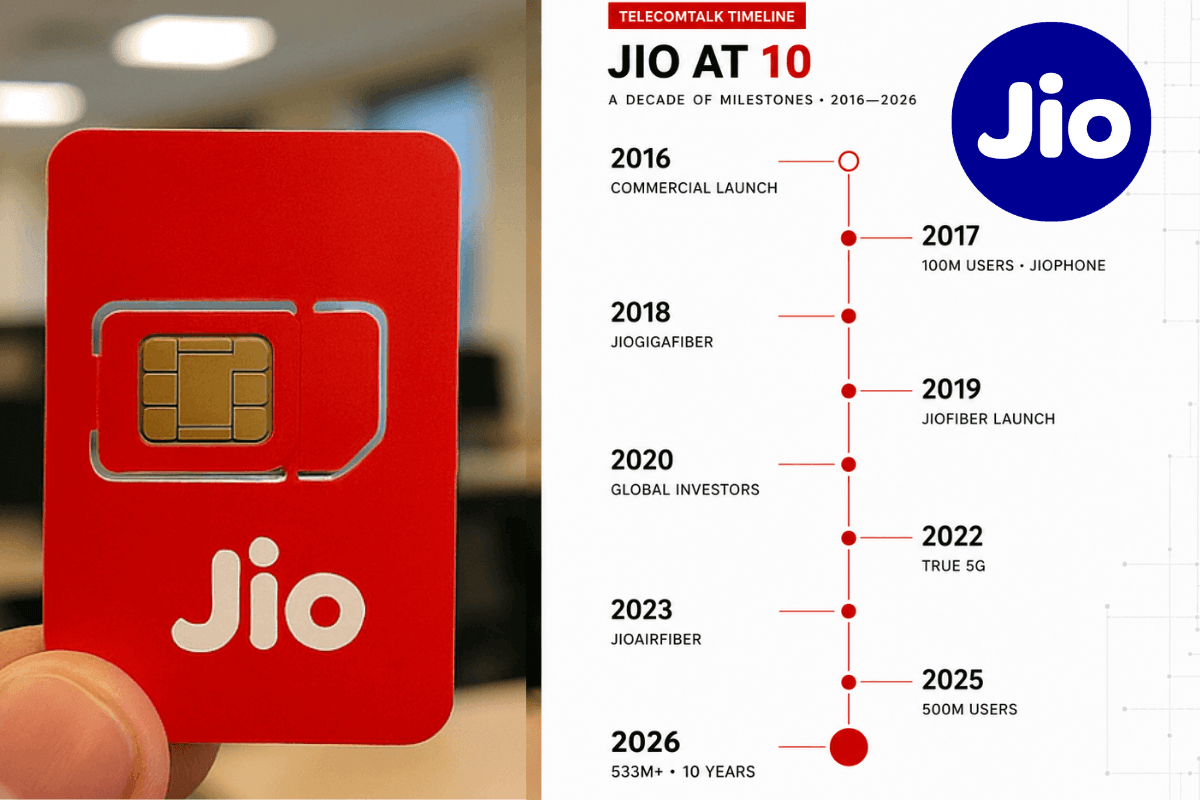
Reliance Jio will complete ten years of commercial operations on September 5, 2026. In one decade, it grew from a new entrant offering free voice and introductory data into India’s largest telecom service provider, while expanding into devices, fibre broadband, fixed wireless access, platforms and enterprise connectivity.
Reliance Jio commercially launched its services on September 5, 2016. Its entry was unlike that of a conventional telecom operator. Jio offered free domestic voice calls and introduced the Welcome Offer, which gave users access to mobile data and a suite of digital applications without charge during the introductory period.
The proposition immediately changed customer expectations. Voice, which had long been a central source of operator revenue, became bundled with data. Consumers started using significantly more mobile internet, while established operators responded with lower data prices, larger allowances and simplified bundles. Jio said it added 16 million subscribers in its first month and crossed 50 million in 83 days, establishing the scale and speed that would define its early expansion.
2017: Subscriber growth and the JioPhone
Jio crossed 100 million subscribers in less than six months after launch. The milestone demonstrated that affordable data had demand far beyond premium smartphone users. The operator also introduced paid services after its initial free-offer period, testing whether the rapidly acquired base could be converted into paying customers.
TELECOMTALK INTELLIGENCE Follow the Global Telecom Conversation Get our weekly intelligence briefing covering telecom, AI, devices, data centres and digital infrastructure. in Subscribe on LinkedIn →
The next major step was the JioPhone, announced as an affordable 4G feature phone for people who had not moved to smartphones. It supported voice over LTE, applications and internet access in a familiar form factor. By linking an inexpensive device with low-cost connectivity, Jio sought to bring users on 2G networks into its 4G ecosystem. The strategy widened Jio’s addressable market and intensified the industry’s shift toward mobile broadband.
2018: Building a wider digital ecosystem
Reliance also unveiled JioGigaFiber, later renamed JioFiber, signalling its intention to compete inside homes as well as on smartphones. The plan combined high-speed broadband, entertainment and fixed-line services. This was an important strategic transition: mobile connectivity had delivered Jio’s initial scale, but home broadband offered another route to serve families, content consumption and connected devices.
2019: JioFiber reaches the commercial market
JioFiber was commercially launched on September 5, 2019, exactly three years after Jio’s public mobile launch. The service brought fibre broadband, voice and entertainment options together under one proposition. Reliance’s ambition was to expand India’s relatively small fixed-broadband market and create a digital platform for connected homes.
2020: Global investors back Jio Platforms
The year 2020 marked Jio’s transformation from a telecom success story into a global technology investment proposition. Facebook, now Meta, agreed to invest Rs 43,574 crore for a 9.99 percent stake in Jio Platforms. Silver Lake, Vista Equity Partners, General Atlantic, KKR, Mubadala, ADIA, TPG, L Catterton, PIF, Intel Capital, Qualcomm Ventures and Google were among the other investors announced during the broader fundraising phase.
Reliance said Jio Platforms raised Rs 1,52,056 crore from 13 global investors. The deals brought capital as well as potential strategic relationships across social platforms, commerce, devices and technology. During the Covid-19 pandemic, Jio’s mobile and fibre networks also became essential infrastructure for remote work, education, entertainment and communication, reinforcing the role of connectivity in daily life.
2021: Devices, spectrum and enterprise ambitions
Jio spent 2021 strengthening the foundations for its next stage. It acquired additional spectrum in the 800 MHz, 1800 MHz and 2300 MHz bands, increasing capacity and supporting network growth. The company also introduced offers designed to move remaining 2G users toward 4G, continuing its stated ambition of a “2G-mukt Bharat.”
Reliance and Google also launched JioPhone Next in 2021. The Android-based smartphone was positioned as an affordable device for Indians seeking to move from feature phones to smartphones.
2022: Jio begins its True 5G rollout
India’s 5G spectrum auction opened the next major chapter. Jio acquired spectrum across multiple bands, including 700 MHz, 3500 MHz and 26 GHz, and emerged as the auction’s biggest spender. Access to the 700 MHz band gave the operator a potentially valuable coverage layer for its standalone 5G architecture.
Jio began the beta rollout of True 5G in October 2022, initially covering Delhi, Mumbai, Kolkata and Varanasi before adding more locations. It chose a standalone 5G network rather than relying on the existing 4G core. The approach required substantial investment but enabled Jio to pursue capabilities such as network slicing, low latency and new enterprise use cases over time.
2023: Nationwide 5G and JioAirFiber
The pace of Jio’s 5G deployment defined 2023. The company expanded across cities and towns and completed its nationwide rollout by December, in line with its announced schedule. Free unlimited 5G data on eligible plans encouraged adoption and allowed customers to experience higher speeds without separate 5G packs.
Jio also launched JioAirFiber in September 2023. The fixed wireless access service used 5G to deliver home broadband where extending fibre could be slower or less economical. It complemented JioFiber rather than replacing it, giving the company two last-mile technologies for connecting homes. The bundled proposition included broadband and entertainment, extending Jio’s strategy of combining connectivity with digital consumption.
2024: Scaling 5G and home connectivity
Jio and other private operators raised mobile tariffs in July 2024. The revision underlined a new phase in the market: after years dominated by acquisition and low prices, operators increasingly focused on average revenue per user, returns on network investment and financial sustainability. Meanwhile, JioAirFiber expanded to more locations and became an important contributor to Jio’s home-connectivity additions.
2025: Jio crosses 500 million users
Jio marked its ninth anniversary with a historic milestone: more than 500 million users. The company celebrated with anniversary offers and rewards, but the subscriber achievement carried the greater significance. In under nine years, Jio had built a base comparable in size to the populations of the world’s largest countries.
The milestone also showed how far its portfolio had developed since 2016. Jio now served consumers through mobile, 5G, fibre, fixed wireless access, applications and devices, while Jio Platforms housed a broader digital and technology ecosystem. Its network carried rapidly increasing volumes of data, reflecting how streaming, social media, payments, gaming, work and learning had become everyday mobile activities.
2026: Ten years, 533 million subscribers
As Jio approached its tenth anniversary, Reliance reported 533.3 million connectivity subscribers, including 285 million 5G users. Home broadband connections reached 28.6 million, of which 14 million were JioAirFiber homes.
Jio’s first decade changed the basis of competition in Indian telecom. It helped make abundant mobile data mainstream, accelerated the transition from 2G and 3G toward 4G and 5G, and pushed operators to compete through bundled digital experiences as well as network coverage. Consumers gained lower data costs and wider access, although the period also brought consolidation and immense pressure on industry revenues.
What could define Jio’s next decade?
The next phase is likely to be shaped less by subscriber acquisition alone and more by monetising the infrastructure already built. Home broadband, enterprise services, cloud, artificial intelligence, connected devices and 5G applications could become larger growth engines. Jio’s work around satellite connectivity and future 6G technology may also extend its reach and capabilities, subject to policy, spectrum and commercial developments.
Jio enters its second decade with enormous scale, but also with higher expectations maintaining network quality, improving customer experience and turning data growth into sustainable returns will be as important as adding users.
Whatever comes next, the first ten years have already secured Jio a defining place in India’s telecom history: it did not merely join the market; it changed how the country connects.
Some people read for free. A few choose to support. If you found TelecomTalk useful, you can help keep us running.