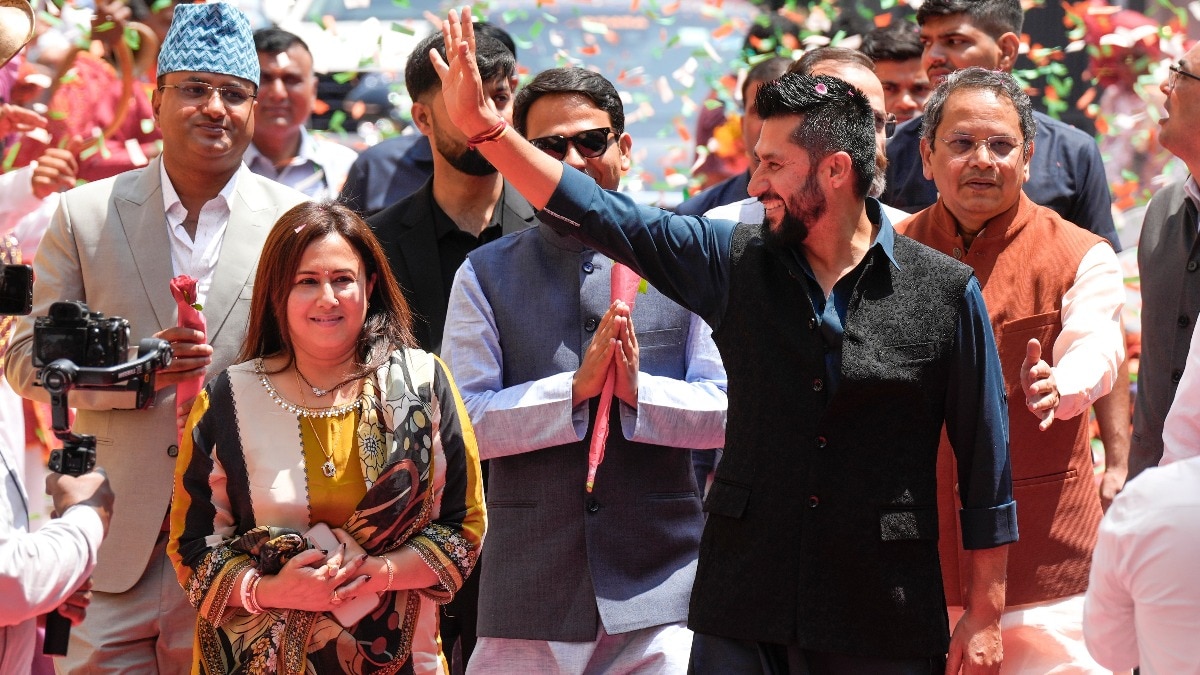
A shower of rose petals along with dhol beats greeted Nepal's ruling party chief, Rabi Lamichhane, as he arrived at the BJP headquarters on Tuesday.
BJP National President Shri @NitinNabin welcomes a delegation of Rastriya Swatantra Party (RSP), Nepal led by RSP Chairman Shri Ravi Lamichhane at BJP headquarters in New Delhi.
Watch pic.twitter.com/ygyRhKXWSh— BJP (@BJP4India) June 2, 2026NEPAL'S RULING PARTY CHIEF IN INDIAWhile only time will tell whether it helps improve ties, what was evident on Tuesday was the importance the BJP attached to Lamichhane's visit.
Nepal's ruling party knows that political rhetoric cannot undo geographical realities.
This may have led Balen Shah to maintain a distance from India and minimise foreign intervention in Nepal's affairs.
A shower of rose petals along with dhol beats greeted Nepal's ruling party chief, Rabi Lamichhane, as he arrived at the BJP headquarters on Tuesday. The optics were significant, as such a grand reception is rarely given for the head of any ruling political party of a foreign country. The visit comes at a sensitive moment, amid friction in India-Nepal ties over territorial disputes under the new Prime Minister Balen Shah.
Read Full Story
While the BJP has described Lamichhane's trip as a bid to strengthen party-to-party engagement, the timing has sparked speculation about its broader diplomatic significance. Will the outreach serve as a stepping stone towards easing tensions and improving relations between India and Nepal?
BJP National President Shri @NitinNabin welcomes a delegation of Rastriya Swatantra Party (RSP), Nepal led by RSP Chairman Shri Ravi Lamichhane at BJP headquarters in New Delhi.
Watch pic.twitter.com/ygyRhKXWSh— BJP (@BJP4India) June 2, 2026
NEPAL'S RULING PARTY CHIEF IN INDIA
While only time will tell whether it helps improve ties, what was evident on Tuesday was the importance the BJP attached to Lamichhane's visit. On Tuesday, Lamichhane, a former journalist, met BJP president Nitin Nabin and other senior leaders.
It was the first formal interaction between the BJP and Nepal's Rastriya Swatantra Party, which came to power in March after a Gen Z uprising toppled the KP Oli government.
Lamichhane was invited as part of the 'Know BJP' initiative. The BJP maintained that it was strictly a party-to-party outreach. However, the strategic calculations behind Lamichhane's visit cannot be ignored.
"The BJP and the Indian government are placing a lot of importance on this visit for sure. Whether this visit will help enhance India-Nepal ties, only time will tell," Sulav Karki, a Nepalese political commentator, tweeted.
Significantly, it marked the first dialogue between the two ruling parties in nearly three months. The BJP will hope that it helps establish a regular channel of communication with Nepal's ruling party at a time when PM Balen Shah has remained out of bounds for foreign delegates.
A scheduled visit by Foreign Secretary Vikram Misri to Kathmandu to meet Shah had to be shelved. In fact, Shah also declined a meeting with US Ambassador Sergio Gor in April.
It has been part of Shah's policy to remain neutral and not lean towards either India, the US or China. It is to maintain this neutrality that Shah has avoided one-on-one meetings with foreign dignitaries, experts have said.
But a landlocked Nepal is significantly dependent on India for trade and infrastructure, energy and connectivity projects. It shares a 1,800 km-long border with India. Nepal's ruling party knows that political rhetoric cannot undo geographical realities. Rabi Lamichhane during a meeting under 'Know BJP' initiative at the party headquaters
BEHIND THE STRAIN IN INDIA-NEPAL TIES
At the centre of the recent strain in India-Nepal ties has been the long-running dispute over Kalapani, Lipulekh Pass and Limpiyadhura - a sensitive region claimed by both countries.
The issue grabbed the spotlight after India announced routes for this year's Kailash Mansarovar Yatra - one through Lipulekh Pass in Uttarakhand and another through the Nathu La Pass in Sikkim. Nepal was quick to warn India of carrying out "any activities", maintaining that Lipulekh was "Nepali territory".
India has maintained that such claims were not based on historical facts and evidence. The region is strategically important for India, allowing it to monitor the approaches near the Tibetan plateau.
The development was not surprising as both Shah and the RSP had taken nationalist positions on relations with India, including the Lipulekh issue, previously.
Border encroachments have been another thorny issue. However, in a clampback of sorts, Balen Shah recently underlined that territorial encroachments along the border were not a one-sided issue.
"I came to know that not only has India encroached on Nepal's land, but Nepal has also encroached on India's land in multiple places," Shah said in his first Parliament speech.
advertisement
While it signalled a departure from his hardline stance, it drew backlash back home. For decades, successive Nepalese governments have been criticised for being overly reliant on India in shaping their foreign policies. It contributed to the rise of an anti-India sentiment, with Gen Z favouring an independent, neutral foreign policy.
This may have led Balen Shah to maintain a distance from India and minimise foreign intervention in Nepal's affairs.
Lamichhane's visit signals that the ruling RSP is keen on keeping communication channels open despite strain. It suggests that Nepal is keen to reassure India that Kathmandu is not eyeing an open confrontation. After all, in diplomacy, timing and optics often speak louder than formal pronouncements.
- Ends