
Weekly Defence Dispatch: China and Turkey rush weapons to Pakistan, Navy's Rs 80,000 crore destroyer fleet, Japan's maritime pact with India, and more
This week, the Defence Ministry added 405 more items to its import ban list, worth around Rs 3,070 crore. This covers the Astra air-to-air missile family and India's tactical air defence missiles. A 10,000 tonne destroyer carrying integrated air defence, long range strike weapons and full electronic warfare suites sits in the same weight class China is now fielding in bulk. Most of that, Rs 145 crore, goes to border security deployment; a smaller Rs 10 crore order comes from urban police for VVIP protection. India has stepped into that space, first with Pinaka rocket systems and Akash air defence and now with an R&D relationship that goes beyond straightforward arms sales.
As a 60-hour airlift of Chinese and Turkish hardware raises questions about whether a cornered Pakistan is restocking or readying for round two, the Navy locks down its Rs 80,000 crore Project-18 destroyer programme, DRDO opens tactical missile production to private firms, India pushes for a role in France's sixth-gen fighter jet, and Japan deepens maritime security ties, Firstpost tracks the week's key developments.
China and Turkey Rush Weapons to Pakistan: Restocking, or Readying for Round Two?
Heavy Chinese and Turkish military transport aircraft made repeated trips to Pakistan's Nur Khan and Masroor airbases over a roughly 60-hour window, security sources told Firstpost. The cargo hasn't been independently verified, but sources point to drones and other materiel, and the concentration of flights in such a tight window suggests a coordinated logistics push, not routine traffic. Nur Khan sits just outside Rawalpindi, minutes from Pakistan's military headquarters, and Masroor in Karachi is one of the country's largest air bases with reach over the Arabian Sea. Neither is where a supplier parks low-priority cargo. It comes days after Pakistan, Turkey and Saudi Arabia signed the Mecca Joint Defence Agreement, a mutual-defence pact treating an attack on one as an attack on all three, officially described by all sides as purely defensive.
Advertisement
A Familiar Supply Chain, Moving Unusually Fast: China and Turkey are Pakistan's two most reliable arms suppliers, and this fits a relationship that deepened visibly during last year's conflict. Army deputy chief Lt Gen Rahul Singh has said China fed Pakistan live satellite inputs during Operation Sindoor and that 81 percent of Pakistan's military hardware is now Chinese-origin, a dependence that effectively ties Islamabad's force posture to Beijing's willingness to keep the pipeline open. Turkish Baykar and Asisguard drones saw combat in the same conflict. What makes this movement stand out isn't the supplier list, it's the compression. A steady trickle of shipments over months reads as routine replenishment. A concentrated 60-hour surge across two of Pakistan's most sensitive airbases reads as urgent restocking, the kind of movement typically reserved for depleted war stocks or a specific capability gap a military wants closed fast.
More from India More from India
What a Surge Like This Usually Signals: Militaries don't compress deliveries into a 60-hour window without a reason driving the timeline. One explanation is straightforward depletion, if Pakistan expended drones and precision munitions faster than expected during recent internal operations in Balochistan and along the Afghan frontier, an accelerated resupply would track with simply running low. A second, more pointed possibility is that Islamabad is pre-positioning stock ahead of a contingency, replenishing exactly the categories of hardware, drones and precision-strike systems, that performed unevenly during Operation Sindoor.
Militaries that Landing in the Middle of a Wider Diplomatic Rupture: The context makes the second explanation harder to dismiss. This airlift lands in a week where Pakistan is losing ground on almost every front it can't fix by force. US Ambassador Sergio Gor, on his first visit to Jammu and Kashmir, called it "an important part of India," dropping the careful hedging Washington has used for decades and prompting Islamabad to summon the US Charge d’Affaires within hours. Pakistan-occupied Kashmir has spent two months under sustained protest, forcing Islamabad to postpone its own legislative elections in Sudhnoti and Rawalakot because it couldn't guarantee a peaceful vote. Balochistan marked its own contested "independence day" on August 11, with an insurgency serious enough to have forced a rare judicial commission on the army's own conduct. And Discovery Channel India's documentary on Operation Sindoor drew a same-night rebuttal from Pakistan's ISPR, the kind of urgency a side doesn't show when it trusts its own version to hold up unchallenged.
Advertisement
Pakistan's military has a documented pattern of reaching for external confrontation precisely when it's losing ground at home, the Kargil intrusion followed a period of domestic weakness, and so did several of the sharper LoC escalations through the 2000s and 2010s. A force quietly rebuilding its drone and precision strike inventory in the exact week its diplomatic corps is fighting rearguard actions on Kashmir, PoK, Balochistan and its own war record is not, on its own, evidence of an operation being planned. But it is the specific combination, capability plus motive plus a deteriorating bilateral track, that has preceded Pakistani miscalculation before.
Why Delhi Will Be Watching This Closely: None of this confirms intent, and Rawalpindi, Beijing and Ankara all have reason to keep the details opaque regardless of what's actually moving through those airbases. What it does confirm is that any future flashpoint, on the LoC, at sea, or in the air, would now be met by a Pakistani force with fresher stock in exactly the categories, drones and precision munitions, that shaped the last conflict's outcome. India's own posture along the LAC and LoC has hardened since Sindoor, and its air defences have already proven they can handle Turkish origin drones without much trouble. But a resupply timed this closely to a new defence pact, a sharpening diplomatic rupture with India, and a narrative Islamabad is losing on every other front, is not the kind of signal a security establishment lets pass without asking what, specifically, Pakistan expects to need it for.
Advertisement
01
THREAT BOARD
A Bangladeshi Spy Delegation Lands in Islamabad
A team from Bangladesh's Directorate General of Forces Intelligence flew to Islamabad this week, continuing contacts with the ISI that began after Sheikh Hasina's ouster in August 2024, as reported by Firstpost. No one outside the room knows what got discussed, but neither side is exactly in a position of strength right now. Pakistan is fighting an insurgency in Balochistan it can't contain and a PoK it can't keep off the streets, and Bangladesh's own interim government is still shaky, months removed from the upheaval that toppled Hasina. Two governments under domestic pressure drawing closer on security cooperation, alongside stalled JF-17 talks and an unanswered BRICS invite, is worth Delhi's attention for what it signals, two weakened states finding common cause on India's eastern and western flanks at the same time.
Over 200 Held in ISI-Linked Terror Bust
Security agencies detained over 200 people across 14 states, taking down the Pakistan based Shahzad Bhatti Network days ahead of Independence Day, as reported by Firstpost. Over 80 FIRs were filed. Recoveries included IEDs, grenades stamped with Pakistan Ordnance Factory markings, and surveillance gear allegedly used to scout police and defence sites. Paying locals to plant surveillance cameras near sensitive sites takes weeks of planning, not a rushed plot. How long this network had been running before it got caught is the question nobody's answered yet.
Poland Backs India's Right to Hunt Terrorists Anywhere
Polish Ambassador Piotr Antoni Switalski said Poland stands with India on counter-terrorism and backs its right to pursue terrorists wherever they go, citing Warsaw's own history as a victim of terrorism, and pitched deeper defence and economic cooperation as Poland ramps up its own procurement spending. Asked about reports that Polish-made drones were used against Pakistani infrastructure during Operation Sindoor, Switalski said he'd seen accounts from both sides and suspected the drones shot down were training variants used as decoys, adding he was surprised by attempts to invoke Poland in Pakistan's version of events and suspected "a kind of foreign agenda" behind it.
The bigger picture: A European capital explicitly endorsing India's cross-border counter-terror doctrine, the same doctrine that underpinned Sindoor, is a useful data point in a wider trend of Western capitals normalising India's post-Pahalgam posture. And an EU ambassador publicly waving off Pakistan's framing of the conflict, rather than staying neutral, signals where European sympathies are settling as India's defence-industrial ties with the bloc deepen, Poland included, at a moment it's spending heavily on rearmament and looking beyond its traditional suppliers.
Pakistan's Naval Modernisation Runs on Two Things: Foreign Contractors and Blaming India
Pakistan Navy's Sea Sultan program, meant to replace its ageing P-3C Orion fleet with converted Embraer Lineage 1000E jets, has not begun flight testing and is now not expected in service before 2030. Islamabad is blaming warming India-Italy defence ties, since Italian firm Leonardo is the program's prime contractor. Blaming a third country for a contractor's slow delivery is convenient and deserves scrutiny rather than acceptance at face value. Even granting it some truth, the underlying problem is structural: Pakistan's naval modernisation runs through Western contractors whose priorities shift with the geopolitical weather, and that weather currently favours Delhi. A patrol aircraft gap through the rest of the decade leaves Pakistan's anti-submarine coverage of the Arabian Sea thinner right as India's P-8I fleet keeps growing.
02
INDIA DEFENCE UPDATES
Indian Army Advances MUM-T System for Autonomous Battlefield Integration
The Army's Armoured Corps is developing a Manned-Unmanned Teaming system pairing unmanned ground vehicles with UAVs under a centralised command station, equipped with LiDAR, thermal imaging and electro-optical sensors. The core UGV is designed to carry 500-1,000 kg payloads at 30-40 km/h, run for up to 12 hours, and navigate autonomously using SLAM based mapping and obstacle avoidance, with room to mount remote weapon stations, machine guns or anti tank missiles.
Bottom line: A ground vehicle that can carry a machine gun or ATGM into contested terrain without a crew changes the arithmetic of an armoured advance, the platform absorbing risk that would otherwise fall on a tank crew or infantry squad clearing the same ground. What matters more than any single spec here is the pairing with UAVs and loitering munitions in one command loop, since that's the actual template modern militaries have converged on: a human making the call, a machine doing the exposure. India's armoured formations along both the China and Pakistan fronts operate in terrain, high-altitude plateau on one side, riverine and desert on the other, where reconnaissance-by-fire has traditionally cost lives before a real threat picture ever formed. A networked UGV-UAV system is meant to build that picture first.
Northern Command Orders 2,405 FPV Anti-Armour Drone Payloads for Ladakh
The Army's Northern Command wants 2,405 small explosive payloads that attach to FPV drones, the same first-person-view quadcopters that have become common in Ukraine's war. Each one weighs about 400 grams and can punch through 100 mm of tank armour. It has to keep working at altitudes up to 4,500 metres, which basically means Ladakh and the high Himalayas. A soldier flying a cheap drone can now knock out an armoured vehicle, a job that used to take a missile team or a dug-in gun. India has been watching how this plays out in Ukraine, and used similar drones during Operation Sindoor. Building it to survive Ladakh's cold and thin air means it's meant specifically for the LAC, where Indian and Chinese troops are eyeball to eyeball.
Foreign Defence Imports Fall to 12% as Sixth Indigenisation List Locks Out 405 More Items
India used to buy about half its big-ticket defence equipment from abroad. That number has dropped to just 12 percent now, one of the sharpest shifts any major military has made toward building its own gear. This week, the Defence Ministry added 405 more items to its import ban list, worth around Rs 3,070 crore. Mostly spare parts and components this time, covering things like the engine on the Su-30MKI fighter jet, T-72 and T-90 tanks, BMP-II infantry vehicles, and the MRSAM missile system, plus sixteen items just for the Coast Guard. Once something is on this list, the forces can't import it anymore, they have to build it in India or buy it from an Indian company.
Bottom line: Six such lists so far have brought over 15,700 items home, saving roughly Rs 9,000 crore in imports over five years. Think of it like this: a tank or a fighter jet is only as good as its supply of spare parts. Every part India stops importing is one less thing a foreign country can use against India during a crisis, by delaying a shipment, hiking the price, or cutting India off entirely. And this isn't just about buying less from outside anymore. With private companies now`building missiles, engines and warship parts alongside government labs, India is building the actual know-how to design its own weapons, not just assemble them.
Navy Doubles Its Leased MQ-9B Fleet for Rs 1,943 Crore
The Defence Ministry signed a 30 month lease with General Atomics on August 17 for two more MQ-9B Sea Guardian drones, worth roughly Rs 1,943 crore. The Navy has run two of these on lease since 2020; this takes the fleet to four. The drone can stay airborne past 30 hours, feeding back real time surveillance the whole time.
Bottom line: India already has 31 of these drones on order outright however none of them land before 2029. Leasing more now is Delhi paying a premium to avoid the gap in maritime surveillance, right as Chinese survey ships and submarines keep turning up in the Indian Ocean more often than anyone in Delhi would like.
Navy Set to Arm Nearly Every Frontline Warship With BrahMos by 2030
Photo Courtesy: Reuters
Around 20 surface combatants now carry BrahMos, with six added in the last year alone, including INS Mahendragiri, the sixth Nilgiri class frigate. Six more high speed missile corvettes built for coastal strike join from 2027, and the Navy wants nearly every destroyer, frigate and corvette carrying the missile by 2030.
The tactical shift: A corvette built for littoral patrol and a blue water frigate built for open ocean escort do not normally share a missile type, different roles, different threat profiles. Standardising both on BrahMos collapses the logistics and training tail into one supply chain instead of several, and it means a coastal patrol vessel doing routine Bay of Bengal duty can suddenly threaten a warship or a shore target without needing to be relieved by a dedicated strike ship. That matters most for a two front scenario, where the Navy can't always choose which class of ship is on station when something happens.
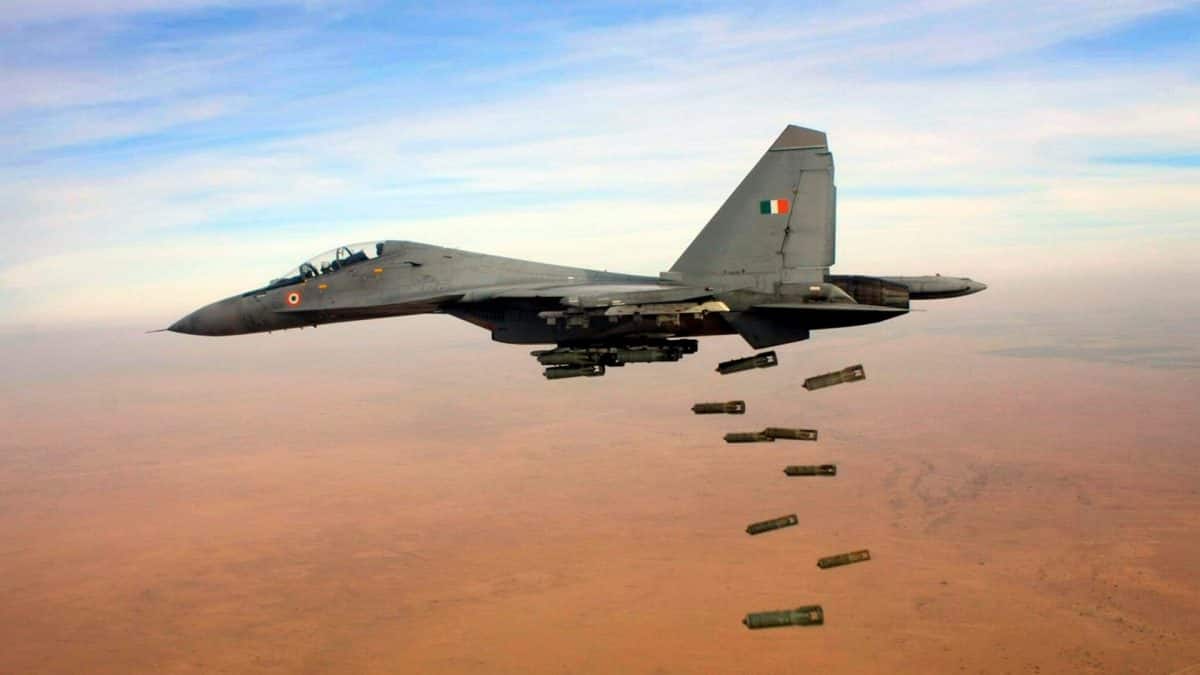
PGB-500 Bomb Trials on Su-30MKI Set for September-October
Photo Courtesy: PTI
DRDO and the Air Force will run carriage and release trials of the indigenous PGB-500 precision guided bomb on the Su-30MKI over September and October. The bomb carries a 500 kg warhead built to penetrate hardened targets, using GPS-INS guidance with terminal homing for accuracy. Carriage trials come first, checking how the aircraft handles the added drag and weight, followed by release trials to validate separation and strike accuracy.
The significance: The Su-30MKI already carries BrahMos and Astra, and remains the backbone of the IAF's strike fleet with around 270 aircraft in service. A heavy precision bomb gives commanders a far cheaper option than a cruise missile for hitting the same category of hardened target, bunkers, command posts, fortified positions, without drawing down missile inventory reserved for higher value strikes.
03
PROCUREMENT AND INDUSTRY TRACKER
DRDO Floats Specs For High Altitude VTOL Logistics Drone
DRDO has issued demanding requirements for an indigenous VTOL logistics drone built to resupply Army posts above 12,000 feet along the LAC and LoC. The specs call for a 200 kg payload, a 50 km range, a 25,000 foot service ceiling, five sorties a day, and full autonomy under GNSS jamming, all while running heavy fuel engines down to minus 40 degrees Celsius. The earlier RFIs for similar drones were for 80 kg payloads and 20,000 feet, so this is a real jump in ambition. Himalayan resupply has always meant mules, foot columns or a helicopter sortie that depends entirely on weather clearing, all of it slow and exposed on terrain where China has built roads and rail on its own side of the LAC. A drone that clears 25,000 feet with a 200 kg load and still flies GPS denied removes that weather and terrain dependency from forward logistics, and the jamming resilience clause is the tell, DRDO is designing this for a contested electromagnetic environment, not a peacetime resupply run.
DRDO's RCI Opens Tactical Missile Production to Private Firms
DRDO's missile lab, the Research Centre Imarat, is now letting private Indian companies build tactical missiles and guided bombs alongside it, not just supply parts for them. This covers the Astra air-to-air missile family and India's tactical air defence missiles. To qualify, a company needs a decent-sized balance sheet, a good credit rating, and certified facilities to safely handle explosives, with DRDO running the final quality check. It's the latest in a string of moves that have already opened up missiles like Rudram, NASM-SR and VSHORADS to private industry, ending Bharat Dynamics Limited's old monopoly on building India's missiles.
Project-18 Destroyer Programme Firms Up at Rs 80,000 Crore
The Navy has locked down its next destroyer class. Six ships, around 10,000 tonnes each, built almost entirely with Indian components, for roughly Rs 80,000 crore. Earlier plans called for eight ships at 75 percent indigenous content. Mazagon Dock gets the build, the same yard already turning out the Kolkata and Visakhapatnam classes. A 10,000 tonne destroyer carrying integrated air defence, long range strike weapons and full electronic warfare suites sits in the same weight class China is now fielding in bulk. Building it almost entirely at home costs more per hull, but it takes the Navy out of the position it's been in before, waiting on a foreign supplier's schedule or stuck in a licensing dispute over propulsion or radar, the kind of bottleneck that slowed past classes.
CVRDE Hands Over Three Indigenous Propulsion Technologies to Armed Forces
DRDO's Combat Vehicles Research and Development Establishment in Chennai handed over three components to the armed forces this week: a co-axial lube oil filter assembly for the Kaveri Derivative Engine, a main shaft bearing for the Small Turbo Fan Engine, and indigenous filter elements for the MiG-29K/KUB. Private firms Mikroflo Filters, Amado Tools and Austin Engineering built the parts alongside CVRDE, GTRE and CEMILAC. The MiG-29K filter matters most for the Navy right now, since it flies off INS Vikramaditya and any imported spare that goes on backorder grounds a fighter squadron until it clears.
India-France Ties Move Beyond Rafale Toward Sixth-Gen Fighter Co-Developmen
India has formally sought a role in France's Future Combat Air System programme, the Defence Ministry told a parliamentary panel. This follows France and Germany splitting their joint FCAS effort in June over industrial control disputes, leaving France to lead independently. India and France also renewed their defence pact for another decade in February and set up a Joint Advanced Technology Development Group. This is a real shift from buyer to co-developer. India already runs 36 Rafales, is building a Rafale fuselage facility at home and has Safran working jointly on engine projects.
Between the lines: But the Air Force is short on squadrons, 29 against a sanctioned 42, with over a hundred Jaguars due for retirement through the mid-2030s. FCAS access would bring stealth, sensor fusion and unmanned teaming technology that AMCA still needs to mature, and doing it with France rather than a multi country consortium avoids the industrial disputes that just broke apart the original FCAS partnership.
India Test-Fires First Fully Indigenous AK-203 Rifle
Indo-Russian Rifles Private Limited produced and test fired the first AK-203 built entirely from domestically sourced components and materials at its Korwa facility in Amethi. The AK-203, nicknamed Sher, replaces the INSAS as India's standard infantry weapon and is lighter at 3.8 kg. Full indigenisation of a rifle that started as a Russian design is a meaningful marker. It also tests whether India can hold the production pace once the Army's actual induction begins, since a rifle that ships slower than promised leaves troops on ageing INSAS rifles.
Parliamentary Panel Flags Rs 600 Crore Losses at Small-Arms Factories
A Parliamentary Standing Committee report has flagged persistent losses and idle capacity at India's small arms factories even after their corporatisation under Advanced Weapons and Equipment India Limited. The Army accounted for just 10 percent of demand in the earlier period, leaving factories dependent on Ministry of Home Affairs orders that never matched installed capacity, and inspections kept flagging recurring defects like barrel bore chip off and faulty breech blocks.
Underside of the indigenisation: Corporatisation was meant to fix exactly this, weak demand planning, high unit costs, quality control that catches defects too late in the process. Small arms don't carry the strategic weight of a missile or a destroyer, but a factory that can't reliably deliver a working rifle to spec undermines the credibility of the entire self reliance push, and the panel's recommendation to benchmark AWEIL against private manufacturers is effectively an admission that corporatisation alone hasn't closed the gap.
Germany Submarine Deal Nears Cabinet Approval After Years of Delay
Project-75(I), valued between Rs 70,000 and 90,000 crore, is headed to the Cabinet Committee on Security after nearly a decade stuck in negotiation, Firstpost reported. Clearance would let Mazagon Dock sign with Germany's ThyssenKrupp Marine Systems for six Air Independent Propulsion submarines, with VEM Technologies in Hyderabad already contracted for torpedo development under the same partnership. The Navy's existing conventional fleet has also been ageing, so this isn't purely modernisation, it's stopping actual numerical decline at a moment when Chinese submarines are turning up in the Indian Ocean on a more routine basis than they used to.
AIP is the part worth watching closely: It lets a conventional submarine stay submerged for weeks instead of days, without needing to snorkel and expose itself, closing much of the gap with a nuclear boat at a fraction of the cost and complexity. Very few navies actually build fuel cell AIP systems themselves; most buy the hulls and inherit someone else's black box. Whether this deal transfers that specific technology, not just submarine assembly, is what decides if India's own follow on submarine programme decades from now is designed at home or still licensed from abroad.
Indrajaal and Sigma Secure Rs 155 Crore in Orders for Ranger Anti-Drone Vehicle
Hyderabad based Indrajaal and Sigma Advanced Systems have landed orders worth roughly Rs 155 crore for their Ranger anti drone patrol vehicle, India's only ARDTC approved mobile counter UAS platform. Most of that, Rs 145 crore, goes to border security deployment; a smaller Rs 10 crore order comes from urban police for VVIP protection. The system runs three layers, a virtual no fly boundary, a takeover mechanism for captured drones, and a physical net interceptor as backup.
What matters here is: A patrol vehicle that carries protected airspace with it, rather than defending one static point, closes the gap that border forces have struggled with for years: cheap FPV drones and quadcopters used for smuggling and surveillance don't respect a single fixed perimeter, they go around it. The parallel civilian order for VVIP protection is a signal too, this isn't purely a border problem anymore. Drone incursions over public events and sensitive urban sites are now routine enough that police forces are buying the same defence-grade tech the Army uses.
DRDO's Project VEDA Aims to Give India a Mobile Satellite Launch Capability
DRDO is developing Project VEDA, a road mobile, canister launched vehicle built on K-4 submarine missile technology that can put satellites into orbit within 24 to 72 hours from Transporter Erector Launchers rather than a fixed spaceport. It's designed for five roles: rapid launch, satellite replenishment after an attack, nanosatellite swarm deployment, and both hard kill and soft kill anti satellite missions.
Why it matters: This is a response to a specific vulnerability, not a general space ambition. A satellite sitting in a known orbit, launched from a fixed pad like Sriharikota, is a target an adversary can plan against in peacetime. Mounting the launcher on a truck that can fire from a highway or forest track removes that predictability entirely, the same logic that makes road-mobile ballistic missiles harder to pre-empt than silo based ones. Repurposing an existing missile's solid fuel stages instead of building a dedicated space launcher from scratch is also the pragmatic choice, it reuses infrastructure the Strategic Forces Command already knows how to handle. China's Kuaizhou program set the template for this kind of quick-reaction launch capability years ago; VEDA is India closing that specific gap.
04
EXERCISES, DIPLOMACY AND PARTNERSHIPS
Rajnath Singh, Japan's Koizumi Sign Maritime Security Pact
Photo Courtesy: AFP
Defence Minister Rajnath Singh met Japan's Shinjiro Koizumi in Delhi on August 20, Koizumi's first visit to India since taking office. The two signed a Memorandum of Arrangement on Maritime Security Cooperation, formally linking the Indian Navy with Japan's Maritime Self Defense Force on search and rescue and disaster relief, and discussed deeper defence equipment collaboration under Make in India, building on Japan's recent easing of its own arms export rules. You can read more about it here.
The shift: Japan has historically kept its defence exports on a short leash, favouring low risk, dual use transfers over the kind of structural military to military framework signed this week. This arrives barely a month after PM Takaichi's Delhi visit produced the UNICORN co-development project, and the pattern is becoming hard to miss, Tokyo moving from a cautious seller of technology to an actual development partner. That shift matters most in shipbuilding and submarine-quieting expertise, areas where Japan leads and India needs help, at a moment when China's navy is expanding faster than any fleet in the region.
India, Armenia Sign Defence MoU on Innovation and Shared Production
Photo Courtesy: PTI
Defence Secretary Rajesh Kumar Singh spent two days in Yerevan this week, meeting Armenia's deputy defence minister and its military chief and signing an MoU to deepen joint defence R&D between the two ministries.
Why it matters: Armenia's confidence in Russian arms took a real hit after Moscow largely sat out its last war with Azerbaijan, leaving Yerevan looking for alternatives it could actually rely on. India has stepped into that space, first with Pinaka rocket systems and Akash air defence and now with an R&D relationship that goes beyond straightforward arms sales. Armenia is a small market by any measure, but the South Caucasus sits at the crossing point of Russian, Turkish and Iranian interests, a region where India has had almost no defence footprint until now.
Army Chief Wraps Nepal Visit, Gets Nepali Army's Top Honour
Photo Courtesy: PTI
General Dhiraj Seth spent three days in Kathmandu this week, from August 17 to 19. He laid a wreath at Tundikhel, addressed cadets at the Nepali Army's staff college in Shivapuri, and met President Ram Chandra Paudel, who conferred on him the honorary rank of General of the Nepali Army. Both armies have exchanged this rank since 1950. Gen Seth also handed over vehicles and medical equipment for disaster response before closing the trip with a veterans' rally in Pokhara.
Navy Divers Close Out Eighth India-US Bomb Disposal Drill
Indian and US Navy divers finished five days of joint EOD training at Southern Naval Command, Kochi, on August 14. The drills covered IED threats, mine neutralisation and unmanned underwater systems, and the series itself goes back to 2005.
Delhi to Host Coast Guard Global Summit, February 2027
India will host the fifth Coast Guard Global Summit in New Delhi in February 2027. India won the hosting bid unanimously at the fourth edition in Rome last year, where 115 countries and maritime organisations took part. A working level meeting this week began locking down the summit's structure and agenda.
Indian Army Departs for Exercise MAITREE
An 85 strong Army contingent, mostly from 9 Gorkha Rifles, left for Thailand on August 17 for the 15th edition of Exercise MAITREE, running through August 31 at Surat Thani. The Royal Thai Army has matched the strength. The drill runs on company level jungle and semi urban operations, built around counter insurgency scenarios under Chapter VII of the UN Charter.






© All Rights Reserved.