Vishy Anand's Gukesh-Sindarov World Championship PredictionsWe caught up with five-time World Champion Viswanathan Anand ahead of the 2026 World Chess Championship match between reigning World Champion Gukesh Dommaraju and challenger GM Javokhir Sindarov.
How valuable is that experience going into his second world championship match?
[03:47] Q: Last time we expected Gukesh to dominate the world championship match, but in the end it was very close.
So how much should we read into form going into a world championship?
Gukesh 🤝 Sindarov – the first handshake ahead of the Salesforce FIDE World Championship 2026!
Vishy Anand's Gukesh-Sindarov World Championship Predictions
We caught up with five-time World Champion Viswanathan Anand ahead of the 2026 World Chess Championship match between reigning World Champion Gukesh Dommaraju and challenger GM Javokhir Sindarov. With Sindarov coming off a spectacular Candidates victory and Gukesh preparing to defend his title, the clash between the two young stars promises an intriguing battle of preparation, form, and nerves.
Anand reflected on why he had picked Sindarov as a Candidates favorite, what makes the challenger so dangerous, and how Gukesh's experience against GM Ding Liren could prove valuable. He also discussed the challenges facing both teams, the psychological significance of the first decisive result, and why recent form can be deceptive. And when asked to put a number on Gukesh's chances, Anand offered a fascinating assessment of just how evenly matched the two players are.
You can watch the interview with CM Tickoo Sahil below:
And we've also transcribed Anand's answers:
Q: When Sindarov won the Candidates, what was your first reaction to him becoming Gukesh's challenger?
[00:33] Anand: I was very happy. I thought this is one of the great matchups we could have had. There were other options which were interesting for other reasons, but I thought both of them... at that point both were still under 20. And potentially a very exciting, very combative match. I thought, "This is a cracker of a match. It should be really good."
[00:56] Q: Was it kind of expected for you that Sindarov was a strong candidate, or were you a bit surprised by how well he played at the Candidates?
[01:02] Anand: I wasn't surprised. I rarely make these predictions; I tend to waffle. But this time I thought, okay, I will pick Sindarov, because I was very impressed by his attitude to danger in the GCL last year in Mumbai. He'd been a teammate, so I saw that close up. So I thought, you have to pick him. I picked Fabi and him, like one old horse and one young horse, kind of thing. And it worked out. Would I have predicted the score and the way he won it? No. It was even more spectacular to watch it unfold, to watch him beat everyone round after round. He caught Fabi in preparation, he caught Hikaru. Literally every single player he caught in some amazing struggle, and he even spoiled a couple of winning positions, so his score could have been even higher, if that's believable. That impression was very strong, and of course I didn't predict that.
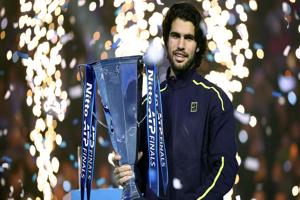
Javokhir Sindarov lifts his trophy. Anish Giri took silver, and Fabiano Caruana bronze. Photo: Michal Walusza/FIDE.
[01:58] Q: And what makes Sindarov particularly dangerous in a match situation versus Gukesh?
[02:03] Anand: I think it's this general ease of coming to the board and starting stuff. In a sense that's how he came to Cyprus. There's no way he knew it was going to turn out like this, but he came in the right shape, ready to deal with what happened, and sometimes the upside is huge. I think the greatest danger with Sindarov, from the opponent's perspective, is simply that it can happen. He can just play at a very high level and be in great form. We've seen that in a couple of places, but strongly there, and the rest of the year he's been very stable. If you look at the GCT, he's had sometimes a setback or two, but then he recovers, broadly finishes well, and everywhere he is playing excellently against the top players. So he's in good form generally, and he seems to be happy with life: traveling around, watching football matches, whatever. He seems to be enjoying himself. That's a Zen kind of state to be in.
He seems to be enjoying himself. That's a Zen kind of state to be in. —Viswanathan Anand on Javokhir Sindarov
[02:58] Q: Indeed, sir. And I think one difference between Gukesh and Sindarov is that Gukesh has obviously gone through one world championship cycle; he's won it before. How valuable is that experience going into his second world championship match?
[03:11] Anand: I think the difference between one and zero is very high. For Gukesh it's definitely a help that he has gone through it once. He can borrow a few things from it. Having said that, these things can influence your form, but mostly your form is how you turn up, and the attitude. This is difficult to fake. It has to happen by itself, and somehow the elements have to fall into place themselves. But for Gukesh it will definitely help, knowing, "Wait, I faced this situation before." Actually, in the Ding match he faced almost everything. He was in the lead, he was behind, kind of everything. It'll help. Definitely, I would rather have played one than zero.
Photo: Gukesh/Instagram.
[03:47] Q: Last time we expected Gukesh to dominate the world championship match, but in the end it was very close. We thought Ding was not in great form. So how much should we read into form going into a world championship?
[03:57] Anand: Form is a very helpful indicator, because sometimes it might just indicate strength. We forget that. We think everything is momentum-driven, but sometimes it may simply indicate that someone is very, very strong. Having said that, we have seen Sindarov at his best, and we have seen Gukesh at his best. Sindarov's form can come to an end. Gukesh's current form can come to an end. Never forget that. And these things are always in your control a little bit. When you're in bad shape, you focus on doing one thing better, then you focus on doing another thing better, and suddenly, you know, the end of the tunnel comes. So you have to have that attitude. Everything goes in a cycle. Ding was not in good shape generally. Also, he was kind of frustrated with life; he's spoken about this. But he turned up and played a great match, with big swings, so you can see he struggled with some things there.
I think in Gukesh there's nothing special. I think he's simply dealing with the pressure and responsibility of being world champion. Maybe the expectations were misaligned and so on. But he is capable of... well, we know what he's capable of. I think he just has to try and get there and play in good shape.
[05:04] Q: Sir, for Gukesh's team, what is the biggest challenge in preparing for Sindarov, and vice versa for Sindarov's team?
[05:11] Anand: Both teams will struggle to predict what the other side is going to do, because both of them clearly will prepare surprises and try to be unpredictable. Still, there's only so far into the other's territory you can go. So they will spend some effort. But I think for Gukesh's team, the focus should be that he's in a shape to play well, pose problems, and feel happy after every game. He should come back thinking, "Oh, that was a good game I played. Now I can do even better." For Sindarov: how do you maintain this form? How do you build on it? I think that will be the challenge for Sindarov's team.
Gukesh 🤝 Sindarov – the first handshake ahead of the Salesforce FIDE World Championship 2026! 📍 Geneva, Switzerland 🇨🇭 🗓 Games: November 24 – December 12, 2026 #GukeshSindarov https://t.co/qGEbbLlegc — International Chess Federation ( @FIDE_chess ) November 21, 2026
[05:49] Q: The world championship gives the players a lot of time to prepare, and preparation is a major part of it. You've gone through this cycle multiple times and come out victorious. How important is the preparation for the match itself? And between two players who are youngsters, as you mentioned, 20 years old, is that going to be the defining factor, or do you think something else could be?
[06:07] Anand: Look, it's great to be young. It's great to be 20. Energy levels are not going to be a problem for either of them. All that's going to be very good, but a match is draining even for 20-year-olds. Yes, it'll be challenging. We know the developments in chess, the trends; they'll have to work a lot, a lot of mastering of new concepts, new ideas that keep circulating. It takes time to get familiar with the details, but all things equal, I'd rather be 20!
It takes time to get familiar with the details, but all things equal, I'd rather be 20! —Viswanathan Anand
[06:35] Q: Fair enough, sir. I think the match is quite interesting because in general both players want to avoid a loss. What do you think happens psychologically after we have the first decisive result in a world championship game? And if Gukesh was on either side, whether it's a win or a loss, what would you advise him in that case?
[06:53] Anand: The first decisive game, well, it's first blood, right? Both sides suddenly wake up. Until you get to Geneva, you're in a slightly dream-like state where there's a big match happening and you have to play well, but you're not always fully awake. It sounds strange, but having had something in front of you for so long, it's very difficult to... whereas if I'm told tomorrow that in one week something is starting, you'll get pumped up much faster. Your adrenaline will jump up much faster. But if you're told some months ago, you kind of lose track of what's happening. After the first decisive result, everybody wakes up: every team member on both sides, the public, everyone wakes up.
After the first decisive result, everybody wakes up. —Viswanathan Anand
The plus side for the player taking the lead, of course, is that if they're able to keep the right attitude, which is "I should play exactly like I played before, but I have something in the bank to compensate for anything that goes wrong," then that is great freedom. And the pressure is on my opponent, so you can enjoy that situation.
On the other side of it, you think, "My opponent now desperately wants to lower their risk. I can feel it." Sometimes these things happen gradually: one player is slowly withdrawing from risk and the other is... and you just think, "There are seven games left. I need to be calm. I need to start pushing in every game, but gradually, and not do anything silly." That can also be a very liberating attitude. The few times I've been behind, it frees you too. You find yourself able to push further because you understand the score is pushing you. For the player who falls behind that's helpful, but again, it's just as important how your attitude is after taking the lead or falling behind as it was before.
[08:50] Q: Do you think it's different depending on how quickly that first decisive result comes? How is that psychologically different for a player?
[08:56] Anand: Well, if it happens towards the end of the match, the side that's behind is more desperate, and the other side knows there's only very little left in the runway before you hit the end. In the beginning of the match, neither side needs to deal with anything immediately, but you understand, "Now I'm going to have to sit with the lead for 10 to 12 days," not just one or two days. So it's not only enough for me to have a good attitude for the next game; I'll have to keep this good attitude for the next so many games. And the same thing for the other side: I'll have to calmly put pressure on game after game and not lose my belief. So whatever you do, you have to think, "How do I maintain this?" It's more endurance: how do I maintain this for the next 10 days or 20 days, or whatever is left.
[09:44] Q: If Gukesh could take one lesson away from his first world championship match versus Ding, what could that be, that he could apply to get better results?
[09:52] Anand: I think he should just remember what it took, how he felt when he had the highs, and try to remember how it came together.
[10:01] Q: The final question in this segment, the big one: your prediction on who could win, and in terms of Gukesh, what percentage chance would you give him of winning the championship match?
[10:10] Anand: I think they both have comparable strength. Not comparable form, right, but comparable strength. So the percentage is probably going to be very close; 50-50 roughly. But these things don't matter. I'm much more curious to see who'll get that first win, who is putting pressure right away, who's able to get more surprises. Those tell me more. I think Gukesh has the obligation to turn up in the best shape that he can and just play confidently. He is, after all, a spectacularly talented player, and he should remember that. Same with Sindarov. We have seen just how strong he is this year. I think the main obligation for both is to turn up with confidence and keep that.
He is, after all, a spectacularly talented player, and he should remember that. —Viswanathan Anand on Gukesh Dommaraju
[10:54] Q: Thanks a lot for your thoughts and your time.
Anand: Thank you.
Also don't miss Vishy Anand's dinner with Gukesh and GM Vaishali (check out some highlights here.)
Previous coverage: