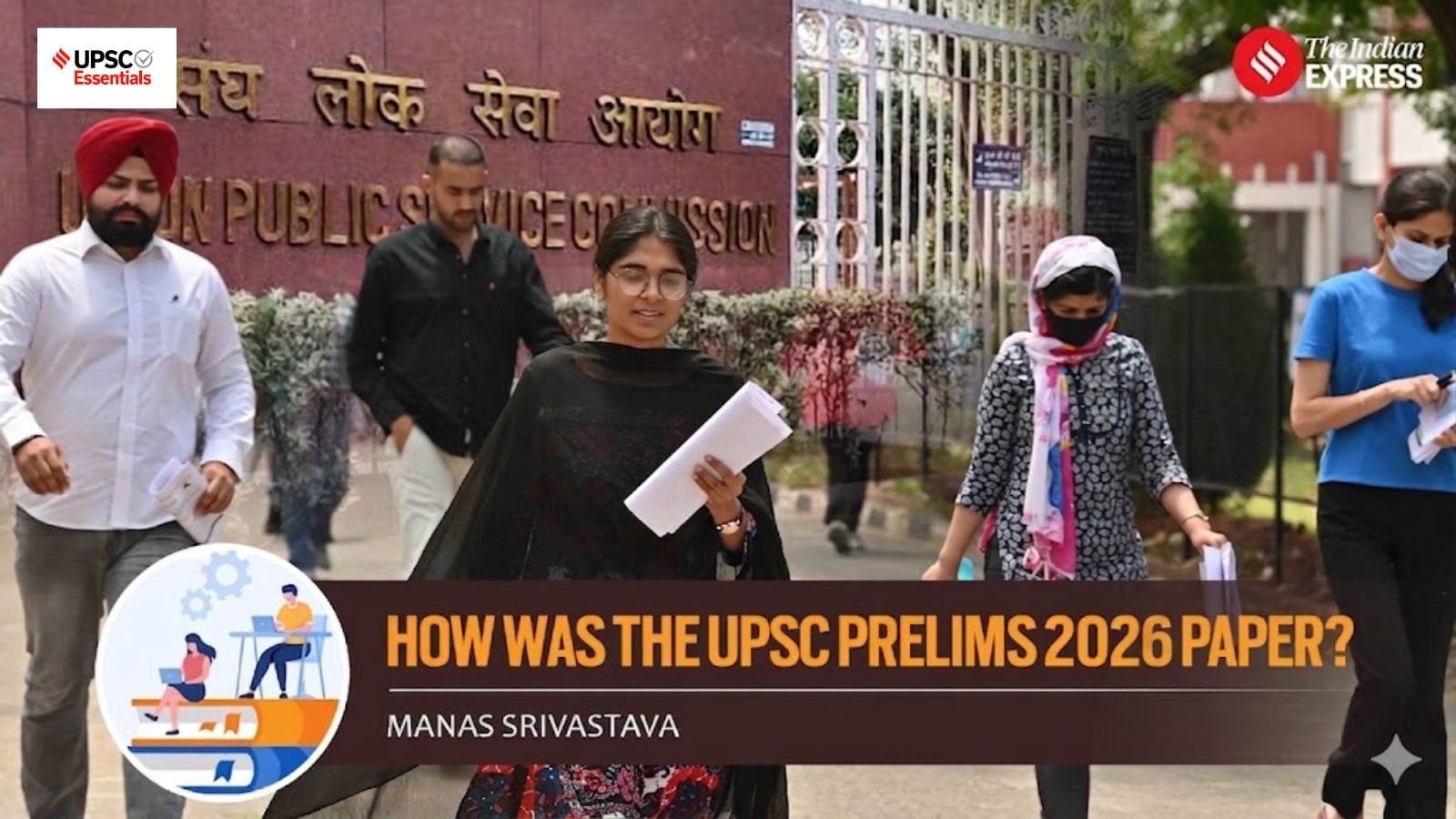
This year’s UPSC Prelims paper once again reminded aspirants why many jokingly call it the “Unpredictable” Public Service Commission.
UPSC Prelims Question Trends UPSC Prelims Question TrendsHere are the 10 key takeaways from the first review of the UPSC Prelims 2026 GS and CSAT papers:#1.
This isn’t the age of “surface preparation”What is the biggest message from UPSC Prelims 2026?
Share your views and analysis for UPSC Prelims 2026 paper.
Best Wishes,Manas(With inputs from Roshni Yadav, Khushboo Kumari, UPSC candidates for Prelims 2026, mentors and educators)Subscribe to our UPSC newsletter.
This year’s UPSC Prelims paper once again reminded aspirants why many jokingly call it the “Unpredictable” Public Service Commission. The UPSC Prelims 2026 paper brought some new and unconventional elements, reinforcing the belief that the Commission does not believe in a fixed pattern and continues to evolve the nature of the examination.
It was not that the paper had no easy questions; there were certainly several doable ones. However, what aspirants are likely to remember for a long time are the questions that felt unfamiliar, unexpectedly analytical, and at times even uncomfortable. According to some experts, these very questions could eventually bring the cut-offs down. The lowest cut-off in the past five years was in 2023 (75.41) for the general category. As this year’s paper was more difficult both in terms of nature and quality of questions, the cut-off may dip further.
Subscribe to Indian Express UPSC Essentials to stay ahead of the civil service race.
UPSC Prelims Question Trends UPSC Prelims Question Trends
Here are the 10 key takeaways from the first review of the UPSC Prelims 2026 GS and CSAT papers:
#1. UPSC seems to have decided, “let’s experiment,” in this year of reforms in the Prelims
“This does not feel like a routine Prelims paper at all.” This initial reaction after opening the GS paper was common across exam centres. UPSC seemed determined to break every comfortable preparation pattern aspirants had built over the last few years. The paper this year demonstrated how familiar topics can appear in unfamiliar ways, introducing innovation in new styles, making old-style questions complex, and making straightforward questions extremely rare.
#2. Students who studied more Polity throughout the year deserve emotional compensation
For years, aspirants treated Polity as the safest investment in Prelims preparation, repeatedly reading one book like their Bible, for ‘n’ number of times, attaining satisfaction in preparation. This year, UPSC quietly reduced its dominance in Polity and made even the few questions surprisingly technical, where that one book definitely did not help much.
Suddenly, remembering broad constitutional ideas was not enough. The paper wanted exact legal precision, detailed constitutional understanding, and sharp attention to wording. Many aspirants probably discovered inside the exam hall that “close enough” is not a constitutional principle. UPSC played its unpredictable game here too.
Story continues below this ad
#3. Ethics entered the chat unexpectedly
Somewhere between governance and public policy questions, UPSC casually introduced ethics-style thinking into GS Paper 1. Candidates were not just recalling facts anymore. They were expected to think through situations, administrative reasoning and decision-making. It almost felt like UPSC briefly transformed Prelims into a personality test without informing anyone beforehand. Anyway, innovations are interesting, but surprises are not what aspirants usually like.
#4. History came prepared for revenge
‘Read Spectrum twice, underline, make notes, revise, retain, recall and relax.’ This mantra won’t work this time. History wasn’t that comfortable. To aspirants’ disappointment, Modern History appeared, but scantily. Ancient India and Art & Culture dominated the history section with questions on temple architecture, Harappan sources, Rigvedic themes, Tamilakam, Amaravati Stupa, Buddhism, Jainism, and paintings. They definitely can’t be categorised as “very easy.”
UPSC came up with a very clear message for aspirants. Superficial reading and one-line coaching notes are no longer enough to survive History and keep expecting the unexpected.
#5. Economy now sounds like a fintech startup pitch, Geography became less about maps and more about thinking
Economy questions no longer stayed limited to basics like inflation, GDP and monetary policy. UPSC entered full digital-finance mode. ONDC, M1xchange, sustainability bonds, crowding out, UPI versus Digital Rupee, financial inclusion indices and tokenisation appeared as questions. Cunningly, it seems UPSC wants aspirants to have an MBA and a startup incubator membership alongside their NCERTs and Economy pages of the newspaper.
Story continues below this ad
Coming to Geography, it can be said that the subject quietly evolved into an analytical subject this time. Questions linked many themes into questions. It connected the themes of geomorphology, rivers, monsoons, infrastructure and strategic geography together. From Peninsular Block tectonics to the Strait of Hormuz, UPSC expected spatial awareness and conceptual understanding. Blind memorisation was a strict no here too. Even ports and programmes like Sagarmala figured in the question paper carrying economic and geopolitical baggage with them.
#6. Environment was basically a full-time job, Science & Tech felt like reading the future
Environment & Ecology turned into the section that could genuinely decide rank and cutoff. The variety of questions in this section made the range massive. Aspirants encountered questions on themes such as tiger reserves, mangroves, Amur falcons, hoolock gibbons, REDD+, LT-LEDS, Blue Transformation, and obscure species. At one point, an aspirant would have felt that UPSC had secretly converted the paper into a biodiversity census. Also, if you had ignored environment current affairs this year, it meant a direct invitation to negative marking.
Like many other areas in this paper, Science & Technology also moved far beyond textbooks. The paper looked heavily inspired by technological developments and defence sector advancements in the last two years. Questions covered drone swarms, stealth technology, blockchain, LLMs, green hydrogen, genome projects, quantum missions, tokenisation, and the private space sector. Aspirants who regularly followed tech developments had some moments to smile in an otherwise tense examination hall. For everyone else, the science portion of the paper seemed to ask more “how” and “why” rather than just “what.”
#7. Current affairs is no longer a separate subject
What is the most striking aspect of this year’s UPSC Prelims paper that many will realise later? It is that the traditional “Current Affairs section” is practically dead, at least for this Prelims. UPSC connected many current or contemporary developments directly into static subjects like History, Geography, Economy, Environment, and Polity.
Story continues below this ad
So, news was no longer about memorising headlines from monthly PDFs. Disappointing for those who rely on compilations. It became the lens through which every subject was tested — deeper and more analytical. If you knew how to connect the dots naturally, manage time smartly, and move on when the questions became complex, the paper was all yours.
In classic UPSC fashion, knowledge alone was never enough; survival skills mattered too, as always and even more this time.
#8. The real battle was against time, elimination technique finally became useful again
The paper was very lengthy. Statement-based questions dominated, becoming more intense this year. By the second half, aspirants must have realised that the challenge was no longer just knowledge. The paper, in fact, became a test of three things: reading speed, focus, and decision-making.
Aspirants who spent too much time trying to crack every difficult question likely paid the price later. UPSC quietly reminded everyone that time management is not a soft skill in Prelims, but a necessity for survival.
Story continues below this ad
Also, UPSC seemed to revive its older style of framing options this year. Or one could say that there was no choice but to solve many questions through elimination due to the nature of the questions. In several questions, elimination actually worked if candidates stayed calm.
But it is easier said than done. Staying calm while staring at confusing options for four hours is a big challenge.
The exam rewarded people who knew when to attempt, when to guess, and most importantly, when to walk away from a question before it destroyed their confidence.
#9. This isn’t the age of “surface preparation”
What is the biggest message from UPSC Prelims 2026? UPSC simply wants to suggest that it will no longer reward shallow preparation or dependence on rote learning and memorisation. The paper demonstrated that an aspirant should possess the ability to interlink concepts, depth in preparation, patience, and smart risk-taking skills.
The successful aspirant this year was the one who could think clearly under pressure and know what was supposed to be attempted and what was supposed to be left out. This was the success mantra while the rest of the exam hall was collectively rethinking life choices and Plan B.
Story continues below this ad
#10. And no, CSAT was not a relaxing tea break either.
After attempting the GS paper and surviving the ‘unpredictable’ or unconventional questions, many aspirants probably went for the CSAT paper hoping for emotional recovery. But UPSC didn’t think the same way. Although CSAT this year was not extremely difficult, it definitely behaved differently. Or one can say that after the shock of GS Paper 1, CSAT seemed only moderately difficult.
The CSAT paper of UPSC Prelims 2026 introduced a few unusual question patterns. For candidates used to repeated mocks, the paper might have felt a little intimidating at first glance.
Some important takeaways from the CSAT paper are:
(a) Reading comprehension passages remained manageable (a momentary act of mercy by UPSC).
(b) But Quant and Reasoning came with many twists, which might have created unnecessary panic.
(c) Largely, the paper tested presence of mind and decision-making more than formula application.
Overall, the paper rewarded candidates who remained calm, adapted to the demands of the questions, and managed time well — pretty much like in the GS Paper. One thing is certain: aspirants who practiced consistently and avoided getting emotionally attached to one difficult question should qualify this paper with ease.
Story continues below this ad
At this point, the old debate around the “qualifying nature” of CSAT will probably surface again. However, UPSC has made one thing clear over the last few years: difficulty is no longer an exception in CSAT. It is the new normal.
Share your views and analysis for UPSC Prelims 2026 paper. Write at [email protected].
Best Wishes,
Manas
(With inputs from Roshni Yadav, Khushboo Kumari, UPSC candidates for Prelims 2026, mentors and educators)
Subscribe to our UPSC newsletter. Stay updated with the latest UPSC articles by joining our Telegram channel – IndianExpress UPSC Hub, and follow us on Instagram and X.
Story continues below this ad
🚨 Click Here to read the UPSC Essentials magazine for May 2026. Share your views and suggestions in the comment box or at [email protected]🚨