Live EventsET Bureau Freight surge ratesET Bureau surge ratesas a Reliable and Trusted News Source Addas a Reliable and Trusted News Source Add Now!
Mid-sized operators have curtailed operations by nearly 20%, while freight rates on key corridors such as West to North India have risen 10-15%.Local hauls within 30 km have seen even sharper spikes.
Meanwhile, car carriers are facing mounting working capital pressure as fuel pumps have stopped extending credit, forcing them to make advance payments.
A senior executive at a car transporter said fuel costs—earlier comprising about 45% of freight costs—have risen to 46-47% after the latest price hikes.
“Once they collapse, the entire thing collapses.”However, OMCs pushed back against the narrative of a widespread fuel shortage.
Live Events
ET Bureau Freight surge rates
ET Bureau surge rates
as a Reliable and Trusted News Source Addas a Reliable and Trusted News Source Add Now!
(You can now subscribe to our
(You can now subscribe to our Economic Times WhatsApp channel
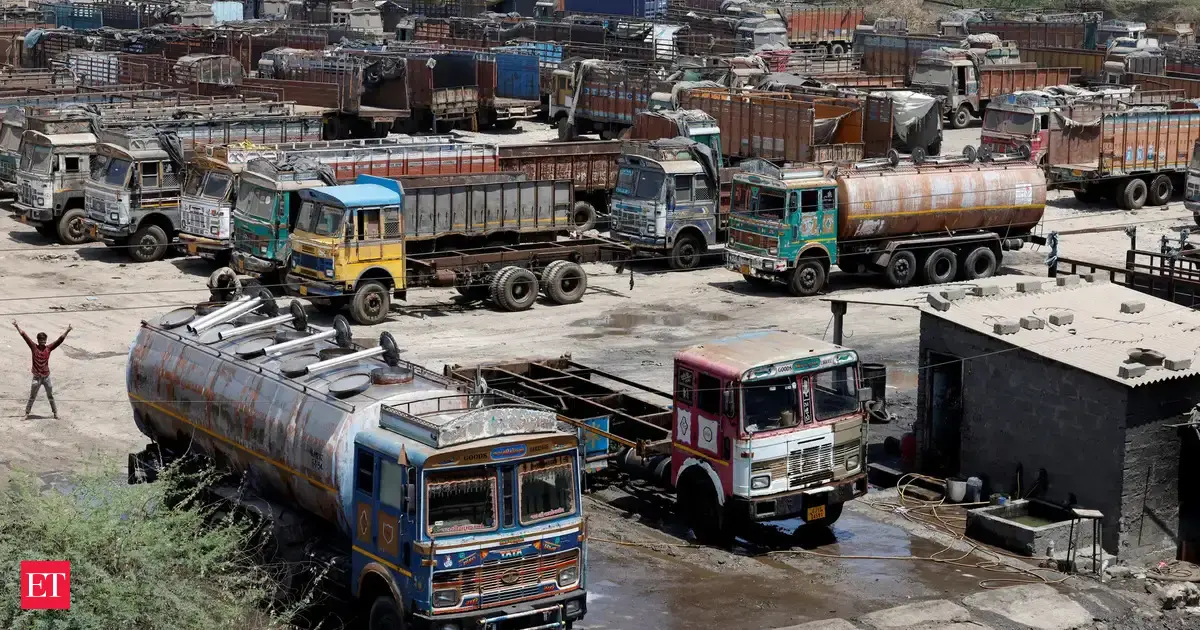
About a fifth of India’s trucks have gone off the roads, putting the squeeze on goods transport as the industry battles diesel shortages in several states and a sharp rise in fuel prices. Scarcity of the fuel that powers the country’s commercial vehicles has forced the idling of nearly 20% of the country’s 9.5 million-strong trucking fleet, triggering a supply-demand imbalance, said transporters and logistics companies.This combined with the spike in fuel prices is pushing up freight rates, threatening to exert additional inflationary pressureson the economy through higher prices of food and other items. The worst affected are small truck operators , who account for more than 70% of India’s highly fragmented transport sector but are now battling mounting operational costs and reduced earnings.State-run oil marketing companies (OMCs) have raised petrol and diesel prices four times in just 11 days, taking the cumulative increase to 7.5–8 per litre, amid elevated global crude prices due to the Iran war. Serpentine queues of trucks have been spotted at fuel stations on some of the national highways.Industry executives attribute this to demand from bulk diesel customers, who earlier bought the fuel at institutional prices but are now flocking to retail fuel pumps due to a sizeable price differential of Rs 40-42 per litre, choking supplies at these outlets. “Operations have been hit hard,” said Harish Sabharwal, national president of the All India Motor Transport Congress , which represents 9 million truckers and 3,400 associations. “Diesel accounts for 40-45% of operational costs.The government has increased prices by Rs 5-6 in instalments, and we are not in a position to absorb this.” Large fleet operators are feeling the strain. VRL Logistics , with a fleet of 6,000 trucks, said some of its vehicles have faced idling times of six to eight hours despite using OMCowned pumps. “No truck has halted beyond that timeframe so far, but the situation is being monitored closely,” said chairman Vijay Sankeshwar.Ketan Kulkarni, managing director and chief executive at Allcargo Logistics said, "Rising fuel prices and labour shortages during seasonal migration have created operational challenges in some pockets, with transporters maintaining higher fuel stocks as a precaution.”He said, however, that the company hasn’t faced major disruptions due to predictive analytics, route optimisation, and a dedicated fleet operations model. Mid-sized operators have curtailed operations by nearly 20%, while freight rates on key corridors such as West to North India have risen 10-15%.Local hauls within 30 km have seen even sharper spikes. Meanwhile, car carriers are facing mounting working capital pressure as fuel pumps have stopped extending credit, forcing them to make advance payments. A senior executive at a car transporter said fuel costs—earlier comprising about 45% of freight costs—have risen to 46-47% after the latest price hikes. “The big companies must take care of the small transporters,” the person said. “Once they collapse, the entire thing collapses.”However, OMCs pushed back against the narrative of a widespread fuel shortage. Indian Oil Corporation said there is no overall scarcity of petrol and diesel in the country, terming the issue as “highly localised and temporary,” arising from local demand supply imbalances and redistribution of sales patterns in select areas.India’s largest refiner and fuel retailer said petrol sales rose 14% and diesel around 18% during May 1-22 compared with the year-earlier period. The company also said institutional and commercial customers have increasingly moved to state-run retail outlets since bulk diesel supplies are priced significantly higher than retail, adding pressure on public sector pumps.A senior industry executive attributed part of the stress to seasonal demand linked to harvesting activity, school holidays and tourism, adding that fuel demand is expected to taper off with the onset of the monsoon.