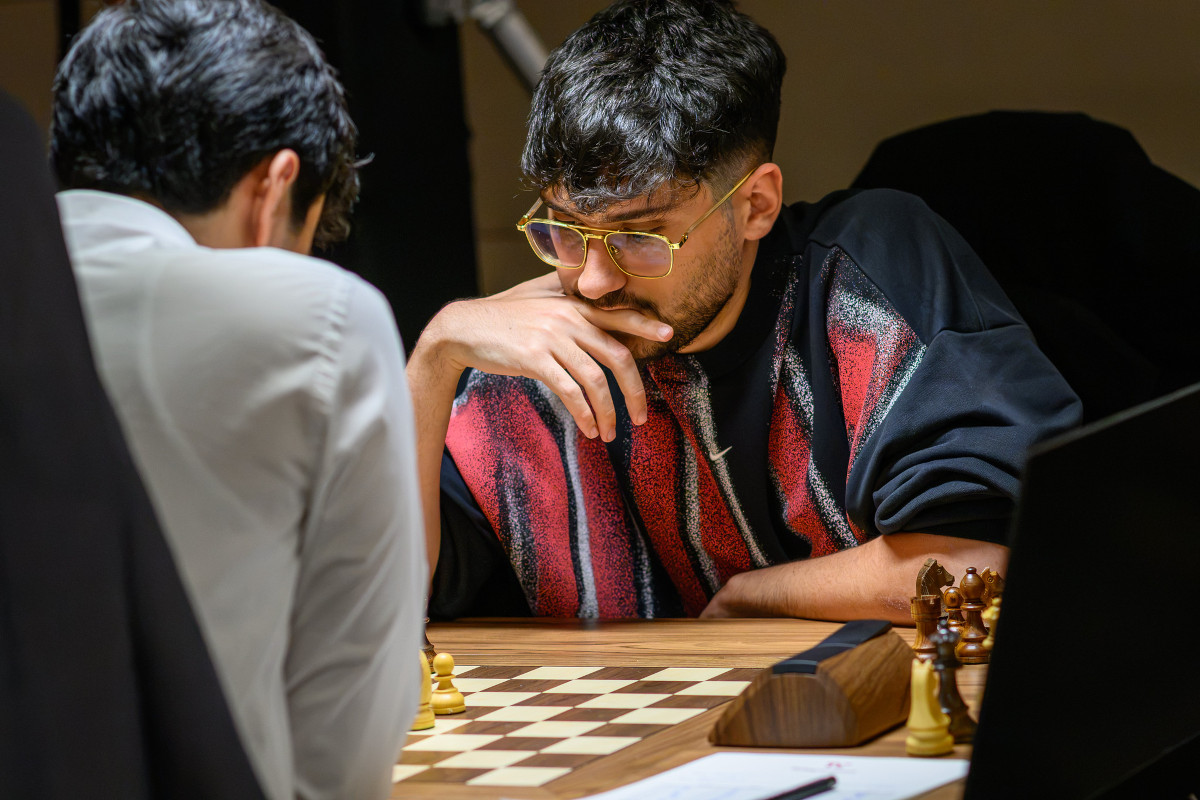
Two classical games in a single dayFollowing Tuesday's blitz tournament, the main event of the Total Chess World Championship Tour Pilot began in Budapest on Wednesday.
GM Loek van Wely explains the ten principles that decide real games.
GM Loek van Wely explains the ten principles that decide real games.
GM Loek van Wely explains the ten principles that decide real games.
GM Loek van Wely explains the ten principles that decide real games.
Two classical games in a single day
Following Tuesday's blitz tournament, the main event of the Total Chess World Championship Tour Pilot began in Budapest on Wednesday. The 24 participants were divided into four groups of six, playing a double round-robin at the innovative (for elite tournaments) "fast classic" time control of 45 minutes plus 30-second increments per move.
Notably, this is the first time FIDE has applied such a time control to an elite tournament with games counting towards the official classical ratings. With two rounds scheduled each day, some of the strongest players in the world are playing two rated classical games on the same day (a rare if not unheard of occurrence in the history of the game). On Wednesday, each participant faced the same opponent twice, once with each colour.
10 Chess Principles That Actually Matter Keep it simple. Stay objective. Watch the clock. Sometimes take the risk. GM Loek van Wely explains the ten principles that decide real games. They aren’t about theory. They’re about what you do at the board when it counts.
Opening theory gets all the attention. But according to GM Loek van Wely, a player who has played in 14 Olympiads, is eight-time Dutch champion, and has decades of experience against Karpov, Kasparov, Anand, and Carlsen, most of what separates strong players from the rest has nothing to do with memorised lines.
Free sample video:
Free sample video:
Keep it simple. Stay objective. Watch the clock. Sometimes take the risk. GM Loek van Wely explains the ten principles that decide real games. They aren’t about theory. They’re about what you do at the board when it counts.Opening theory gets all the attention. But according to GM Loek van Wely, a player who has played in 14 Olympiads, is eight-time Dutch champion, and has decades of experience against Karpov, Kasparov, Anand, and Carlsen, most of what separates strong players from the rest has nothing to do with memorised lines.Free sample video: Introduction Free sample video: Don't Bluff the Donkey
Another distinctive feature is the use of football-style scoring: 3 points for a win, 1 for a draw and none for a loss. The effect was already apparent in Group C, where Magnus Carlsen and Anish Giri drew both their games to finish on 2 points each, behind Ian Nepomniachtchi, who collected a win and a draw for 4 points, and also behind Shakhriyar Mamedyarov and Haik Martirosyan, who exchanged victories with the black pieces to score 3 points each. Under this scoring system, a win and a loss are worth more than two draws.
No player managed to start the group stage with back-to-back wins on Wednesday. The top six scorers finished the day with 4 points out of a possible 6: Jan-Krzysztof Duda and Alireza Firouzja in Group A, Fabiano Caruana and Le Quang Liem in Group B, Ian Nepomniachtchi in Group C and Maxime Vachier-Lagrave in Group D.
The event is taking place at the beautiful Anantara New York Palace Hotel in Budapest - thus, it is only natural that Hungarian legend Peter Leko played the first move for Hungary's number one Richard Rapport in the first round | Photo: Michal Walusza
Ian Nepomniachtchi scored a win (with white) and a draw against Abhimanyu Mishra to take the lead in Group C | Photo: Michal Walusza
Bibisara Assaubayeva struggled in the blitz event on Tuesday, but remarkably twice held draws against Wesley So in the fast classic games | Photo: Michal Walusza
Practical Tips for the Tournament Player Vol.1: Fundamentals of Practical Chess How grandmasters win without fireworks: GM Jan Markos shows you 11 very practical tips from "How to play in a lost position" to "Be patient like Carlsen" that will improve your tournament chess.
Most chess books teach you what to think about. This series teaches you what to actually do when the clock is running and the result is on the line. Compiled from GM Jan Markos's acclaimed "Practical Tips for the Tournament Player" column in ChessBase Magazine, Volume 1 covers the decisions every tournament player faces before the position ever gets complicated: how you use your time, how you handle pressure, and how you think when the stakes are real.
Free Video Sample:
How grandmasters win without fireworks: GM Jan Markos shows you 11 very practical tips from "How to play in a lost position" to "Be patient like Carlsen" that will improve your tournament chess.Most chess books teach you what to think about. This series teaches you what to actually do when the clock is running and the result is on the line. Compiled from GM Jan Markos's acclaimed "Practical Tips for the Tournament Player" column in ChessBase Magazine, Volume 1 covers the decisions every tournament player faces before the position ever gets complicated: how you use your time, how you handle pressure, and how you think when the stakes are real.Free Video Sample: How to use your time effectively
Anish Giri and Magnus Carlsen, who have been members of the elite for nearly two decades now, played two fighting games which ended in draws | Photo: Michal Walusza
Group A
Standings (win = 3 pts., draw = 1 pt.)
Attacking Chess: Know When to Strike Most players don’t lack the urge to attack, they just strike at the wrong moment, and GM Sipke Ernst shows you which signals tell you to go for the king and which tell you to choose another plan.
Most players know how to attack. What separates strong players from the rest is knowing when. In this course, GM Sipke Ernst, a grandmaster from the Netherlands and experienced coach, addresses the mistake he sees most often in his own students: attacking with the right idea, at the wrong moment.
Free video sample:
Free video sample:
Most players don’t lack the urge to attack, they just strike at the wrong moment, and GM Sipke Ernst shows you which signals tell you to go for the king and which tell you to choose another plan.Most players know how to attack. What separates strong players from the rest is knowing when. In this course, GM Sipke Ernst, a grandmaster from the Netherlands and experienced coach, addresses the mistake he sees most often in his own students: attacking with the right idea, at the wrong moment.Free video sample: Introduction Free video sample: Example Game: Ernst - Mediema
Jorden van Foreest, not one to steer away from complications | Photo: Michal Walusza
All games
Group B
Standings (win = 3 pts., draw = 1 pt.)
King's Indian Attack - Simple. Flexible. Dynamic. The King‘s Indian Attack is a universal opening: easy to learn, flexible, and rich in both tactical and positional opportunities. The King‘s Indian Attack is a universal opening: easy to learn, flexible, and rich in both tactical and positional opportunities.
Le Quang Liem facing Vladislav Artemiev | Photo: Maria Emelianova
All games
Group C
Standings (win = 3 pts., draw = 1 pt.)
Master Class Vol.17 - Boris Spassky In this video course, experts including Dorian Rogozenco, Mihail Marin, Karsten Müller and Oliver Reeh, examine the games of Boris Spassky. Let them show you which openings Spassky chose to play, where his strength in middlegames were and much more. In this video course, experts including Dorian Rogozenco, Mihail Marin, Karsten Müller and Oliver Reeh, examine the games of Boris Spassky. Let them show you which openings Spassky chose to play, where his strength in middlegames were and much more.
Haik Martirosyan, Armenia's highest-ranked player | Photo: Michal Walusza
All games
Group D
Standings (win = 3 pts., draw = 1 pt.)
10 Chess Principles That Actually Matter Keep it simple. Stay objective. Watch the clock. Sometimes take the risk. GM Loek van Wely explains the ten principles that decide real games. They aren’t about theory. They’re about what you do at the board when it counts.
Opening theory gets all the attention. But according to GM Loek van Wely, a player who has played in 14 Olympiads, is eight-time Dutch champion, and has decades of experience against Karpov, Kasparov, Anand, and Carlsen, most of what separates strong players from the rest has nothing to do with memorised lines.
Free sample video:
Free sample video:
Keep it simple. Stay objective. Watch the clock. Sometimes take the risk. GM Loek van Wely explains the ten principles that decide real games. They aren’t about theory. They’re about what you do at the board when it counts.Opening theory gets all the attention. But according to GM Loek van Wely, a player who has played in 14 Olympiads, is eight-time Dutch champion, and has decades of experience against Karpov, Kasparov, Anand, and Carlsen, most of what separates strong players from the rest has nothing to do with memorised lines.Free sample video: Introduction Free sample video: Don't Bluff the Donkey
Vaishali Rameshbabu facing Maxime Vachier-Lagrave | Photo: Michal Walusza
All games
Links