HomeViews On NewsMay 27, 2026 - Top 5 Semiconductor Stocks in India to WatchTop 5 Semiconductor Stocks in India to WatchImage source: sefa ozel/www.istockphoto.comWe live in a world quietly held together by tiny slivers of silicon.
The project was approved by the Union Cabinet of India on 23 September 2024, under the India Semiconductor Mission.
Apart from OSAT, CG Power is also building exposure to advanced semiconductor technologies through another subsidiary, Axiro Semiconductor Private Limited.
In April 2026, Axiro Semiconductor, along with Japan-based venture capital firm MPower Partners, invested in Japanese fabless semiconductor company EdgeCortix, which specializes in energy-efficient AI processors.
Through this collaboration, the companies plan to explore opportunities across semiconductor fabrication (Fab), Outsourced Semiconductor Assembly and Test (OSAT), and semiconductor design services.
Home
Views On News
May 27, 2026 - Top 5 Semiconductor Stocks in India to Watch
Top 5 Semiconductor Stocks in India to Watch
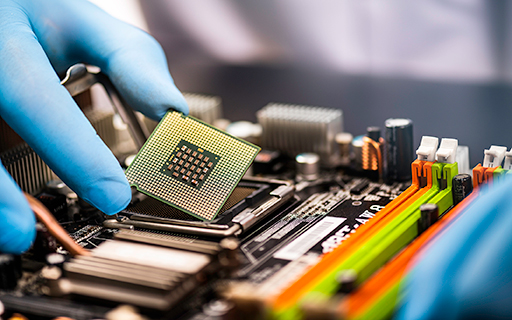
Image source: sefa ozel/www.istockphoto.com
We live in a world quietly held together by tiny slivers of silicon. The chip inside your phone, the sensor in your car, the processor powering an AI model answering your questions right now, none of it exists without semiconductors.
What was once a niche engineering domain has become the backbone of the modern economy, and increasingly, a theatre of global strategic competition.
India is waking up to this reality, and moving fast. As of May 2026, the country has 13 approved semiconductor projects either operational or in active development.
The momentum is hard to ignore: on May 15th, a brand-new ATMP/OSAT facility opened its doors in Bhiwadi, Rajasthan - a landmark moment, as it's the first semiconductor unit established outside the India Semiconductor Mission framework, signalling that private industry is stepping up independently.
Just a day later, Tata Electronics inked a deal with ASML, the Dutch giant whose machines are irreplaceable in chipmaking, to set up India's first front-end semiconductor fabrication plant in Gujarat.
This isn't just about manufacturing. India's semiconductor ambitions stretch across telecom, IoT, defence, and even healthcare - the chips that run MRI machines, wearable health monitors, and diagnostic tools are all part of this story.
So whether you're an investor looking for the next big theme or simply someone trying to make sense of a fast-changing world, Indian semiconductor stocks deserve a close look. Here are the top 5 semiconductor stocks in India worth adding to your watchlist.
The screening criteria include almost continuous growth in sales and profit over the last three years, zero debt, ROE and ROCE above 7%, involvement in the semiconductor ecosystem, and promoter holding of more than 39%.
#1 Kaynes Technologies
First on the list is Kaynes Technology.
Over the past six years, Kaynes Technology has evolved from a focused electronics manufacturing player into an integrated technology company with end-to-end capabilities across design, manufacturing, testing, and semiconductor packaging.
The company is involved in semiconductor through its wholly owned subsidiary Kaynes Semicon focuses on advanced semiconductor manufacturing.
The subsidiary runs facilities designed to meet global semiconductor standards, supported by state-of-the-art infrastructure, precision engineering systems, and scalable production capabilities.
Narendra Modi inaugurated Kaynes Semicon's plant in Sanand on 31 March 2026. The project was approved by the Union Cabinet of India on 23 September 2024, under the India Semiconductor Mission.
With an investment of Rs 33 bn, the facility is expected to further strengthen India's semiconductor ecosystem.
The plant is an OTSAT facility, which focuses on testing and packaging semiconductor chips before they are delivered to end customers.
The facility is designed to handle approximately 6.3 m chips per day, marking a significant step in building domestic semiconductor manufacturing capabilities.
Further, according to media reports dated 6 April 2026, Kaynes Semicon is planning to expand its presence under the upcoming ISM 2.0 scheme by exploring opportunities in gallium nitride (GaN) and micro-LED technologies.
Speaking to Moneycontrol, CEO Raghu Panicker said the company has started evaluating a GaN fabrication unit focused on power applications, aligning with the government's push toward next-generation semiconductor technologies. He also highlighted that Kaynes Semicon is actively exploring the micro-LED segment and may seek benefits under the ISM 2.0 scheme for the same.
While the GaN project is still in the early evaluation stage, the company is reportedly at a more advanced stage in micro-LEDs and is expected to announce a joint venture soon. For this partnership, Kaynes Semicon is looking at potential collaborators from Southeast Asia, preferably non-Chinese partners.
On the financial front, over the past three years the company's revenue has seen a growth of 19.3%, meanwhile, net profit grew at a CAGR of 9%.
The company's three-year average ROE and ROCE stand at 13.6% and 17.4%.
Kaynes Technologies Financial Snapshot
Year 2023 2024 2025 Revenue (Rs in m) 43,001 46,511 50,562 Revenue Growth (%) 44.5 8.2 8.7 Net Profit (Rs in m) 2,944 2,252 2,392 Net profit margin (%) 6.8 4.8 4.7 Return on equity (%) 18.6 11.4 10.9 Return on capital employed (%) 19.4 17.3 15.4
Source: Equitymaster
For more details, see the KAYNES TECHNOLOGY company fact sheet and quarterly results.
#2 CG Power and Industrial Solutions Next on the list is CG Power and Industrial Solutions. The company is a leading Indian engineering player with a strong presence in electrical equipment for power and industrial applications. Over the past few years, CG Power has also been steadily expanding its footprint in India's semiconductor ecosystem. Its subsidiary, CG Semi Private Limited, recently launched its first Outsourced Semiconductor Assembly and Test (OSAT) facility in Sanand, Gujarat, according to a BSE filing dated 28 August 2025. With this development, CG Semi has become one of India's early full-service OSAT providers, offering both traditional and advanced semiconductor packaging solutions. Backed by support from both the central and state governments, CG Semi is developing two advanced facilities in Sanand in partnership with Renesas and Stars Microelectronics. The company plans to invest more than Rs 76 bn over the next five years for the project. Apart from OSAT, CG Power is also building exposure to advanced semiconductor technologies through another subsidiary, Axiro Semiconductor Private Limited. Axiro focuses on areas such as RF, mmWave, wireless infrastructure, and satellite communication technologies, which are expected to play a major role in the growth of 6G and AI-led connectivity solutions. In April 2026, Axiro Semiconductor, along with Japan-based venture capital firm MPower Partners, invested in Japanese fabless semiconductor company EdgeCortix, which specializes in energy-efficient AI processors. The investment further highlights CG Power's growing focus on next-generation semiconductor and AI technologies. On the financial front, over the past three years the company's revenue has seen a growth of 21.8%, meanwhile, net profit grew at a CAGR of 15.6%. The company's three-year average ROE and ROCE stand at 33.1% and 44.3%. CG power & Industrial Financial Snapshot Year 2023 2024 2025 Revenue (Rs in m) 69,725 80,460 99,087 Revenue Growth (%) 27.2 15.4 23.2 Net Profit (Rs in m) 7,963 8,711 9,730 Net profit margin (%) 11.4 10.8 9.8 Return on equity (%) 44.6 29.1 25.5 Return on capital employed (%) 57.7 39.2 35.9 Source: Equitymaster
For more details, see the CG POWER & INDUSTRIAL company fact sheet and quarterly results. #3 MosChip Technologies Next on the list is MosChip Technologies. The company is one of India's earliest fabless semiconductor companies with more than 25 years of industry experience. MosChip Technologies has built strong expertise across a wide range of semiconductor technologies, from 180nm to advanced 2nm nodes, catering to digital, analog, and mixed-signal chip designs. Over the years, Moschip has delivered semiconductor solutions for multiple high-growth sectors including high-performance computing (HPC), automotive, consumer electronics, industrial applications, power management, and communication technologies. The company offers end-to-end semiconductor services covering chip design, verification, integration, validation, testing, and volume manufacturing support. Moschip has completed more than 600 successful tape-outs and has established itself as a trusted partner for global semiconductor companies. Its capabilities span the entire semiconductor development lifecycle, including RTL design, FPGA, IP integration, embedded software, hardware platforms, and production release. The company also benefits from strategic partnerships with leading foundries and OSAT players, including being a trusted TSMC DCA partner. With growing global demand for AI, automotive electronics, and advanced computing chips, Moschip continues to strengthen its position within the semiconductor ecosystem. On the financial front, over the past three years the company's revenue has seen a growth of 46.8%, meanwhile, net profit grew at a CAGR of 73.1%. The company's three-year average ROE and ROCE stand at 7.2% and 11.1%. Moschip Technologies Financial Snapshot Year 2023 2024 2025 Revenue (Rs in m) 1,984 2,939 4,668 Revenue Growth (%) 34.3 48.2 58.8 Net Profit (Rs in m) 62 99 335 Net profit margin (%) 3.1 3.4 7.2 Return on equity (%) 6.3 4 11.4 Return on capital employed (%) 12.4 6.9 14 Source: Equitymaster
For more details, see the MOSCHIP TECHNOLOGIES company fact sheet and quarterly results. #4 Bharat Electronics Next on the list is Bharat Electronics. BEL, a Navratna PSU under the Ministry of Defence India, is a leader in India's defence and strategic electronics sector. It is a multi-product, multi-technology enterprise with a portfolio of over 600 products spanning radars and fire control systems, weapon systems, communication and network-centric systems, and other advanced electronics solutions. In the semiconductor space, the company has been actively strengthening its partnerships and expanding its domestic capabilities. In June 2025, Tata Electronics signed a Memorandum of Understanding (MoU) with Bharat Electronics to jointly develop indigenous electronics and semiconductor solutions in line with India's self-reliance ambitions. Through this collaboration, the companies plan to explore opportunities across semiconductor fabrication (Fab), Outsourced Semiconductor Assembly and Test (OSAT), and semiconductor design services. Further strengthening its semiconductor ambitions, on 24 March 2026, Bharat Electronics signed another MoU with RRP Electronics and RRP Defense, both part of the RRP Group. The collaboration aims to jointly pursue opportunities in semiconductors, electro-optics, unmanned systems, and other advanced defence technologies, expanding BEL's role within the broader semiconductor ecosystem. On the financial front, over the past three years the company's revenue has seen a growth of 15.6%, meanwhile, net profit grew at a CAGR of 31%. The company's three-year average ROE and ROCE stand at 23.9% and 32.1%. Bharat Electronics Financial Snapshot Year 2023 2024 2025 Revenue (Rs in m) 1,77,344 2,02,682 2,37,688 Revenue Growth (%) 15.4 14.3 17.3 Net Profit (Rs in m) 29,404 39,431 52,872 Net profit margin (%) 16.6 19.5 22.2 Return on equity (%) 21.2 24.2 26.5 Return on capital employed (%) 28.4 32.3 35.6 Source: Equitymaster
For more details, see the BHARAT ELECTRONICS company fact sheet and quarterly results. #5 Tata Elxsi Last on the list is Tata Elxsi. Tata Elxsi is among the world's leading providers of design and technology services, catering to industries such as automotive, broadcast, communications, healthcare, and transportation. The company helps clients reimagine products and services through a strong design-led approach, combined with advanced digital technologies like IoT (Internet of Things), cloud, mobility, virtual reality, and artificial intelligence. In the semiconductor space, Tata Elxsi offers its SDK and reference design solutions as a comprehensive embedded software development framework. It covers the entire development cycle-from bare-metal or OS-based system bring-up to performance optimization-while integrating testing, compliance, and security at every stage. By bringing together different design elements into a unified framework, the company aims to speed up product development, improve interoperability across platforms, and reduce overall development effort for semiconductor solutions. It also develops custom firmware for RTOS and bare-metal environments, including support for networking, communication, and memory interfaces. Its expertise spans protocols and interfaces such as Wi-Fi, BLE, cellular, SPI, I2C, UART, and USB. Through customized driver development, Tata Elxsi enables faster SDK creation and quicker deployment across connected semiconductor platforms, supporting innovation in embedded and next-generation devices. On the financial front, over the past three years the company's revenue has seen a growth of 14.7%, meanwhile, net profit grew at a CAGR of 12.6%. The company's three-year average ROE and ROCE stand at 31.9% and 41.9%. Tata Elxsi Financial Snapshot Year 2023 2024 2025 Revenue (Rs in m) 31,447 35,521 37,290 Revenue Growth (%) 27.3 13 5 Net Profit (Rs in m) 7,552 7,922 7,849 Net profit margin (%) 24 22.3 21 Return on equity (%) 36.2 31.8 27.6 Return on capital employed (%) 45.8 43 36.9 Source: Equitymaster
For more details, see the TATA ELXSI company fact sheet and quarterly results. Conclusion India is steadily building a resilient and globally competitive semiconductor ecosystem, supported by focused policy measures and targeted industry incentives under the Semicon India Programme. With initiatives like Make in India and Make for the World, the country is positioning itself as both a manufacturing hub and a key player in the global supply chain. As per the India Brand Equity Foundation (IBEF), the Indian semiconductor market has already expanded from around US$ 38 bn in 2023 to an estimated US$ 45-50 bn in 2024-25, and is projected to reach US$ 100-110 bn by 2030. This strong growth outlook highlights the sector's long-term potential. However, while the long-term opportunity remains strong, investors should approach the space with a balanced view, focusing on execution capability, policy rollout, and valuation comfort before making investment decisions. Investors should carefully evaluate these companies' fundamentals, corporate governance, and valuations as key factors when conducting due diligence before making investment decisions. --- Advertisement ---
Investment in securities market are subject to market risks. Read all the related documents carefully before investing
Should You Sell? Hold? Or Buy the Dip?
History shows that moments of global uncertainty - like 9/11, the 2008 crisis, and the Covid crash - created powerful opportunities for investors who stayed calm.
That's why our research team has identified 3 fundamentally strong stocks that could potentially outsmart the current market fall.
Get Full Details
Details of our SEBI Research Analyst registration are mentioned on our website - www.equitymaster.com
--------------------------------------------------- Disclaimer: This article is for information purposes only. It is not a stock recommendation and should not be treated as such. Learn more about our recommendation services here...