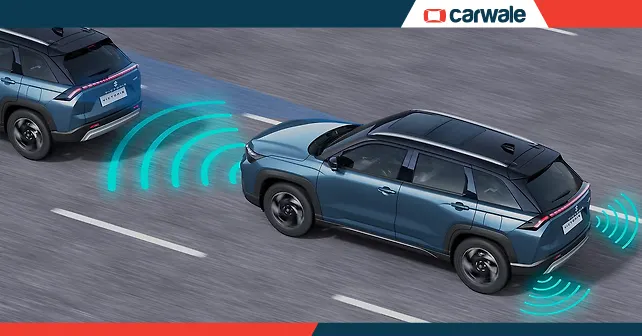
Suzuki plans to make essential ADAS functions standard across its future modelsMaruti already offers different levels of driver assistance across modelsSuzuki has announced a new technology strategy for the next decade, with one of the key plans being to make essential ADAS functions standard across its future cars.
The company says it will develop market-specific, ‘Just-Right’ ADAS systems rather than offering the same technology package across every model.
Maruti already has different ADAS systemsInterestingly, Maruti Suzuki is already taking different approaches to ADAS across its portfolio.
The recently launched Baleno also gets Level 2 ADAS, but with a different feature set.
The interesting part of Suzuki's announcement isn't simply that it wants more cars to have ADAS.
Suzuki plans to make essential ADAS functions standard across its future models
Maruti already offers different levels of driver assistance across models
Suzuki has announced a new technology strategy for the next decade, with one of the key plans being to make essential ADAS functions standard across its future cars. The company says it will develop market-specific, ‘Just-Right’ ADAS systems rather than offering the same technology package across every model.
For a company that operates heavily in the mass-market segment, this could be a significant shift. Brand says it is working on technologies that can reduce the cost and weight of ADAS hardware while adapting the systems to local driving conditions. Autonomous emergency braking and lane-departure prevention are among the functions it wants to make more widely available.
Maruti already has different ADAS systems
Interestingly, Maruti Suzuki is already taking different approaches to ADAS across its portfolio.
The Victoris gets the most comprehensive implementation, with a Level 2 ADAS system offering more than 10 functions, including automatic emergency braking, adaptive cruise control, lane keep assist and blind spot monitoring.
The recently launched Baleno also gets Level 2 ADAS, but with a different feature set. It gets automatic emergency braking, lane keep assist, adaptive cruise control and lane departure prevention, and is currently limited to the top-spec Alpha (O) variants.
The new Brezza takes another approach. It gets active safety features such as blind spot warning, lane change alert and rear cross traffic alert, but does not get the full Level 2 ADAS suite offered by the Victoris and Baleno.
This gives us a good indication of what Suzuki could mean by its ‘Just-Right ADAS’ strategy. Standardising ADAS does not necessarily mean putting the same suite of features on every car. Instead, the technology could be tailored to the vehicle, its price point and the market it is sold in.
The Indian road challenge
For India, the more important question will be how well these systems work in real-world conditions.
Our roads present a very different set of challenges for ADAS. Motorcycles filtering through gaps, pedestrians crossing unexpectedly, inconsistent lane markings and vehicles stopping without warning can all test the limits of driver-assistance systems.
This is where Suzuki's focus on market-specific technology becomes important. The company says it wants to develop systems suited to local requirements rather than simply deploying a one-size-fits-all solution.
And there is a strong argument for this approach. Not every car necessarily needs every ADAS function. For an affordable hatchback, automatic emergency braking or forward collision warning could arguably be more relevant than a comprehensive highway assistance package. The real challenge will be making these systems reliable while keeping costs under control.
Could this change the mass-market segment?
The interesting part of Suzuki's announcement isn't simply that it wants more cars to have ADAS. It is how far down the price ladder the technology can eventually go.
Maruti has already demonstrated that it can offer a comprehensive Level 2 system in the Victoris, while the Baleno shows how the feature set can be adapted for a smaller car. If Suzuki can eventually bring some of these safety functions to its more affordable models without significantly increasing prices, it could change what buyers expect from a mass-market car.
However, making ADAS standard and making it genuinely useful are two different things. A long list of features on a brochure means little if the system struggles with Indian traffic or constantly produces false warnings. That is ultimately where Suzuki's ‘Just-Right ADAS’ strategy will be tested.
If the company gets the balance between cost, functionality and Indian road conditions right, ADAS could gradually move from being a premium feature to becoming a basic safety expectation across the mass-market segment.