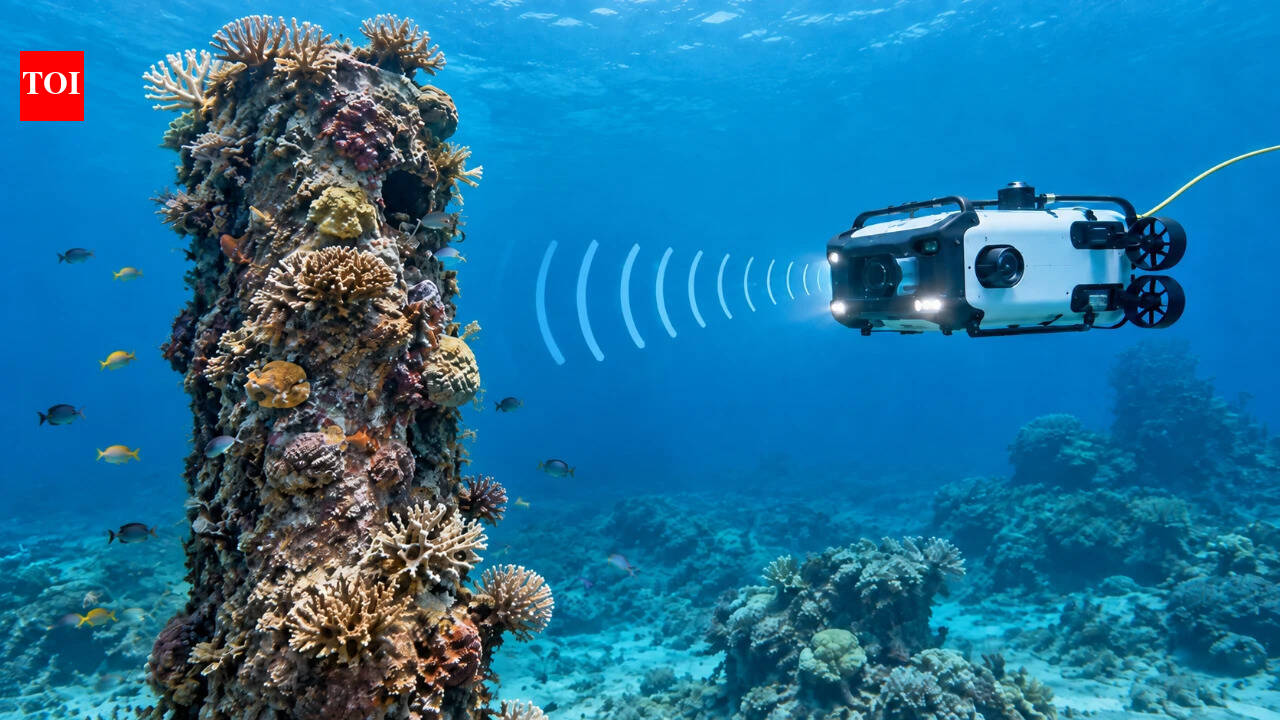
Representative image of an underwater reef robot detecting coral habitats and marine life using reef sounds.
From reef surveys to conservationA small autonomous underwater robot is giving scientists a new way to locate areas of unusually high biological activity on coral reefs.
Instead of relying only on divers and cameras, the system combines underwater sound recordings with visual observations of the reef.
Visual surveys found fish densities nearly 25 times higher near the structure than on the rest of the reef.The result also points to the importance of reef structure in understanding where marine life concentrates.
On the other hand, other research projects have shown that underwater sound can be very useful for analysing the structure of coral reefs.
Representative image of an underwater reef robot detecting coral habitats and marine life using reef sounds. Image Credits: ChatGPT.
A robot that listens as well as looks
One coral structure stood out
According to the Woods Hole Oceanographic Institution, in field trials in the US Virgin Islands, the robot repeatedly identified a hotspot around a large pillar coral structure where fish densities were nearly 25 times higher than elsewhere on the reef. Image Credits: Wikimedia Commons.
From reef surveys to conservation
A small autonomous underwater robot is giving scientists a new way to locate areas of unusually high biological activity on coral reefs. Instead of relying only on divers and cameras, the system combines underwater sound recordings with visual observations of the reef. According to the Woods Hole Oceanographic Institution , in field trials on the US Virgin Islands, the robot repeatedly identified a hotspot around a large pillar coral structure where fish densities were nearly 25 times higher than elsewhere on the reef.The system could also follow biological sounds through the water, successfully tracking sound sources from distances of up to 80 metres in controlled experiments. The technology, developed by researchers at the Woods Hole Oceanographic Institution (WHOI), is called CUREE, short for Curious Underwater Robot for Ecosystem Exploration.Traditional reef surveys often rely on divers, cameras and other instruments to collect observations. These approaches can provide detailed observations, but their coverage and duration can be limited by the practical constraints of working underwater. CUREE was designed to move autonomously through complex reef environments and collect information while it searches for areas of unusually high biological activity.The robot combines cameras with hydrophones, underwater microphones that record sounds produced by marine animals. Its onboard computers analyse the audio and visual signals in real time as the vehicle moves. The cameras provide detailed information at close range, while acoustic sensing can detect biological activity farther from the robot.The two sensing methods compensate for each other's limitations. Cameras can provide species-level information, but only at relatively short range. Acoustic signals can provide information over a broader area, but they contain less species-level information and can be difficult to localise in a noisy reef environment. CUREE can therefore use sound to locate areas of interest before using its cameras to examine them at close range.The research team tested the system during three expeditions to Joel's Shoal in the US Virgin Islands between 2022 and 2024. CUREE consistently identified the same area as a biological hotspot. Visual surveys found fish densities nearly 25 times higher near the structure than on the rest of the reef.The result also points to the importance of reef structure in understanding where marine life concentrates. Complex reef structures can provide shelter and feeding opportunities, potentially helping explain why some features support greater concentrations of animals. Detecting these fine-scale hotspots could help researchers investigate why neighbouring parts of the same reef support very different levels of biological activity.The robot was also able to home in on specific biological sounds. In controlled experiments, CUREE tracked sound sources from distances of up to 80 metres, while in separate tests it autonomously converged on natural reef hotspots. The system can also track individual animals. Earlier CUREE experiments demonstrated autonomous tracking of a barracuda and a stingray, showing how the robot can follow moving animals as part of its reef observations.The potential advantage is that a robot could search a reef while adapting its movements to the biological signals it detects, rather than simply collecting observations along a fixed survey route. Such a system could be useful for monitoring reefs that are difficult to survey repeatedly as they face pressures including warming, disease and pollution.The researchers at WHOI have pointed out that although coral reefs cover only about 0.1% of the ocean area, they host about one-quarter of all marine life forms, which makes their identification a potential asset for ecological studies and conservation. On the other hand, other research projects have shown that underwater sound can be very useful for analysing the structure of coral reefs. Researchers at WHOI demonstrated in 2024 that the sound from healthy reefs made coral larvae settle up to seven times more than at a degraded reef.It should also be noted that the results obtained using CUREE do not imply that there will be no need for the work of marine biologists or traditional reef surveys because the robot is regarded by scientists as an instrument that can expand human perception through the ability to work for extended time frames, access difficult terrain and integrate different data. The ultimate goal is to develop a fleet of autonomous vehicles capable of investigating poorly mapped reefs. By finding areas of aggregation of fish and other creatures, robots can allow for a better understanding of the ecosystem of reefs than before.