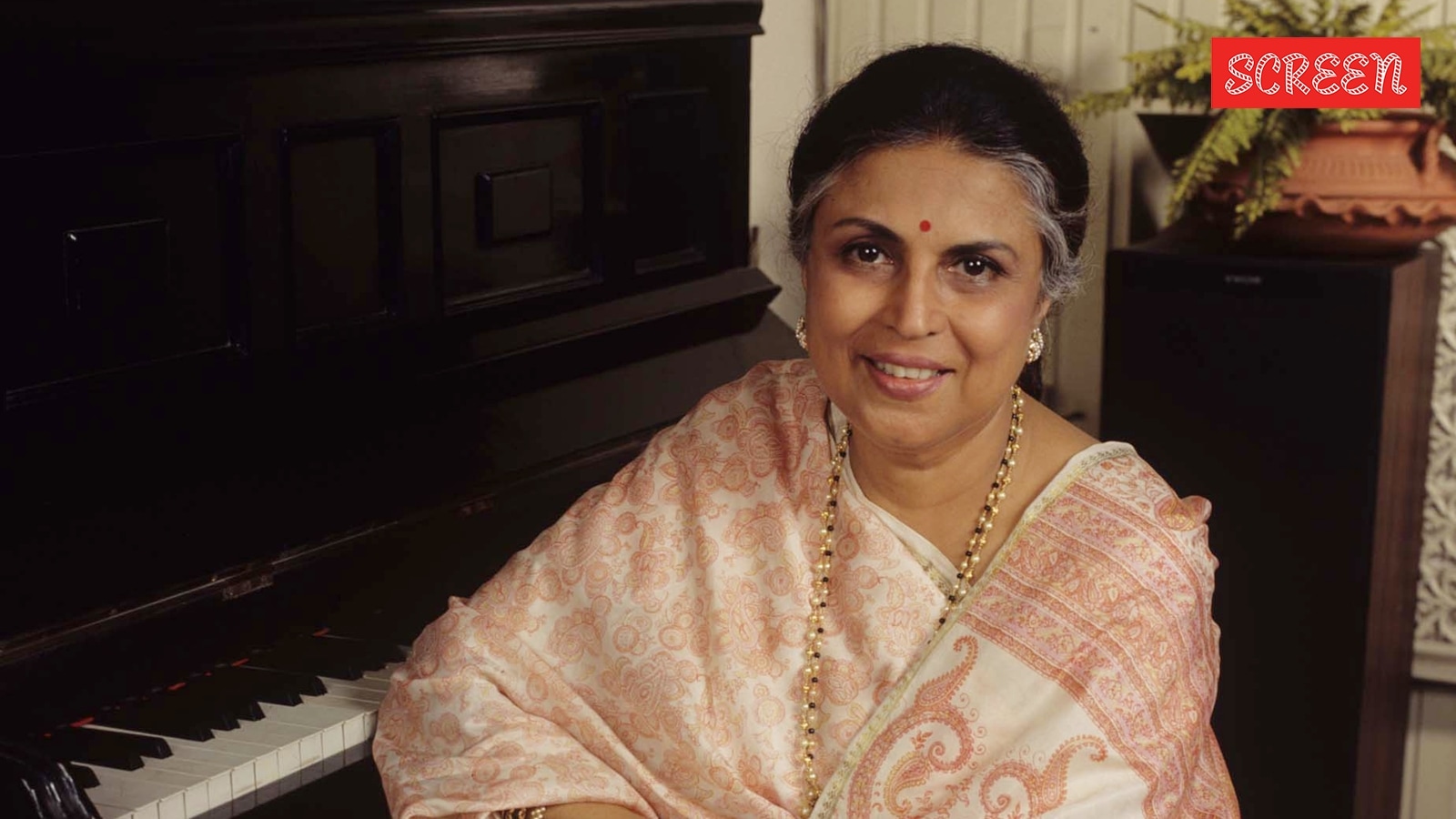
There may be no better endorsement for a woman playback singer than being mistaken for Lata Mangeshkar.
For most of her career, playback singer Suman Kalyanpur lugged both.
Singer Suman Kalyanpur passes away.
(Express archive photo) Singer Suman Kalyanpur passes away.
(Express Archive Photo) Suman Kalyanpur, Madan Mohan and Mohammed Rafi at a song recording.
There may be no better endorsement for a woman playback singer than being mistaken for Lata Mangeshkar. There possibly cannot be a longer shadow to live under either. For most of her career, playback singer Suman Kalyanpur lugged both.
Whether it was the playful ‘Na na karte pyar’ (Jab Jab Phool Khile, 1965), the longing in ‘Ajhun na aaye baalma‘ (Saanjh aur Savera, 1964), the soft romance of ‘Na tum humein jaano’ (Baat ek Raat ki, 1962) or the exuberance of the utterly delightful ‘Aaj kal tere mere pyar ke charche’ (Brahmachari, 1968), Kalyanpur came to be known as a singer without any excess and with a clear and clean tone. On May 31, Kalyanpur passed away at her residence in Mumbai’s Lokhandwala. She was 89 and had been unwell for a little over a month. She will be cremated at 2 pm in Mumbai’s Santa Cruz on Monday.
Mangala Khadilkar, who wrote Kalyanpur’s biography in Marathi, confirmed the news to The Indian Express. “It happened around 8 pm. I am going to remember what a gentle person Suman tai was. As for her voice, its sweetness was so different, soft, gentle and touched your heart instantly,” said Khadilkar.
Singer Suman Kalyanpur passes away. (Express archive photo) Singer Suman Kalyanpur passes away. (Express archive photo)
Back in the 1960s, Mumbai’s music industry was producing songs at an astonishing pace and quality, creating what would later be remembered as the golden age of Hindi film music. This was also the time when the world of playback singing was dominated by the Mangeshkar sisters: Lata and Asha. Kalyanpur, somehow, naturally sounded like Mangeshkar and was extremely diligent and sharp in terms of hitting the notes. When Mangeshkar was abroad or unavailable, or if the producers could not afford her rate of Rs 100 per song, or if the song suffered because she refused to sing with Mohammand Rafi over royalty issues, Kalyanpur, ‘the other Lata’ as she was called, was asked to come in. In fact, Na tum humein jaano was recorded with Kalyanpur because SD Burman was not speaking to Mangeshkar at the time.
In a rare interview with this writer, Kalyanpur once said of the comparison, “In my college days, I used to sing Lata ji’s songs. Meri aawaaz nazuk aur patli thi (My voice was fragile and thin). Also, when Radio Ceylon relayed the songs, the names were never announced. Even the records sometimes gave the wrong name. Maybe that caused more confusion. Shreya Ghoshal’s voice is also thin, but can people go wrong now? We were living in different times then,” she said in 2016. It was a conversation that took months of convincing.
Kalyanpur sang two duets with Lata before her own songs became popular. Kabhi aaj kabhi kal in the Balraj Sahni-starrer Chand (1959) was a Hemant Kumar composition.
Growing up in a pre-Partition Mumbai, Kalyanpur was the eldest of five sisters. The girls growing up in a conservative house sang because they couldn’t play outside. Her parents loved bhajans. But singing could be done at home. She was still a teenager when some neighbours asked her to sing for Ganpati Mahotsav. After listening to her, another one of her neighbours, DB Jog, asked her to sing for his Marathi film Shauchi Chandni (1953). That got Kalyanpur inside a recording studio. Jog was her father’s friend and permission was granted. The film, however, never took off.
Story continues below this ad
Suman Kalyanpur, Madan Mohan and Mohammed Rafi at a song recording. (Express Archive Photo) Suman Kalyanpur, Madan Mohan and Mohammed Rafi at a song recording. (Express Archive Photo)
At 16, when she was a student at Sir JJ School of Art, noted singer Talat Mehmood heard her sing at a college function and “gave shabaashi”. He then put her in touch with the recording company HMV. Despite the equivalents of A & R managers of today calling her voice “amateurish”, Kalyanpur bagged a song in Darwaaza (1954) and debuted alongside Mehmood with the delicate and melodious Ek dil, do hain talabgaar. The film was produced by Ismat Chughtai and people noticed. This was followed by Chhodo chhodo mori baiyaan (Miya Bibi Raazi, 1960), Na tum humein jaano (Baat Ek Raat Ki, 1962), Mere sang ga, gunguna (Janwar, 1965), and Tumne pukaara aur hum chale aaye (Rajkumar, 1964), among others.
“Post Independence, everyone was really excited to do something. My father also agreed about me singing but accompanied me to every recording. It was quite conservative at that time as people talked quickly,” says Kalyanpur, who, after getting married in 1958, was accompanied by her husband to every recording session.
When Kalyanji Anandji’s Na na karte pyar came out, Mangeshkar, many people thought, had woven her magic once again. So in the late ’80s, when Doordarshan, in its famous show, Chhaya Geet, attributed the song to singers Lata Mangeshkar and Mohammad Rafi, no one batted an eyelid. Kalyanpur’s daughter Charul called up the Prasar Bharati office and requested them to rectify the error. “No one believed me. It sounded like Lataji’s,” said Charul Hemmady to The Indian Express.
Her last popular number in the industry was Behna ne bhai ki kalai pe (Resham Ki Dori) in 1974. She sang about 100 songs for composer Usha Khanna. She also sang for composer Anu Malik and Bappi Lahiri in the ’80s but soon bowed out of the industry in 1986, after singing for almost 100 films. Her final song, which was for the film Love 86, actor Govinda’s debut, was never released. Laxmikant Pyarelal didn’t use her version. They rerecorded it in Alka Yagnik’s voice.. She did do an HMV album in 1997, rerecording her old numbers, but the album didn’t get much attention.