You said it's got four carbon atoms in it, so what is it, and do we understand the chemistry that must have gone into making it?
So in particular for the sugar with four carbon atoms, we start from two kind of Lego blocks of two carbon atoms.
Because you're saying you build a four carbon sugar by joining a couple of two carbon elements together.
So there's as much sugar as one third of the yearly production of sugar here in the world.
And then what we currently believe is that the sugar that we have detected in particular, the sugar with four carbon atoms, may have been a precursor of ribose, which is actually the sugar that we can find in RNA.
To another groundbreaking study now, where scientists have detected large amounts of a sugar in deep space, which seems to have managed to form there despite temperatures near absolute zero and in a near vacuum. The same sugars - constructed from 4 carbon atoms and known as erythruloses - crop up naturally in fruits here on Earth - they are also used in some sun tanning liquid - leading to the tantalising hypothesis that their delivery here billions of years ago, not in the suncream, from clouds out in space might be why biology adopted very similar molecules as the backbones for DNA and RNA at the dawn of life on the early Earth. Izaskun Jiménez-Serra made the discovery at the Centre for Astrobiology in Madrid, and she's been speaking with Chris Smith...
Izaskun - We have found a sugar with four carbon atoms, which means that it's one of the simplest sugars that we know of, and we have detected it in the interstellar space between stars within our galaxy.
Chris - How did you see a sugar in deep space?
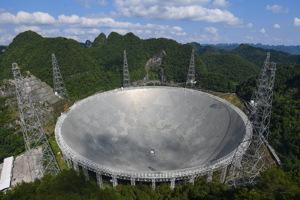
Izaskun - So we see it because each molecule has its own fingerprint, and this fingerprint is characterised by light because these molecules are in vapour state at the very cold conditions of this nebula in space. The only thing that they can do is rotate, and when they rotate, they emit light at radio frequencies. So by using our radio telescopes, we can measure these fingerprints, and that's how we know these sugars are present there.
Chris - How did they get there in the first place? Why is there a cloud with sugar in it in deep space?
Izaskun - So that's the interesting thing. Even under the extreme conditions that we can find in these huge clouds of gas and vapour, we can form these complex molecules that are relevant for life. So that's one of the main results of this work. Even under those extreme conditions of very cold temperatures, very close even to the absolute zero, pressure conditions of vacuum, these kind of molecules can form.
Chris - What actually is the sugar you found then? You said it's got four carbon atoms in it, so what is it, and do we understand the chemistry that must have gone into making it?
Izaskun - So this sugar is present in red fruits, and in particular in raspberries, and it can also be found in these self-tanning cosmetics that maybe some of you have used.
Chris - I would never use a self-tanning cosmetic. I'd just go to a nice country like Spain where it's sunny.
Izaskun - I've used it in the UK though, so I think sometimes it's useful.
Chris - True, true. But where did it come from out in space, and how does it actually get built? So raspberries can make it, yes, it's in biology here on Earth, but out in space?
Izaskun - In space, so the way they are formed is on the icy surface, on the cold surface, of very small particles that we call interstellar dust particles. These particles are very, very tiny, so they are of a size of a bacteria. They are covered by these ices, very cold ices, and then these sugars can form on top of those ices because they can meet, they can join together, and then they can form. So in particular for the sugar with four carbon atoms, we start from two kind of Lego blocks of two carbon atoms. They meet, they react, and that's how we make the with four carbon atoms.
Chris - Where did the simpler molecules come from in the first place though? Because you're saying you build a four carbon sugar by joining a couple of two carbon elements together. Where do they come from?
Izaskun - They come from even simpler molecules, and the simplest one of them is carbon monoxide, which is basically a carbon atom and an oxygen atom. That molecule is on these ices, on top of these ices, and then by adding hydrogen atoms on the surface, because these interstellar dust particles, they act as a catalyser. So that's how these more larger structures start forming by adding hydrogen atoms and other carbon atoms subsequently.
Chris - Where does the energy come from to kickstart the reaction though? Is that light, or do they just naturally want to react to form these sugars?
Izaskun - That's the interesting thing. So because the temperatures are very low, are very close to absolute zero, the energy available is really, really tiny, is very, very small. So what happens is that these two, these molecules, in the case for this sugar of four carbon atoms, the precursor molecule, so these two Lego blocks, so they form in the same place on this ice, and then they approach, and then they join together chemically. So because there's enough energy, it's very tiny, but there's enough energy to join together, and then that sometimes produces an excess of energy just by that chemical reaction.
Chris - Presumably if you've detected it, there must be quite a lot of this sugar and similar molecules out there then.
Izaskun - Yes, so these sugars are in huge amounts. I've made some estimates. Basically the amount of sugar that is available on this cloud that we have used for our study, very near the galactic centre. So there's as much sugar as one third of the yearly production of sugar here in the world.
Chris - What are the implications then for the early Earth? Because you've mentioned that raspberries use this as well as self-tanning products, but raspberries probably came first in evolutionary terms. So biology uses this. So the tantalising hypothesis would be then, does it use it because it got here from space in the early Earth in the first place?
Izaskun - What we believe and what we are proposing in our work is that these sugars form very early in these clouds of gas before stars and planets form. So that means that they are incorporated later on into these planetesimas, into these embryos of planets and also embryos of asteroids, meteorites, comets. And what we know is that Earth experienced this period of a late heavy bombardment between 4.1 and 3.8 billion years ago, in which huge amounts of organics arrived to Earth on board meteorites, comets, interplanetary dust particles. And we believe that if sugars were present there, they could have joined these prebiotic soups that were available on the surface of Earth, triggering the first biochemical reactions that led possibly to the formation of the first RNA molecules.
Chris - Indeed, because nucleic acids like DNA and its RNA relative use sugars as an intrinsic part of the backbone of the molecule. So that might be why then, if this stuff was already being made out there in the galaxy more broadly, it was a useful building material to work with for those sorts of processes right back at the beginning.
Izaskun - Exactly, yes. And then what we currently believe is that the sugar that we have detected in particular, the sugar with four carbon atoms, may have been a precursor of ribose, which is actually the sugar that we can find in RNA.