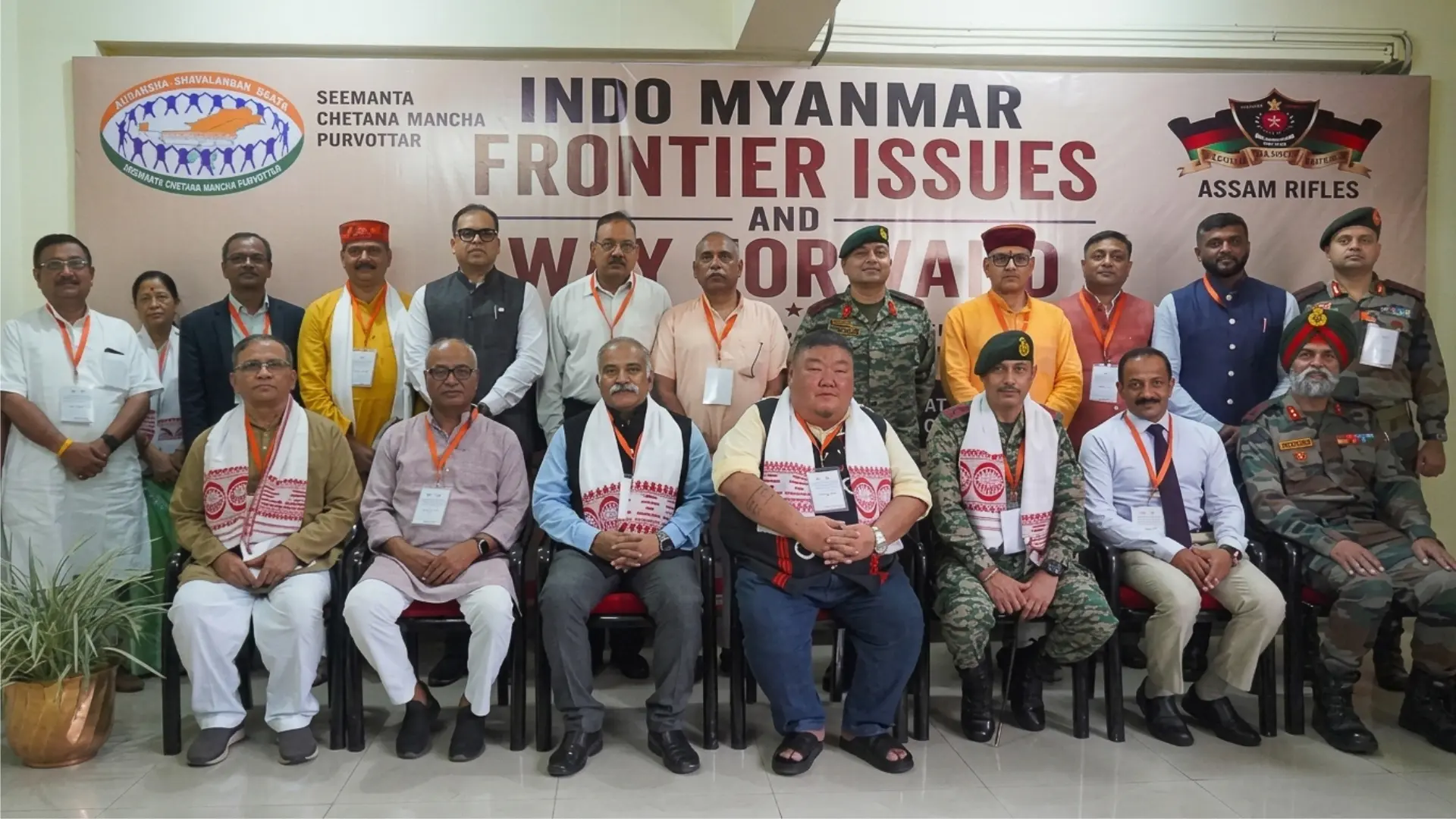
Mall was speaking at a two-day conference that an RSS-affiliate, Seemanta Chetana Mancha Purvottar, jointly hosted with Assam Rifles, the Union government’s counter-insurgency paramilitary force in the northeast.
Inspector General of Assam Rifles (North), Major General Harinder Singh Mavi spoke at a seminar on ‘Indo-Myanmar Frontier Issues’ co-hosted by his force and an RSS body.
When his turn came, Assam Rifles’ Major General Harinder Singh Mavi appreciated the session organised by Assam Rifles and Seemanta Chetana Mancha Purvottar saying it provided “a platform where operational experience and academic rigour converge.”Mavi was speaking on behalf of his superior and the DG of Assam Rifles who did not return for his closing lecture.
Through the seminar, current and former officials of the Assam Rifles and security experts raised concerns about the Indo-Myanmar border, which they described as complex and sensitive.
But, the Assam Rifles meeting with RSS affiliates was uncommonly candid.
Guwahati: On June 18, in a nondescript government building in Guwahati, a veteran associated with the Rashtriya Swayamsevak Sangh (RSS), Jagdamba Mall, addressed a gathering.
Among other things, he said, “What is behind the insurgency in Nagaland? Where there is religious shift, there occurs insurgency, where there is no religious shift, means no conversion, no insurgency.”
He was suggesting that Christianity was to blame for the insurgency in Nagaland and other parts of India’s northeast.
Mall’s utterances were not out of his character. They fall within the range of what RSS propagates.
What was odd was the gathering itself. Mall was speaking at a two-day conference that an RSS-affiliate, Seemanta Chetana Mancha Purvottar, jointly hosted with Assam Rifles, the Union government’s counter-insurgency paramilitary force in the northeast.
Other collaborators included three universities from the region. Dibrugarh University, Manipur University and Rajiv Gandhi University, Arunachal Pradesh.
The topic: “Indo-Myanmar Frontier Issues and Way Forward.”
In attendance, alongside the RSS-affiliate organisations and others, was the highest ranking officer of Assam Rifles, its Director General, Lieutenant General Vikas Lakhera.
He was accompanied by the Inspector General of Assam Rifles (North), Major General Harinder Singh Mavi, and retired Lieutenant General Rana Pratap Kalita of the Indian Army, along with other serving and retired army and intelligence officials from the region, journalists, and a smattering of academics.
This is arguably the first such meeting co-hosted by a wing of the armed forces with an RSS-affiliate on issues of strategic and security importance that has come to light.
Assam Rifles does engage with civilian groups, including universities and civil society organisations in the region, but one co-hosted with an RSS-affiliate came loaded with different implications.
The Collective sent questions to the Assam Rifles, the Ministry of Home Affairs, and the Ministry of Defence, asking whether and how permissions and clearance were granted to co-host the event. The copy will be updated if a response is received.
Inspector General of Assam Rifles (North), Major General Harinder Singh Mavi spoke at a seminar on ‘Indo-Myanmar Frontier Issues’ co-hosted by his force and an RSS body. Photo Credit: Angana Chakrabarti
Also in attendance from the RSS was the Akhil Bharatiya Sah-Prachar Pramukh (All India Co-Public Relations Chief) Pradeep Joshi, alongside Bharatiya Janata Party (BJP) MLA from Nagaland, Temjen Imna Along.
Through panel discussions and speeches across two days, senior army officials — both retired and serving — shared notes, data and analysis with the gathering, information that they rarely share openly with civilians.
Traditionally, retired military officers and think-tank experts speak on behalf of the government and security agencies. This allows official institutions to maintain distance from controversy. The Guwahati conference broke with that convention with alacrity.
The gathering at the conference, held at the National Institute of Rural Development and Panchayati Raj campus, in a corner of Guwahati, enjoyed some rare candour.
While the RSS-affiliated speakers casually spoke of Akhand Bharat – an idea of unified Greater India imagined by the RSS – and tribals in the region originally being ‘Hindu,’ the Assam Rifles officers and others candidly discussed India’s strategic challenges in the northeast and Myanmar
The All India Convenor of the RSS-associated Seema Jagran Mancha, Muralidhar Bhinda said, “Myanmar is weak…It has been a part of Bharat, but right now it is an independent country. It is weak. The other powers of the world are at work there. There are other anti-India activities happening there. We need to study how we can end those activities”
Muralidhar Bhinda of the Seema Jagran Manch, an RSS-affiliate addressed the gathering at the seminar. Photo Credit: Angana Chakrabarti
The Seema Jagran Mancha and its northeast counterpart, the Seemanta Chetana Mancha Purvottar, claim to work towards the security of India’s borders by “building a national consciousness in border villages,” “empower local communities”, and “build a strong India by integrating them into the national mainstream”.
In his speech, Mall had already criticised the first Indian Prime Minister, Jawaharlal Nehru’s policy for the region, “There’s a saying in Hindi — chamde ki thaili, kutta rakhwala. If you give a leather bag to a dog, will they protect it or bite it? Like that, the northeast was set on fire [by the British]. To resolve this, Nehru ji appointed the person who set the fire itself as an adviser.”
According to Mall, the tribals “were all Hindus before” and were made “non-Hindus” by being taught English, particularly through missionaries, who also built churches.
When his turn came, Assam Rifles’ Major General Harinder Singh Mavi appreciated the session organised by Assam Rifles and Seemanta Chetana Mancha Purvottar saying it provided “a platform where operational experience and academic rigour converge.”
Mavi was speaking on behalf of his superior and the DG of Assam Rifles who did not return for his closing lecture. Mavi added, “There could not have been a better setting to discuss such a regional, complex issue.”
The meeting took place at a time when Manipur is witnessing an upsurge in violence between the Kuki and Naga armed groups.
Assam Rifles has again been accused, this time by the Naga leaders, who once signed a peace accord with Prime Minister Narendra Modi, of siding with the Kuki armed groups. Assam Rifles has denied such accusations.
And, the RSS itself has faced scrutiny for its role in trying to embed a deeper saffron hue among the Meitei community in Manipur valley.
Reading the Frontier
Through his speech, Mavi highlighted the “security challenges” that included the “over 200 distinct ethnic communities, subnational identities,” “conflicting territorial claims between communities,” which are “instrumentalised by both internal actors and external” threats and the region’s difficult terrain.
During the two-day seminar, armed forces and intelligence officials, academics, RSS-affiliated representatives and security experts presented papers on various issues connected to the Indo-Myanmar border. These covered “illegal migration,” “security threats,” "drug and human trafficking", “impact of instability in Myanmar,” “challenges of insurgency,” India-Myanmar economic initiatives, among other topics.
Through the seminar, current and former officials of the Assam Rifles and security experts raised concerns about the Indo-Myanmar border, which they described as complex and sensitive.
Major General Mavi noted, “With insurgent groups levying transit taxes, funding operations through drug revenue and deepening state fragility in border districts. [This is] the last national insurgent sanctuary… Insurgent groups, factions of NSCN, ULFA, PLA, et cetera continue to maintain camps in Myanmar’s Sagaing and Chin regions.”
He added, “Chinese influence in Myanmar, through economic leverage, arms supplies, and selective engagement, with ethnic armed organisations to create strategic capability, that indirectly kill sanctuaries inimical to India’s interests.”
Last week, The Collective reported on how territorial claims and control over illicit trade by different armed groups were central to the new phase of conflict in Manipur between the Naga and Kuki communities.
Mavi argued that Bangladesh’s political instability is letting militant groups reactivate bases. Added to this, he further claimed, is information warfare, identity contestation, demographic anxiety, and “secessionist” narratives online with “external interference” and “resource contestation” by China which he said makes the threat too complex for a “purely military” response.
What he said was required was an “integrated mode of combat response anchored in strategic patience and operational surveillance.”
Retired Lt Col Ujjual Abhishek Jha presented a paper on the ‘Impact of Instability in Myanmar on India’s security perspective’ at the seminar. Photo Credit: Angana Chakrabarti
Retired Lieutenant Colonel Ujjual Abhishek Jha, an ex-Military Intelligence officer, added a note of caution: “It is important to understand where we are investing. If we say we are investing in the Chin National Army (CNA), we must understand that CNA had 50 cadres in Camp Victoria [near the Mizoram border] before this military transfer of power. So when we invest on CNA, Facebook presence or online presence of an ethnic armed group and on the ground presence are very different things.”
His argument: The Indian government has close relations with the Myanmar military junta. To invest and back an armed group in Myanmar, the CNA, which is fighting against the junta, could create a diplomatic problem for India.
The CNA is fighting the junta in Myanmar to secure the rights of the Chin people, who share ethnic ties with the Kuki and Mizo people.
India does not formally acknowledge its role in supporting any armed group in Myanmar and continues to dialogue with Myanmar junta to not allow its territories to be used by armed groups from India.
It’s for these reasons that Indian security agencies, the government and the armed forces usually remain tight-lipped about their operations in the region within and across India’s borders to maintain plausible deniability. But, the Assam Rifles meeting with RSS affiliates was uncommonly candid.
Along with Jha, other speakers like Suwa Lal Jangu, an assistant professor of Political Science at Mizoram University highlighted how countries such as China and the United States are competing to increase their influence in Myanmar through economic projects – including the export of rare earth minerals – and diplomacy.
His presentation included a slide showing on how the US was now trying to keep both China and India ‘strategically preoccupied.’
Mizoram University’s Suwa Lal Jangu’s presentation examined Chinese and American influence in Myanmar. Photo Credit: Angana Chakrabarti
What stood out was not the substance of the presentations, which largely reflected established security opinions, but the setting itself: serving senior officers of a key counter-insurgency force of the government sharing a platform with RSS members in a seminar.
The convergence between RSS, the ideological mothership of the political party in power, Bhartiya Janta Party and state security forces, is a marker of what potentially influences India’s security apparatus and thinking.