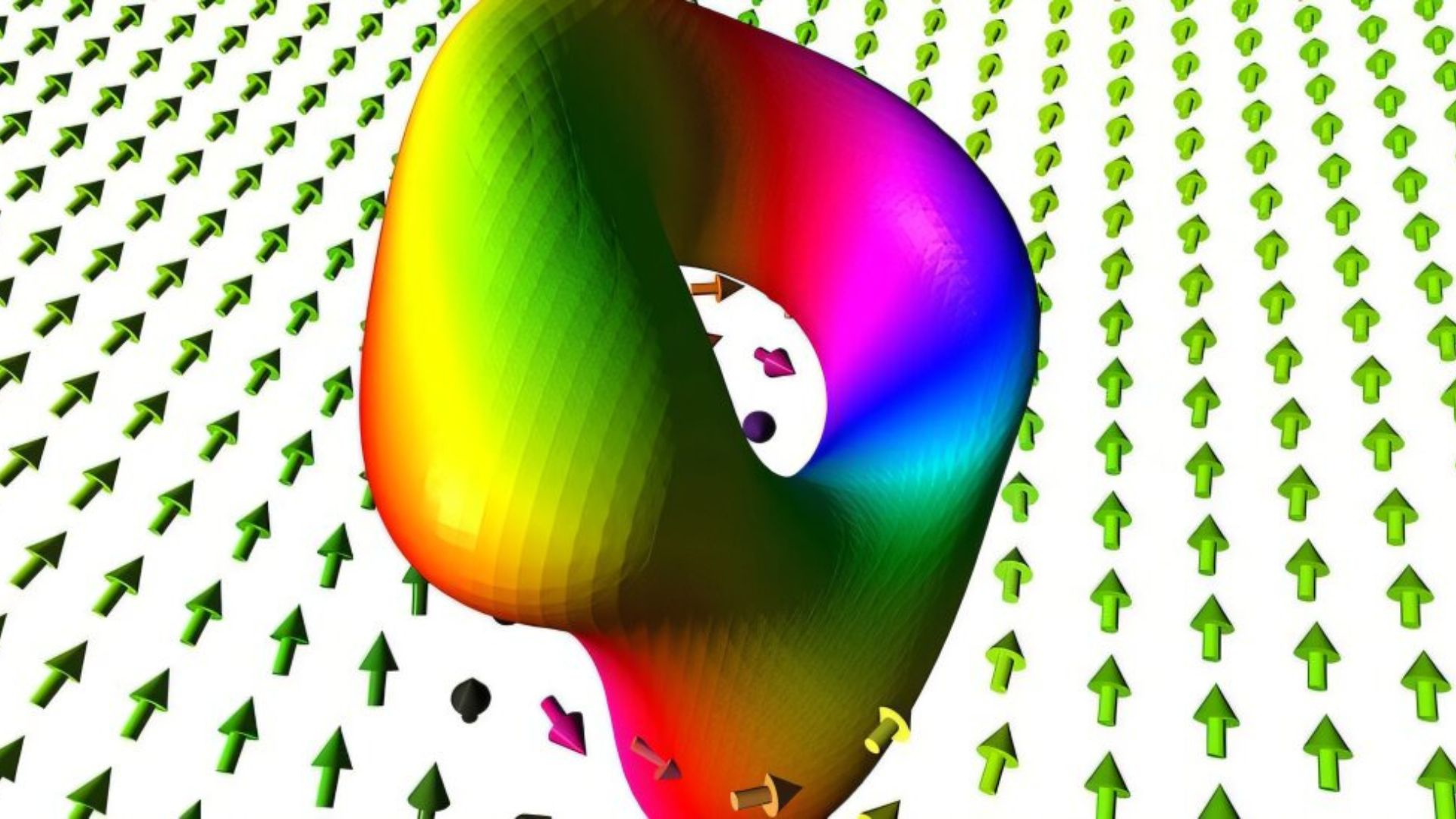
For the first time, an international team of researchers has experimentally observed magnetic hopfions.
This is a new three-dimensional magnetic structure where electron spins form closed, linked loops and point in all possible directions within a limited volume.
A Swedish-German-Luxembourg-Chinese collaboration demonstrated the existence of these magnetic hopfions using femtosecond laser flashes.
A hopfion is a stable, three-dimensional magnetic structure where electron spins point in every conceivable direction within a confined space.
To shatter those barriers, the collaboration turned to extreme speed and used femtosecond lasers.
For the first time, an international team of researchers has experimentally observed magnetic hopfions. This is a new three-dimensional magnetic structure where electron spins form closed, linked loops and point in all possible directions within a limited volume. While the existence of hopfions had been predicted by theory, actually proving the structures existed had been a major hurdle until now.
A Swedish-German-Luxembourg-Chinese collaboration demonstrated the existence of these magnetic hopfions using femtosecond laser flashes. “Hopfions are fascinating because of their structure. They are three-dimensional objects made of spins that form closed and linked loops. Once they appear, they keep their form and are largely unaffected by their surroundings,” said Philipp Rybakov, Researcher at the Department of Physics and Astronomy at Uppsala University. 3D magnetic structures Magnetism has long been treated like a simple, one-way street. A refrigerator magnet points one way, a compass needle points another, and information in our hard drives is saved in simple, flat lines. But it behaves in far more complex ways at the nanoscale. Magnetism originates from “spin” — a quantum property acting like a microscopic internal compass inside each electron. When countless numbers of these spins interact within a solid material, stable and intricate patterns naturally emerge.
A hopfion is a stable, three-dimensional magnetic structure where electron spins point in every conceivable direction within a confined space. The material encounters massive energy barriers that prevent it from naturally reaching this state. To shatter those barriers, the collaboration turned to extreme speed and used femtosecond lasers. A femtosecond is an unimaginably small fragment of time, specifically, one millionth of a billionth of a second. Asymmetric “chiral” crystals were used to capture these hopfions. Interestingly, these crystals are 110–200-nanometer-thin films of iron germanium whose mirror-image structure naturally forces magnetic spins into unique arrangements. As normal energy barriers usually block hopfions from forming, the team used ultra-fast femtosecond laser pulses to shock the spin system out of equilibrium.
The lasers violently shocked the material’s electrons out of their comfort zone. The strategy worked perfectly. The sudden jolt forced the spins to reorganize. When the dust settled, the spins stabilized into tightly linked, closed loops. A hopfion was born. Application in spintronics Proving that the formation of hopfion required complex confirmation. The researchers turned to advanced electron microscopy to observe the material in real time after each laser strike. Simultaneously, a specialized simulation program called Excalibur was used to create “digital twins” of the experiment. It modeled how millions of interacting spins evolve to recreate the exact same magnetic patterns. “Theory helped point us in the right direction, experiments made the structures visible, and simulations and topology helped us interpret what we were seeing,” said Rybakov
This discovery is important for spintronics, a field that aims to replace heat-generating electrical currents with electron spin in computing. These newly discovered hopfions could serve as three-dimensional data packets. If successful, it could pave the way for next-generation data storage that is vastly denser, faster, and far more energy-efficient than today’s silicon microchips. To prove this wasn’t a fluke, a parallel study published in Nature Communications used the exact same laser-light technique on a different chiral material. This time, it successfully created “bimerons”—the two-dimensional cousin of the hopfion. These two studies prove that lasers can function as a versatile tool for controlling magnetism across multiple dimensions. The study was published in the journal Nature Physics.