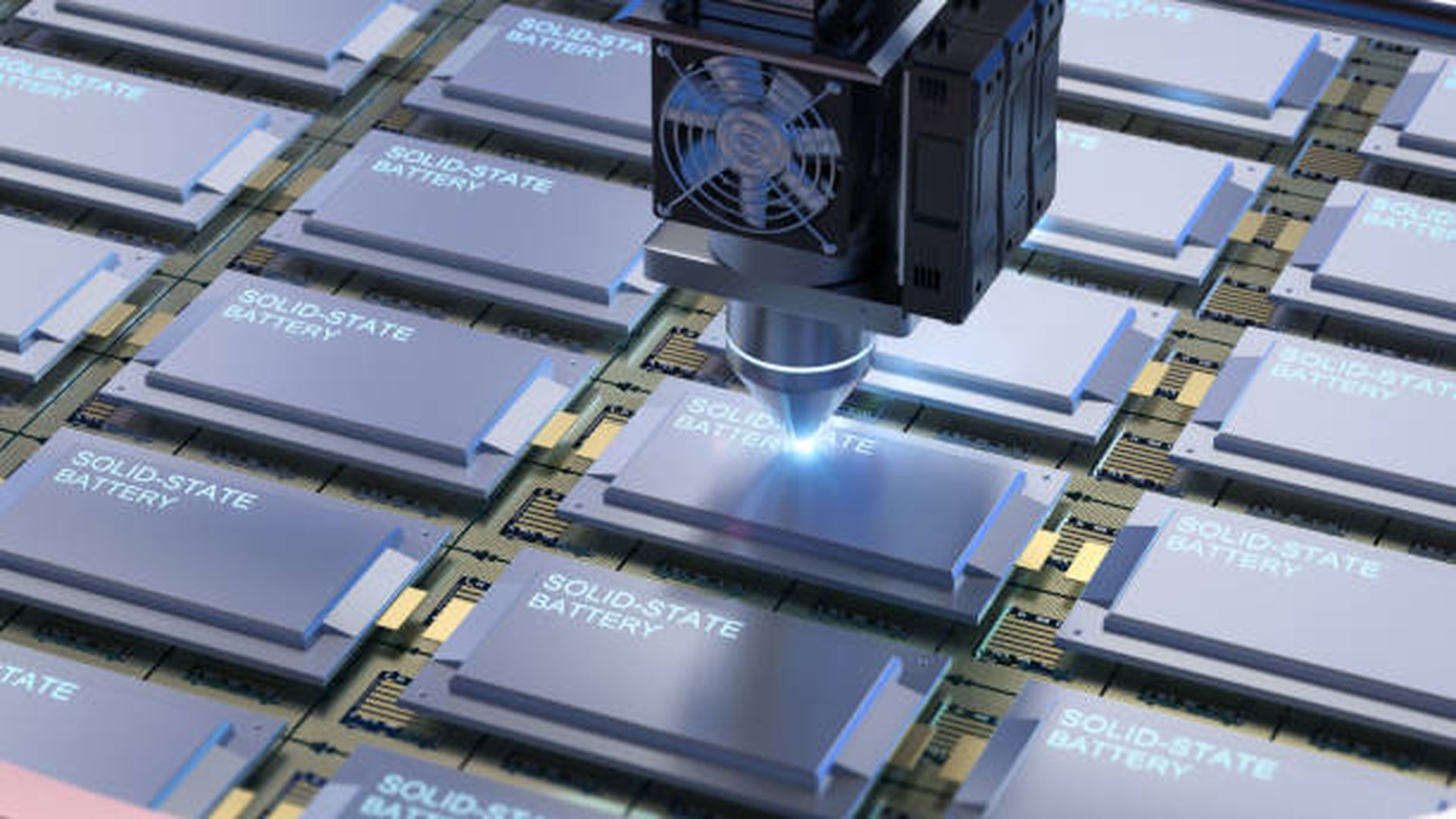
The findings could lead to longer-lasting sodium solid-state batteries that retain their capacity and offer an alternative to lithium-ion cells.
Researchers in the US have discovered why sodium solid-state batteries could last longer without losing capacity, while uncovering a surprising way to grow sodium metal crystals using powerful electron beams.
In 2024, the University of Chicago team developed the world’s first anode-free sodium solid-state battery.
To better understand its performance, they examined the solid electrolyte used in the battery with advanced electron microscopy.
When the electron beam charged the solid electrolyte, it pushed the highly mobile sodium ions through the material.
The findings could lead to longer-lasting sodium solid-state batteries that retain their capacity and offer an alternative to lithium-ion cells.
US researchers discovered that sodium metal can form directly from a solid electrolyte without creating a harmful chemical layer linked to battery capacity loss.
Researchers in the US have discovered why sodium solid-state batteries could last longer without losing capacity, while uncovering a surprising way to grow sodium metal crystals using powerful electron beams. The project was led by researchers at the University of Chicago, who joined forces with Argonne National Laboratory (ANL) and Thermo Fisher Scientific. They found that sodium metal can form directly from a solid electrolyte without developing a harmful chemical layer linked to battery degradation.
The team also found that electron microscopes, which are often used to examine battery materials at the atomic level, can damage the materials they are meant to study. This, the team says, could improve sodium batteries. “Zooming in and being able to see what happens at the interfaces between battery components is an invaluable tool to diagnose what’s going wrong in our batteries and to figure out how we can heal that problem and fix it in the next generation,” James Burrow, PhD, ESRA deputy assistant director, highlighted. Hidden battery flaws Most modern rechargeable batteries rely on lithium-ion cells. However, lithium supplies are limited, and some batteries require critical minerals such as cobalt and copper. Sodium offers a more widely available alternative. In 2024, the University of Chicago team developed the world’s first anode-free sodium solid-state battery. It showed promise for fast charging and long-term energy storage. To better understand its performance, they examined the solid electrolyte used in the battery with advanced electron microscopy.
Thomas Marchese, a PhD student at the University of Chicago and lead author of the study.
Credit: John Zich However, the research team realized that the powerful electron beams inside the microscope can change the structure and chemistry of sensitive battery materials, and produce misleading results. To address the challenge, they utilized advanced detectors capable of capturing detailed information with just 10 to 50 electrons per square angstrom. Burrow said that the team used an electron beam to examine the sample. “In this process, the electrons interact with the sample and also destroy it,” he said. “This is something that’s often overlooked in the literature.” They found out that cooling the material to extremely low temperatures did not prevent damage, unlike in previous battery studies. Instead, the team identified electrostatic charging as the main cause. Sodium crystal formation To the researchers’ surprise, the unexpected damage mechanism led to another important discovery. When the electron beam charged the solid electrolyte, it pushed the highly mobile sodium ions through the material.