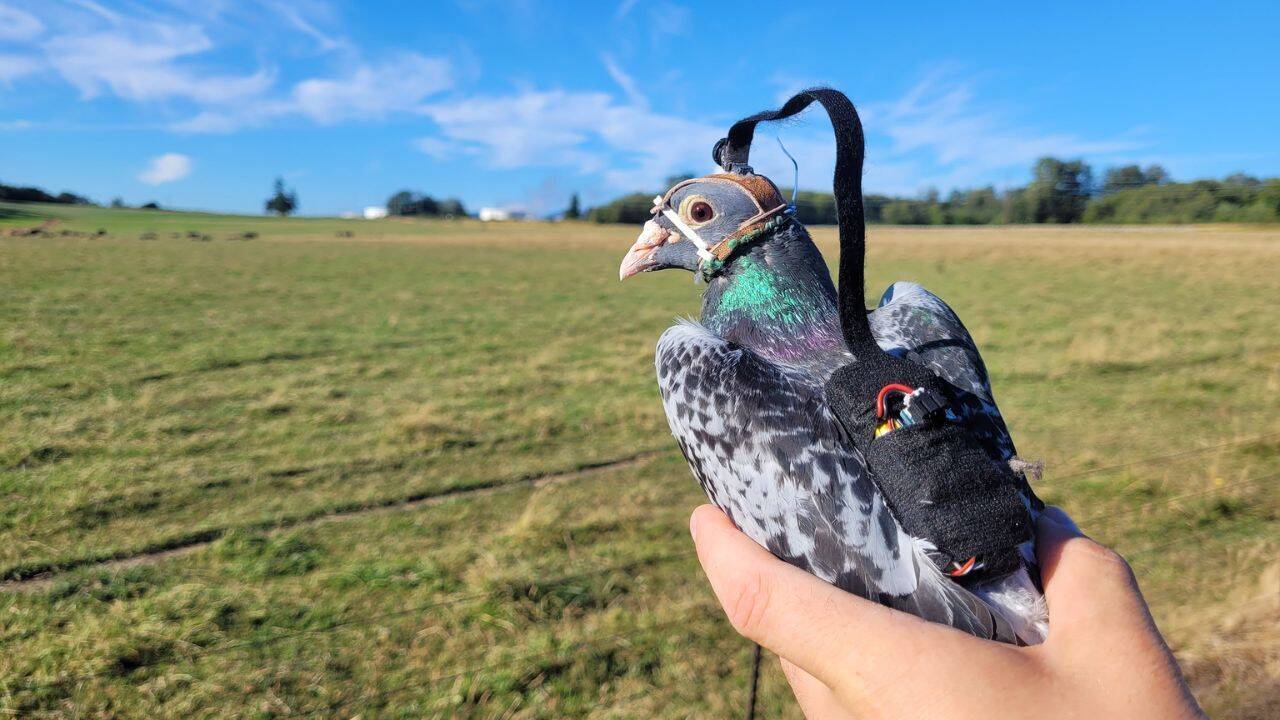
Tiny backpacks, hand-stitched hoods inspired by falconry gear, miniature cameras and lightweight electronics were all carefully fitted to birds that would simply fly home as they always had.
Because the birds already experience constant visual motion as they move through the air, additional eye movements were thought to complicate rather than improve what they saw.
The camera system suggested something different.According to Dr Lapsansky, the recordings showed pigeons making slow, gentle eye movements while flying forward instead of holding their gaze completely still.
Instead of treating the eye as a stationary camera, pigeons subtly move it while simultaneously processing the visual information that motion creates.
Earlier work published in Current Biology reported that pigeons largely maintain a stable eye position during flight after take-off, suggesting they actively keep their gaze aligned while flying.
PC: University of British Columbia (UBC), Credit: Anthony Lapsansky
How tiny backpacks and cameras were designed for homing pigeons
Tiny cameras reveal how pigeons move their eyes while flying
How pigeon eye movements could improve autonomous drone vision
Technology that revealed hidden eye movements in flying pigeons
At first glance, the equipment looked surprisingly elaborate for a flock of homing pigeons. Tiny backpacks, hand-stitched hoods inspired by falconry gear, miniature cameras and lightweight electronics were all carefully fitted to birds that would simply fly home as they always had. The unusual setup was not designed to change how pigeons fly, but to reveal something scientists had never been able to observe directly: exactly what their eyes are doing while they are in the air. According to researchers at the University of British Columbia (UBC), understanding those movements could reshape how engineers think about autonomous drones, while also offering a clearer picture of how birds gather visual information during flight.The challenge was less about electronics than practicality. According to UBC, lead researcher Dr Anthony Lapsansky drew on his previous experience as a falconer to design custom-made hoods that could securely hold a tiny camera on each bird's head. He also hand-sewed miniature backpacks to carry the remaining equipment until he found a design that fit comfortably.The finished system weighed only 27 grams. It combined a miniature computer, a modified commercial camera, motion and orientation sensors, wiring and protective tape into a package light enough for normal flight.During the trials, two pigeons in a flock carried the recording equipment while other birds wore dummy packs to keep conditions as similar as possible. The flock was then released along a route the pigeons already knew well, with the research team racing back to collect the recorded footage once the birds returned home.Using homing pigeons simplified one practical problem. As Dr Doug Altshuler explained, pigeons naturally return to their loft, making them suitable subjects for repeated outdoor experiments without the risk of permanently losing expensive recording equipment.For many years, scientists generally assumed pigeons kept their eyes almost perfectly fixed while flying. Because the birds already experience constant visual motion as they move through the air, additional eye movements were thought to complicate rather than improve what they saw. The camera system suggested something different.According to Dr Lapsansky, the recordings showed pigeons making slow, gentle eye movements while flying forward instead of holding their gaze completely still. Rather than interfering with flight, these adjustments may allow the birds to gather additional visual detail from their surroundings while still interpreting the motion of the landscape beneath them.The observations also revealed another unexpected behaviour as pigeons approached a landing perch. UBC reports that both eyes turned inward during landing, a movement that could improve depth perception by allowing the bird to compare slightly different images from each eye. Until now, that type of binocular depth judgement had mainly been associated with certain birds of prey rather than pigeons.The research extends well beyond bird biology. According to UBC, many autonomous drones estimate their speed, direction and distance from obstacles using fixed forward-facing cameras. Those systems assume the camera itself remains rigid while software interprets changes in the surrounding scene.Birds appear to be working differently. Instead of treating the eye as a stationary camera, pigeons subtly move it while simultaneously processing the visual information that motion creates. Dr Lapsansky said this suggests flight vision is more dynamic than previously believed, with the movements potentially providing extra information about nearby objects and the environment.That difference could influence future robotic design. Engineers developing autonomous flying machines may eventually build vision systems that imitate these active eye movements instead of relying entirely on fixed cameras, producing drones that can better navigate cluttered spaces or changing landscapes.Reportedly, this also stands apart because of the technology itself. Recording eye movements from freely flying birds has long presented technical obstacles, and the custom-built head-mounted camera system offered researchers a way to observe behaviour that had previously remained hidden.The study also adds another perspective to ongoing research into pigeon vision. Earlier work published in Current Biology reported that pigeons largely maintain a stable eye position during flight after take-off, suggesting they actively keep their gaze aligned while flying. The newer UBC observations indicate that pigeons also perform slow eye adjustments during forward flight and more pronounced inward eye movements while landing, pointing to a more flexible visual strategy than previously appreciated.Taken together, the work shows that the tiny backpacks were never the real story. They were simply the tools that allowed scientists to observe a part of bird flight that had remained largely invisible, offering fresh ideas for both animal vision research and the future design of autonomous flying machines.