Earlier work had laid groundwork for ice behavior under changing carbon dioxide, but never with continuous forcing like this.
“After this transition, the Antarctic ice sheet reacts much more strongly to changes in climate forcing,” said Yun.
Study co-author Axel Timmermann said the ice sheet proved more sensitive to outside forces than scientists had assumed, raising hard questions about its future.
Researchers now have evidence that the Antarctic ice sheet has crossed a sensitivity threshold before.
Identifying this tipping point gives modelers a real target as they sharpen predictions of sea level rise along the world’s coastlines.
Climate scientists who project future sea level rise generally assume that ice sheets respond to warming in a gradual and somewhat predictable way.
As temperatures increase, the ice retreats at a pace that can be estimated with climate models.
However, new research suggests that assumption has a problem.
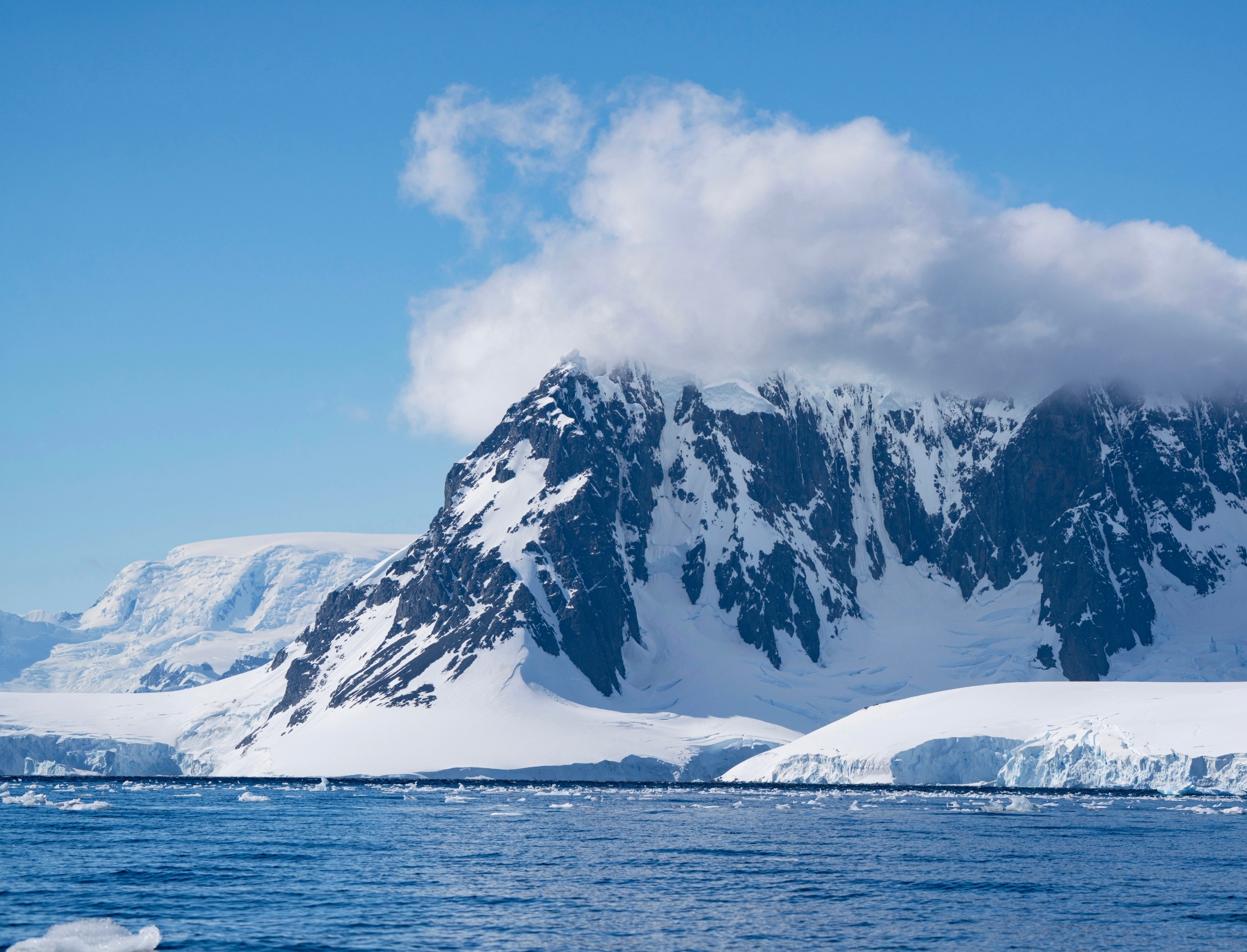
A million years ago, the Antarctic ice sheet crossed an invisible line and began reacting to climate changes far more sharply than it had before.
The same forces were acting on it, but the ice had a fundamentally different response.
A switch that flipped
The change came during a stretch geologists call the Mid-Pleistocene Transition, when Earth’s ice ages grew longer and more severe.
Before it, glacial cycles ran on a roughly 41,000-year beat. After, they stretched to about 100,000 years, with deeper cold.
That much scientists already knew. What stayed murky was how those ice sheets actually behaved through the transition.
No one had the detailed climate records needed to drive a realistic model that far back. The data simply didn’t exist.
Filling in the missing history
Kyung-Sook Yun, a researcher at the Center for Climate Physics at Pusan National University (PNU) in South Korea, led the team that found a way around the problem.
The experts built the missing climate history themselves, and then watched what the ice did with it.
The team started with a computer reconstruction of global climate stretching back three million years, capturing temperature and rainfall as they shifted across that enormous span.
Earlier work had laid groundwork for ice behavior under changing carbon dioxide, but never with continuous forcing like this.
Tracking the evolution of an ice sheet
The team fed that climate history into a separate ice sheet model from Penn State University – one that tracks how ice flows, thickens, warms, and spreads.
The model also captures the behavior of the floating ice shelves ringing the continent, where land ice drains into the sea.
Running the simulation required one of South Korea’s fastest scientific supercomputers.
Rather than recreating a single moment in Earth’s history, the model tracked the evolution of Antarctica’s ice sheet continuously over the past three million years.
A clear and abrupt tipping point
Buried in that record was a number. When atmospheric carbon dioxide dropped below roughly 240 parts per million, the Antarctic ice sheet stopped responding gently to changes in air and ocean temperature.
Its response started swinging hard. This is the tipping point that no one had pinned down before.
The ice didn’t ease into its new behavior as the planet slowly cooled. It crossed a line and changed character. The response amplified suddenly rather than gradually.
“After this transition, the Antarctic ice sheet reacts much more strongly to changes in climate forcing,” said Yun.
“This indicates that the system does not evolve gradually but instead becomes more responsive after crossing a particular threshold in the climate system.”
A mix of environmental factors
In the simulation, three factors appear to have combined to make Antarctic ice swell and hold after the transition.
Colder glacial oceans likely melted less ice from below, where the sheet meets the sea, slowing the steady loss that warmer water had been driving along the underside.
Lower seas contributed further. With global sea level 160 to 330 feet lower than today, pressure on the seafloor eased, and the bedrock beneath the ice began a slow upward rebound.
That uplift, in the model, let ice pile thicker along the coast.
Working together, colder water and rising rock built the bigger, more stubborn ice sheets that defined later ice ages.
Each nudge fed the next. A heavier, more persistent frozen state had taken hold.
Implications for sea level rise
The reason a million-year-old freeze lands in present-day conversations comes down to one word: thresholds.
An ice sheet that can flip its sensitivity in the cold direction can flip it in the warm direction too, and that possibility reshapes how researchers read the risk ahead.
Study co-author Axel Timmermann said the ice sheet proved more sensitive to outside forces than scientists had assumed, raising hard questions about its future.
Other recent modeling has flagged how little ocean warming it might take to push West Antarctica past a tipping point.
The practical worry is sea level. Antarctica is the largest single wild card in how high the oceans climb this century and beyond.
Projections that assume smooth, predictable melting may be reading the ice wrong. Recent projections already span a wide range depending on emissions.
A sharper warning for the future
What changed with this study is concrete. Researchers now have evidence that the Antarctic ice sheet has crossed a sensitivity threshold before.
The ice sheet flipped from a steady response to a violent one at a specific carbon dioxide level. That behavior was long suspected. Now it has a number.
The shape of the danger looks different as a result. If ice can switch regimes at a threshold, then forecasts built on gradual change risk missing the moment the system lurches.
Identifying this tipping point gives modelers a real target as they sharpen predictions of sea level rise along the world’s coastlines.
The study is published in the journal Nature Geoscience.
—–
Like what you read? Subscribe to our newsletter for engaging articles, exclusive content, and the latest updates.
Check us out on EarthSnap, a free app brought to you by Eric Ralls and Earth.com.
—–