After weeks of relentless heat and a delayed southwest monsoon, there is finally some good news for Delhi and north India.
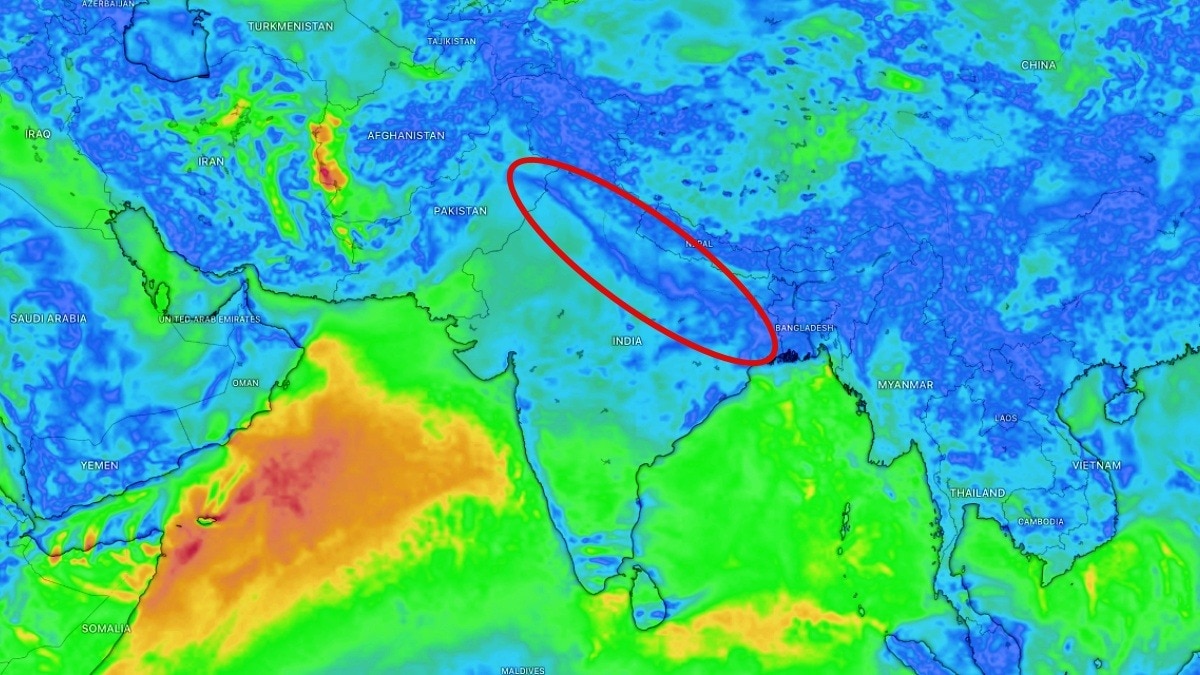
Satellite imagery has captured the formation of a nearly 1,500-km-long monsoon trough stretching from the northern Bay of Bengal to Jammu and Kashmir, a crucial weather feature that could pave the way for widespread rainfall over the region in the coming days.
Read Full StoryThe India Meteorological Department (IMD) said the monsoon trough has now developed, although it remains positioned close to the foothills of the Himalayas.
When the trough lies farther north, rainfall remains concentrated along the Himalayan foothills, leaving the northern plains, including Delhi, Haryana and Rajasthan, hot and largely dry.
In addition to the monsoon trough, forecast models indicate that a fresh low-pressure area is likely to develop over the Bay of Bengal later this week.
After weeks of relentless heat and a delayed southwest monsoon, there is finally some good news for Delhi and north India.
Satellite imagery has captured the formation of a nearly 1,500-km-long monsoon trough stretching from the northern Bay of Bengal to Jammu and Kashmir, a crucial weather feature that could pave the way for widespread rainfall over the region in the coming days.
Read Full Story
The India Meteorological Department (IMD) said the monsoon trough has now developed, although it remains positioned close to the foothills of the Himalayas. As the trough gradually shifts southward towards its normal position, meteorologists expect thunderstorm activity to increase significantly across north India, helping the monsoon establish itself over the region between July 1 and July 4.
The satellite image from INSAT-3DS shows a broad swath of dense cloud cover extending from eastern India into the Himalayan belt, highlighting the strengthening monsoon circulation after nearly three weeks of sluggish progress.
WHAT IS A TROUGH?
The trough acts as the backbone of the southwest monsoon. It is an elongated zone of low atmospheric pressure that draws moisture-laden winds from the Arabian Sea and the Bay of Bengal deep into the Indian mainland.
When the trough lies farther north, rainfall remains concentrated along the Himalayan foothills, leaving the northern plains, including Delhi, Haryana and Rajasthan, hot and largely dry.
That has been the story so far this June.
Delhi continued to reel under heatwave conditions on Monday, with temperatures crossing 42°C at Safdarjung and 43.4°C at Delhi Ridge. Rohtak recorded 43.5°C, while Sriganganagar in Rajasthan remained the hottest location in the region at 45.1°C.
The combination of intense heat and abundant moisture has also pushed humidity levels higher, making conditions feel even more oppressive despite isolated thunderstorms reported over parts of Haryana, Rajasthan and the National Capital Region.
Meteorologists say the evolving weather pattern now favours a gradual transition to active monsoon conditions.
In addition to the monsoon trough, forecast models indicate that a fresh low-pressure area is likely to develop over the Bay of Bengal later this week.
The system is expected to strengthen the monsoon flow, inject more moisture into northern India and trigger widespread showers and thunderstorms across Delhi, Punjab, Haryana, western Uttar Pradesh and Rajasthan. High humidity level in Delhi-NCR.
While isolated pre-monsoon thunderstorms are possible over the next two days, the likelihood of more organised and sustained rainfall will increase from the middle of the week onward.
If the forecast holds, Delhi could finally see the arrival of the long-awaited monsoon in the first week of July, bringing relief from one of the hottest and most humid spells of the season.
- Ends