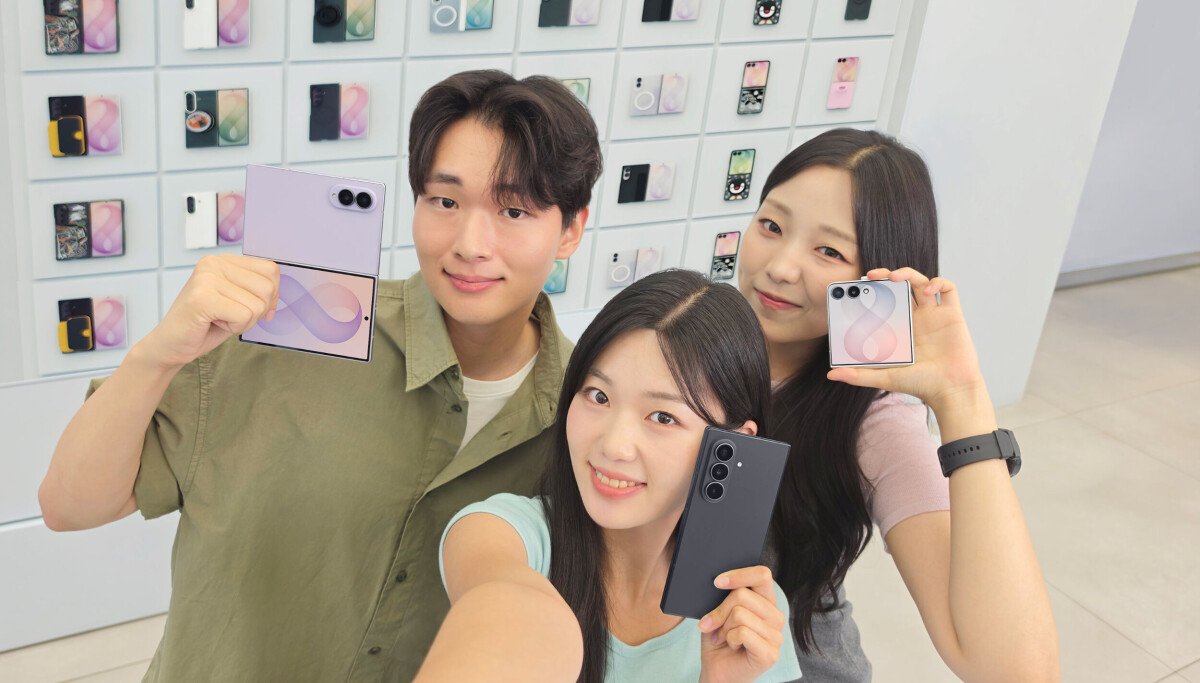
Models each pose with the latest Galaxy Z series at a Samsung store in Seoul.
From left are Galaxy Z Fold 8, Z Fold 8 Ultra and Z Flip 8.
Jeong Seo-hee, 22, takes a selfie with the newly released Galaxy Z Fold8 at Samsung Store Hongdae in Mapo District, western Seoul, on Aug. 11.
A visitor tries out the Galaxy Z Fold8 at Samsung Gangnam in Seoul's Seocho District on July 23.
“We welcome it, because more companies will enter a mature market,” Samsung Electronics Device eXperience head Roh Tae-moon said.
Models each pose with the latest Galaxy Z series at a Samsung store in Seoul. From left are Galaxy Z Fold 8, Z Fold 8 Ultra and Z Flip 8. SAMSUNG ELECTRONICS
Galaxy finally for the win — Samsung Electronics’ Galaxy Z Fold8 is gaining traction among younger consumers, namely women who have typically favored Apple’s iPhone, as the thinner, lighter "passport-size" foldable wins new fans.
Domestic preorders reached 1.44 million units for Z Fold8, the highest ever for a Galaxy device, while cumulative global sales have surpassed 5 million units. According to Samsung.com, half of preorder customers were in their teens, 20s, or 30s, and within that group, purchases by women more than doubled compared to the previous model.
“Considering that 67 percent of Korean women in their 20s use iPhones, the increase in purchases among women in their teens through 30s is significant,” an industry source said.
The shift was visible Tuesday at Samsung Store Hongdae in Mapo District, western Seoul. Three teenage girls headed straight for the Galaxy Z Fold8 as soon as they entered the store, then began folding and unfolding the device and taking selfies.
“This is it!” one of them exclaimed. The group lingered around the device, saying they “really wanted one.”
“I was going to switch to an iPhone this time, but after actually trying the Z Fold8, I changed my mind because it’s light and the photos have a nice aesthetic,” 22-year-old Jeong Seo-hee said.
The new hip
Some iPhone users are already making the switch. Social media posts about moves to the Fold8 have included comments such as “The iPhone feels like a dad phone now” and “A 10-year Apple devotee is saying goodbye through tears.”
“I fell in love with it as soon as I saw it in person because it was so pretty,” said 26-year-old Jeong Da-um, who switched from an iPhone 17 Pro to the Fold8 and posted an unboxing review on Instagram.
Jeong Seo-hee, 22, takes a selfie with the newly released Galaxy Z Fold8 at Samsung Store Hongdae in Mapo District, western Seoul, on Aug. 11. LEE YOUNG-KEUN
Samsung’s foldable is also drawing attention in Japan, long considered an Apple stronghold. In a market where iPhones account for more than half of smartphone use, some Fold8 models temporarily sold out after their Aug. 7 launch. Reservations to try the device at Samsung’s flagship store in Harajuku, Tokyo, also filled up.
“Galaxy is still a minor player in Japan, but there is a growing perception that Samsung has an advantage over Apple when it comes to foldables,” IT engineer Leo Yasumura said in a video interview.
Love at first sight
Consumers often become attracted to a product first and look for reasons to justify that attraction afterward. Smartphones appear to be no different.
When 20 women in their teens through 30s at Samsung Store Hongdae were asked about their first impression of the Fold8, most responded with words such as “cute,” “thin,” “pretty” and “interesting.” Performance and specifications came later.
The new form factor — the physical size, shape and design layout of a piece of hardware — also gives the device a conspicuous presence. At 201 grams, the Fold8 is the lightest foldable Samsung has ever made.
An iPhone user compares the weight of their phone with that of the Galaxy Z Fold8 at Samsung Store Hongdae in Mapo District, western Seoul, on Aug. 11. LEE YOUNG-KEUN
When a 28-year-old office worker surnamed Cho took out a Fold8 at a cafe, an employee asked, “Is that the new one that just came out?” Cho said the phone also drew attention from people around the table when unfolded at a company dinner.
“It’s like dating — you have to like it first before you start paying attention to the specs,” Cho said. “I can’t remember the last time I owned a smartphone that attracted this much attention.”
With the Fold8, Samsung Electronics has finally cracked the "desirable" code that it has yearned for years, according to Kim Dae-jong, a professor of business administration at Sejong University.
“Stimulating the feeling of ‘I want that’ is the starting point of sales, and that has been an area where Samsung Electronics has faced difficulties,” Prof. Kim said. “This time, by becoming a first mover with a new form factor, it has appealed to consumers with a strong desire to differentiate themselves.”
A lasting love
But the excitement of owning something “hip” can fade quickly. The real test is whether the device can move beyond catching attention at first glance and become part of users’ daily lives in a way that improves their overall experience.
That is why Lee Il-hwan, executive vice president and head of the design team at Samsung Electronics’ Mobile eXperience business, has emphasized designing not only the physical product but “every moment the user experiences.”
Customers examine Samsung Electronics’ new Galaxy Z Fold8 Ultra, Fold8 and Flip8 foldable smartphones at Samsung Gangnam in Seocho District, southern Seoul, on Aug. 7, their official release date. NEWS1
The Fold8’s design was inspired by a passport. Samsung focused on making a device that could comfortably fit in one hand like a passport while offering a large display once unfolded. Earlier foldables often prompted the question of whether there was any real need to fold a smartphone. The Fold8, however, has been praised for giving the device distinct value when both folded and unfolded.
“The Fold8 is a form factor that maximizes the content-consumption experience for YouTube, webtoons, e-books and other media in line with changes in global lifestyles,” said Kim Duk-jin, head of the IT Communication Research Institute.
13 years in the making
The design did not emerge overnight. At CES in 2013, Samsung Electronics presented a vision for a 4:3 smartphone that could fold and unfold like a wallet or passport. Technical limitations at the time, however, made such devices too thick and heavy.
Technology ultimately turned the long-envisioned “passport phone” into reality 13 years later. Samsung Electronics and Samsung Display applied a titanium alloy film about 20 times stronger than the previous material to the Fold8, reducing the display’s thickness by 12 percent.
The companies also developed a new reinforced titanium plate with smaller micro-holes to provide denser support around the folding area. The changes significantly reduced the visible crease, one of the longstanding weaknesses of foldable smartphones.
A visitor tries out the Galaxy Z Fold8 at Samsung Gangnam in Seoul's Seocho District on July 23. YONHAP
One major variable is Apple’s expected entry into the foldable market. Apple plans to release a 4:3 foldable smartphone called the “iPhone Ultra” in September. Competition over form factors is expected to intensify as Apple enters the passport-style foldable market that Samsung has moved into first.
“We welcome it, because more companies will enter a mature market,” Samsung Electronics Device eXperience head Roh Tae-moon said.
Form-factor innovations tend to shape the market for extended periods once established, meaning the real competition will begin after the initial novelty fades. Samsung’s next challenge is to turn first-glance appeal into lasting satisfaction with the user experience.
“This new product has achieved something by delivering both design and performance,” said Lee Seong-yeob, a professor at Korea University’s Graduate School of Management of Technology. “But Samsung will need to maintain its price competitiveness and strengthen its AI ecosystem if it wants to retain the top position in the foldable market.”
LEE YOUNG-KEUN [[email protected]]
This article was originally written in Korean and translated by a bilingual reporter with the help of generative AI tools. It was then edited by a native English-speaking editor. All AI-assisted translations are reviewed and refined by our newsroom.