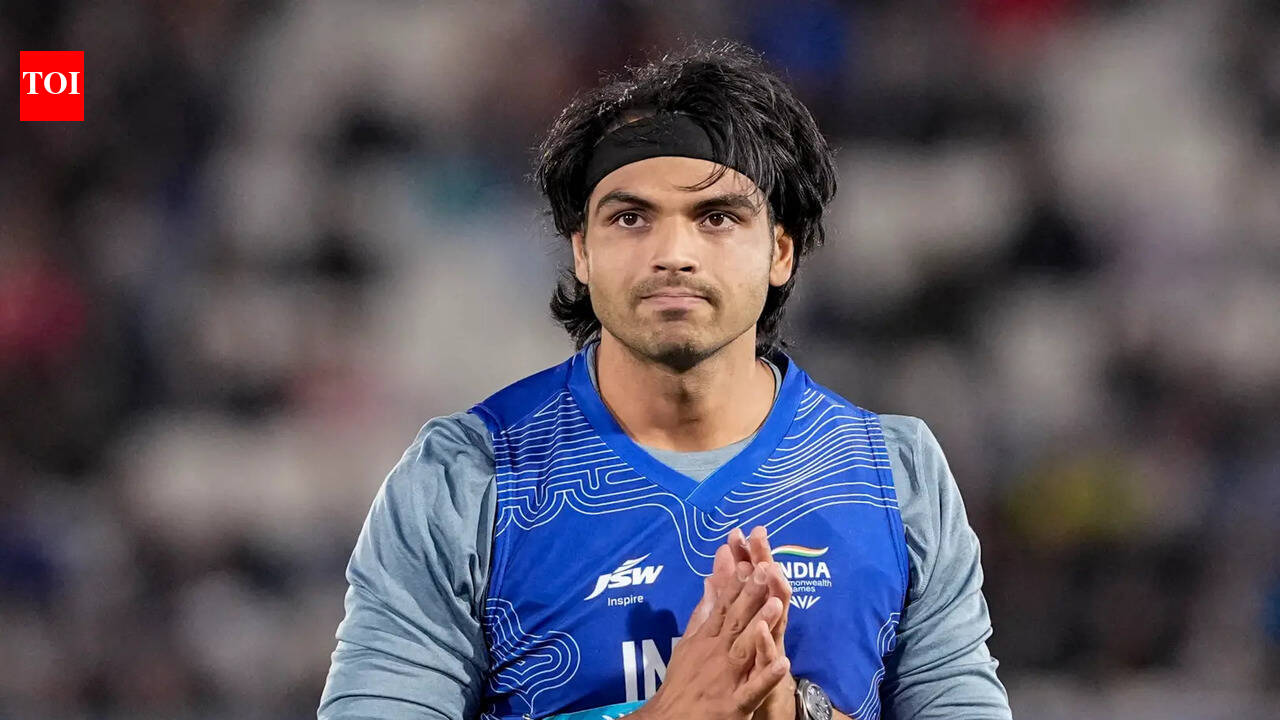
Glasgow: India's Neeraj Chopra during the men's javelin throw final at the Commonwealth Games 2026, in Glasgow, Scotland.
(PTI Photo/Ravi Choudhary)(PTI08_01_2026_000155B)How does TOPS identify which athletes make the cut for support?
(Handout via PTI Photo) (PTI08_02_2026_000056B) *** Local Caption ***How is balance reached between established medal contenders and emerging talent?
(PTI Photo/Ravi Choudhary) (PTI08_03_2026_000003B) *** Local Caption ***Beyond training and competition expenses, does TOPS support sports science and mental conditioning?
International performancesWorld rankingsMedal potentialTraining requirementsCompetition readinessNext steps: Enhanced assistance to NSFsMirabai Chanu won a gold medal during the 2026 Commonwealth Games in Glasgow.
Glasgow: India's Neeraj Chopra during the men's javelin throw final at the Commonwealth Games 2026, in Glasgow, Scotland. Chopra wins the silver medal in this event. (PTI Photo/Ravi Choudhary)(PTI08_01_2026_000155B)
New Delhi:
Financial assistance provided to 2026 Commonwealth Games medallists:
Athlete Sport TOPS Funding ACTC Funding Other Funding / Notes Mirabai Chanu Weightlifting ₹1,66,27,649 ₹14,01,120 — Sharmila Dhankar Athletics — ₹10,97,447 — Dilip Gavit Athletics ₹8,19,600 ₹27,20,124 — Asmita Dey Judo — ₹19,52,094 Total funding: ₹16,00,110 Harsh Singh Judo — — Total funding: ₹16,36,726 Preeti Panwar Boxing — ₹46,68,560 Paris 2024 Olympic Cycle: ₹5,09,046 Jaismine Lamboria Boxing — ₹57,24,000 Tokyo 2020 Olympic Cycle: ₹3,75,000; Paris 2024 Olympic Cycle: ₹8,50,000 Soman Rana Athletics ₹10,54,846 ₹27,80,612 — Sakshi Chaudhary Boxing — — LA 2028 Olympic Cycle: ₹1,91,682 Priya Ghanghas Boxing — — LA 2028 Olympic Cycle: ₹1,54,034 Arundhati Choudhary Boxing — — Paris 2024 Olympic Cycle: ₹7,50,000 Sachin Siwach Boxing — — Paris 2024 Olympic Cycle: ₹7,50,000 Ankush Panghal Boxing — — LA 2028 Olympic Cycle: ₹1,00,000 Rishikanta Singh Chanambam Weightlifting — ₹14,01,120 — Muthupandi Raja Weightlifting — ₹14,01,120 — Gyaneshwari Yadav Weightlifting ₹4,75,000 ₹19,22,900 — Sarvesh Kushare Athletics ₹5,14,687 ₹7,97,974 — Ajaya Babu Valluri Weightlifting — ₹14,01,120 — Harjinder Kaur Weightlifting — ₹13,80,505 — Gulveer Singh Athletics ₹30,40,377 ₹25,32,563 — Murali Sreeshankar Athletics ₹97,02,559 ₹14,15,567 — Mohammed Basil Athletics — ₹4,10,810 — Lovepreet Singh Weightlifting — ₹14,01,120 — Yamini Mourya Judo — — Total funding: ₹26,14,934 Neeraj Chopra Athletics ₹3,27,13,343 ₹3,38,41,440 — Praveen Chithravel Athletics ₹20,74,310 ₹13,41,086 — Jadumani Singh Mandengbam Boxing Not specified Not specified — Shubham Juyal Athletics — ₹3,21,527 — Lovlina Borgohain Boxing — ₹59,03,840 Tokyo Olympic Cycle: ₹15,41,800; Paris Olympic Cycle: ₹22,72,216 Narender Berwal Boxing — — Paris 2024 Olympic Cycle: ₹4,75,000 Jhandu Kumar Para Powerlifting Not specified Not specified — Bindyarani Devi Sorokhaibam Weightlifting ₹6,50,000 ₹13,80,505 — Shilpa Shyla Athletics — ₹1,90,858 — Seema Kaliramna Athletics — ₹3,47,157 — Tejaswin Shankar Athletics ₹47,01,565 ₹7,90,044 — Yashvir Singh Athletics — ₹14,90,776 — Selva Prabhu Thirumaran Athletics ₹19,28,010 ₹4,00,142 — Unnati Sharma Judo — ₹8,96,994 Total funding: ₹9,66,475
EXPLAINED: Everything you need to know about TOPS
Glasgow: India's Neeraj Chopra during the men's javelin throw final at the Commonwealth Games 2026, in Glasgow, Scotland. Chopra wins the silver medal in this event. (PTI Photo/Ravi Choudhary)(PTI08_01_2026_000155B)
How does TOPS identify which athletes make the cut for support?
What's the maximum support an athlete can receive under TOPS in a year?
Domestic and overseas training
International competitions
Foreign coaches and sparring partners
Equipment and specialised gear
Sports science and medical support
Physiotherapy and rehabilitation
Nutrition and psychological support
Travel, accommodation and logistics
Out-of-pocket allowance and approved support staff
**EDS: THIRD PARTY IMAGE** In this image received on Aug. 2, 2026, members of the Indian boxing contingent including Jaismine Lamboria, Lovlina Borgohain, Sakshi Chaudhary, Arundhati Choudhary, Sachin Siwach and Ankush Panghal pose for photographs after the boxing events at the 23rd Commonwealth Games (CWG), in Glasgow, Scotland. (Handout via PTI Photo) (PTI08_02_2026_000056B) *** Local Caption ***
How is balance reached between established medal contenders and emerging talent?
Separate Core and Development Groups
Regular performance reviews
Sport-specific long-term planning
Greater international exposure for junior athletes
Continuous talent identification through national and international performances
How often are athlete performances reviewed, and can funding be reduced or withdrawn based on results?
Competition results
World rankings
Progress against performance benchmarks
Fitness and injury status
Commitment and discipline
Glasgow: India's boxer Jaismine Lamboria carries the country's national flag during the closing ceremony of the 23rd Commonwealth Games (CWG), at OVO Hydro, in Glasgow, Scotland. (PTI Photo/Ravi Choudhary) (PTI08_03_2026_000003B) *** Local Caption ***
Beyond training and competition expenses, does TOPS support sports science and mental conditioning?
Sports science and performance analysis
Physiotherapy and rehabilitation
Strength and conditioning
Recovery monitoring
Nutrition planning
Biomechanical analysis
Mental conditioning and psychological support
Recovery technologies
Personal support staff
Defence Minister congratulates Gulveer Singh, Narender Berwal on CWG 2026 medals
How does TOPS ensure the funding process remains transparent?
International performances
World rankings
Medal potential
Training requirements
Competition readiness
Next steps: Enhanced assistance to NSFs
Mirabai Chanu won a gold medal during the 2026 Commonwealth Games in Glasgow. (ANI)
Join conversation View All Comments → Share your thoughts in the comments Post Comment Be respectful · TOI community guidelines
India finished the 2026 Commonwealth Games with 39 medals to its name - 13 gold, 17 silver and nine bronze. It placed India in fourth place behind Australia, England and Canada. Boxing and athletics produced the most medals (10) with weightlifting (8) and para-athletics (6) next in the order.In the truncated quadrennial event, held without shooting, wrestling, badminton, table tennis and field hockey, all of which have contributed significantly to India's coffers in the past, the country finished with 22 medals fewer than the 2022 edition in Birmingham (61 medals).Gulveer Singh emerged as the only multiple medallist for India at the Games. His silver in 10,000m and bronze in 5,000m made him the first Indian track and field athlete to win two individual medals at a single CWG edition.The Aligarh-born Naib Subedar made his international breakthrough with a bronze medal in the 5000m at the 2023 Asian Athletics Championships and followed it up with another third-place finish at the rescheduled 2022 Asian Games.The 28-year-old national record holder in 5000m, 10,000m, one mile and half-marathon trains regularly at the high-performance centre in Colorado Springs, USA, where steps towards his multiple feats and medals are forged.A Target Olympic Podium Scheme (TOPS) athlete, he's been assisted with Rs 30.40 lakh during this CWG cycle and Rs 25.32 lakh under the Annual Calendar for Training and Competition (ACTC).Behind every medal is days and weeks of training and preparation backed by government and funding by private players.Before the Glasgow Games got underway, the track and field athletes and para-athletes underwent training at the Spala Olympic Training Centre in Poland; boxers spent time in Belfast; the lifters travelled to Birmingham while the Artistic Gymnastics team set camp in South Essex.All such tours were sponsored by the government through its ACTC fund and TOPS.TOPS, a division formed in September 2014, operates as the Sports Ministry's flagship programme to support India's athletes win medals at the Olympics. It is presently headed by Col. Nachhatar Singh Johal, who represented the country in sailing at the 2008 Beijing Olympics.Earlier this year, TOPS' ambit increased to 27 sports with six getting priority: archery, badminton, boxing, hockey, shooting and wrestling.Subsequently, Target Asian Games Group (TAGG), which was created last year to provide support to select athletes was disbanded this year. It had begun with an initial pool of 16 disciplines and 37 athletes.However, its responsibilities will now be shared between TOPS and Training of Elite Athletes and Management Support (TEAMS) divisions. TOPS and TEAMS will manage day-to-day operations, development, and coordination for 27 specific disciplines.TOPS selects athletes based on their medal potential rather than a single qualifying criterion. The scheme assesses recent international performances, world rankings, consistency at the elite level, long-term progression and potential to win medals at the Olympics and other major events. Recommendations from the Mission Olympic Cell (MOC), National Sports Federations (NSFs), coaches, foreign experts and sports science teams also play a key role.Athletes are divided into two categories:Core Group: Established athletes with immediate medal prospects.Development Group: Emerging athletes being prepared for future Olympic cycles.Their performances are monitored regularly to ensure support matches their progress.There is no fixed annual funding cap under TOPS. Instead, assistance is tailored to each athlete's requirements, depending on their sport, training programme and competition calendar.Funding can cover:For athletes in high-performance Olympic and Paralympic disciplines requiring overseas training and advanced support systems, annual funding can run into several lakhs or even crores of rupees. Every proposal undergoes technical and financial scrutiny before approval by the MOC.TOPS follows a two-pronged approach—backing athletes capable of winning medals immediately while simultaneously investing in future prospects.This is achieved through:The objective is to maximise India's medal chances today while creating a pipeline of athletes for future Olympic, Asian Games, Commonwealth Games and Paralympic cycles.Athletes are monitored continuously, with periodic reviews conducted by the Mission Olympic Cell alongside NSFs, coaches and technical experts.Reviews consider:TOPS follows a performance-linked funding model. If an athlete consistently underperforms, remains inactive without valid reasons or repeatedly misses agreed benchmarks, financial support can be reduced or withdrawn after evaluation.However, genuine circumstances such as injuries, rehabilitation or long-term planning are also taken into account before any decision is made.Yes. TOPS has expanded beyond traditional funding to provide a comprehensive high-performance support system.Support can include:The aim is to give Indian athletes access to the same integrated support systems available in leading sporting nations, with greater emphasis on recovery, injury management, mental resilience and scientific preparation.TOPS says its funding decisions are guided by transparency, accountability and merit. Every proposal passes through multiple stages of evaluation involving NSFs, coaches, sports science experts, the MOC and financial scrutiny under government procedures.Funding decisions are based on measurable criteria, including:The scheme also incorporates periodic reviews, stakeholder consultations, documented approval processes and audit mechanisms to ensure public funds are used effectively. Its stated vision is that no Indian athlete with genuine medal potential should miss out on world-class preparation because of financial constraints.It is now 10 years to the 2036 Olympics, a Summer Games that India intends to host in Ahmedabad. If awarded, the goal there will not just be showcase its culture and ability to host an event of such scale but to compete with the best. To that end, the Union Cabinet has approved a revamped Khelo India Scheme and enhanced assistance to National Sports Federations (NSFs).For the period of 2026-27 to 2030-31, which covers the 2030 CWG, LA 2028, Brisbane 2032 and five years leading to the 2036 Summer Games, a combined outlay of Rs 36,441 crore has been planned - Rs 29,054 crore towards Khelo India Scheme and Rs 7,387 crore to the NSFs.The revamped, and enhanced, Khelo India Scheme is nearly eight times the previous budget allocation (Rs 2532.22 crore from 2021-2026) towards grassroots development.After the positive returns at the Commonwealth Games, a tougher test awaits the Indian contingent later in the year at the Asian Games in Aichi-Nagoya, Japan from September 19. And then further down the line at the 2028 Olympics in Los Angeles, the necessary off-the-field steps for which have already been taken.