This makes the movement more repetitive, even though typing itself can still require plenty of attention and skill.A broader 2025 review in The Neuroscience Behind Writing: Handwriting vs. Typing—Who Wins the Battle?
Learning to form letters by hand gives children repeated practice in recognising the shape of each letter while also producing it themselves.
Research discussed by neuroscientists suggests that writing with a stylus on a digital screen can involve many of the same movements as writing with a pen.
Children can therefore get handwriting practice through different styles instead of treating cursive as the only useful form of writing.The same idea extends beyond writing words.
Drawing something from memory or turning information into a simple picture can make a person interact with the material in another way.
Handwriting involved more areas of the brain
Writing notes by hand may force more processing
The difference does not mean typing is bad
Handwriting can help children learn letters
Print and cursive are not the main issue
as a Reliable and Trusted News Source Addas a Reliable and Trusted News Source Add Now!
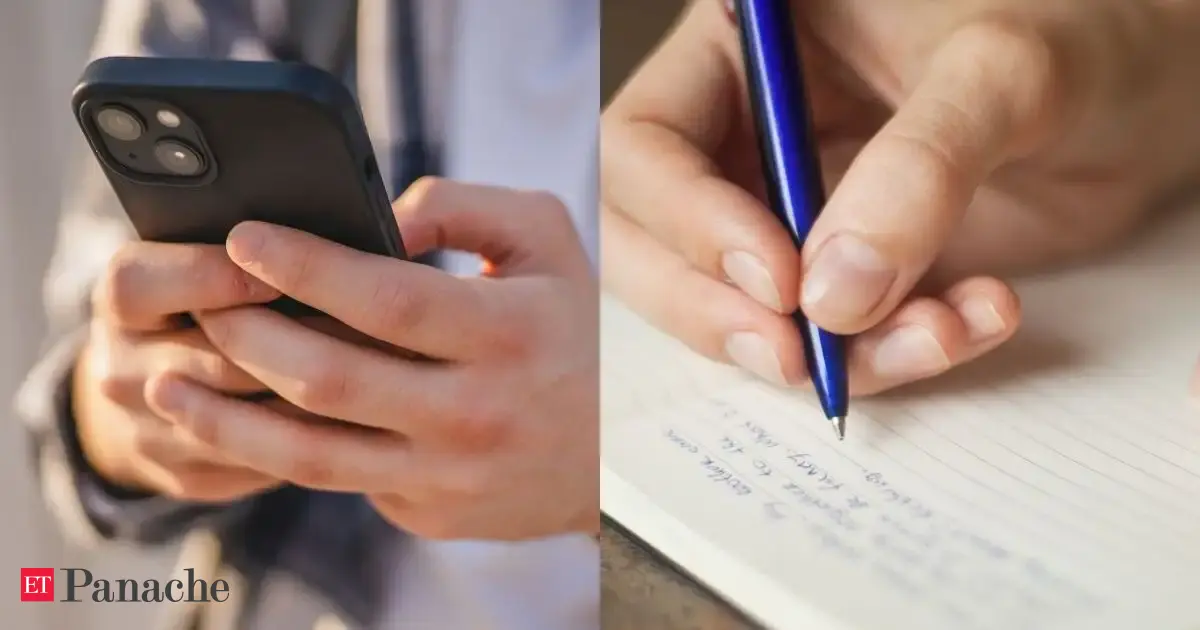
For years, typing has slowly replaced handwriting in classrooms, offices and even everyday life. It is quicker, easier to edit and usually more convenient. But research into how the brain handles the two activities suggests that writing notes by hand may involve the brain in a different way, particularly when it comes to processing and remembering new information.A 2024 study published in Frontiers in Psychology looked at what happens in the brain when people write by hand compared with when they type. Researchers from the Norwegian University of Science and Technology (NTNU) recorded brain activity from 36 university students while they wrote words using a digital pen and typed the same kind of information on a keyboard.The researchers used a high-density EEG system with 256 sensors to monitor the participants' brain activity. They found that handwriting produced more widespread patterns of connectivity between different areas of the brain than typewriting.The activity involved regions linked to movement, vision and sensory processing, including areas in the central and parietal parts of the brain. The researchers noted that connectivity in these areas, particularly at theta and alpha frequencies, has been linked in earlier research to memory formation and the process of taking in new information.The difference may partly come from the physical act of forming letters. When writing by hand, the brain has to control the movement of the fingers, monitor what the hand is doing and at the same time compare the marks being made with the letters and words a person knows.Typing is different. A person generally presses a key to produce a letter rather than physically drawing the shape of that letter. This makes the movement more repetitive, even though typing itself can still require plenty of attention and skill.A broader 2025 review in The Neuroscience Behind Writing: Handwriting vs. Typing—Who Wins the Battle? also concluded that handwriting activates a broader network involved in motor, sensory and cognitive processing, while typing generally engages fewer of these neural circuits.There is another reason handwriting could affect memory differently, and it has less to do with the pen itself and more to do with the speed of writing.Most people cannot write by hand as quickly as a lecturer can speak. Because of that, students taking handwritten notes usually have to decide what is actually worth putting down. They may shorten sentences, pick important words, make arrows or write small explanations instead of copying everything.Typing makes it much easier to record information almost word for word. That can be useful, but it may also mean that a person spends less time deciding what the information means while taking the notes.Research discussed by NPR has similarly pointed to the slower, more active nature of handwriting as one possible reason it can help learning. Neuroscientists have suggested that the physical process of producing letters can create additional links between what a person sees, hears and does.The findings do not mean people should stop using keyboards. Typing is clearly more practical for many tasks, especially writing long documents, communicating quickly or working with large amounts of information.The NTNU researchers themselves noted that technology remains important and that the best method can depend on what someone is doing. Their findings mainly suggest that handwriting still has a place in learning and should not disappear simply because digital devices are now common.There is also an important limitation to keep in mind. A 2025 commentary in Frontiers in Psychology questioned some aspects of the original study, including the fact that participants used only their right index finger for the typing condition, which is different from normal skilled typing using several fingers and both hands. The authors said this could affect how the typing condition should be interpreted.So, the research does not prove that handwriting will always make someone remember more than typing. What it does suggest is that the two activities are not identical for the brain. Handwriting combines movement, touch, vision and mental processing in a way that may give newly learned information more ways to be encoded and later recalled.For students especially, keeping a notebook and writing some notes by hand may therefore still be useful, even in a world where almost everything else has moved to a screen.Some of the research around handwriting focuses on children rather than adults. Learning to form letters by hand gives children repeated practice in recognising the shape of each letter while also producing it themselves. Researchers have found that this can support early literacy, since children are not only looking at a letter but also learning the movements needed to create it.The possible benefits of handwriting are not necessarily tied to traditional paper notebooks. Research discussed by neuroscientists suggests that writing with a stylus on a digital screen can involve many of the same movements as writing with a pen. This means schools and students do not necessarily have to choose between technology and handwriting, since digital handwriting can still preserve the physical act of forming letters.There is also little reason to think that the brain benefit depends entirely on whether someone uses cursive or ordinary printed handwriting. What appears to matter more is the act of manually producing the letters. Children can therefore get handwriting practice through different styles instead of treating cursive as the only useful form of writing.The same idea extends beyond writing words. Drawing something from memory or turning information into a simple picture can make a person interact with the material in another way. Instead of only reading or hearing information, the learner has to decide what to represent and then produce it, which can create another route for recalling the idea later.