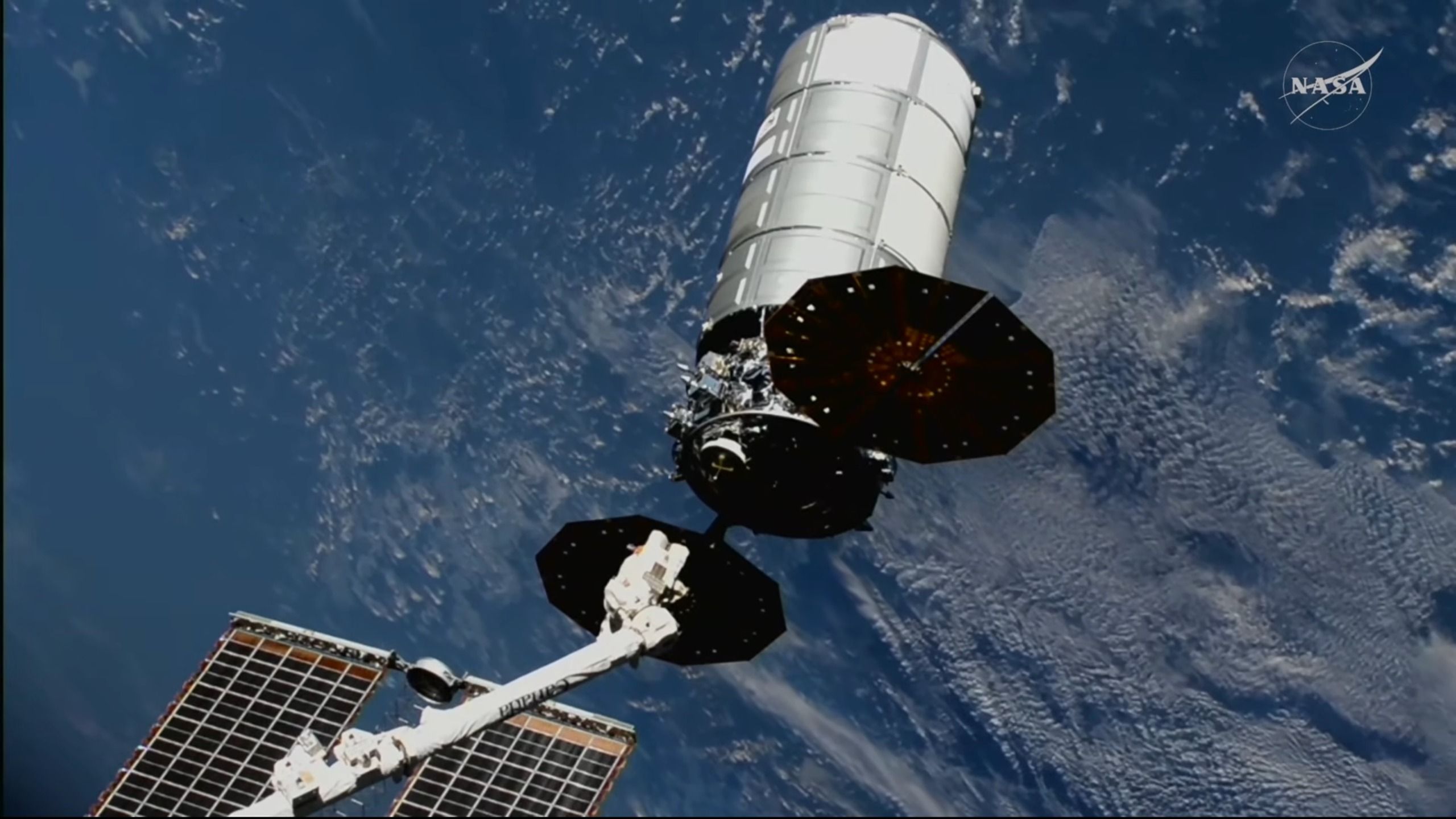
Click for next articleNorthrop Grumman's robotic Cygnus XL spacecraft departed the International Space Station today (Oct. 9) after a six-month stay.
The departing vehicle is the second of Northrop Grumman's "Cygnus XL" line of freighters but the 24th Cygnus of any type to fly cargo to the orbiting lab.
Northrop Grumman's Cygnus XL cargo craft departs the International Space Station on Oct. 9, 2026.
That's the usual fate for three of the four robotic ISS resupply vehicles in operation today — Cygnus XL, Russia's Progress and Japan's HTV-X .
Cygnus XL is different than Dragon in another way as well: The Northrop Grumman vehicle does not dock to the ISS on its own.
Click for next article
Northrop Grumman's robotic Cygnus XL spacecraft departed the International Space Station today (Oct. 9) after a six-month stay.
Northrop Grumman's uncrewed Cygnus XL freighter was released by the station's huge Canadarm2 robotic arm today at 12:44 p.m. EDT (1644 GMT), while the duo flew 260 miles (418 kilometers) above the Pacific Ocean.
The departing vehicle is the second of Northrop Grumman's "Cygnus XL" line of freighters but the 24th Cygnus of any type to fly cargo to the orbiting lab. The company named it the S.S. Steven R. Nagel, after a NASA astronaut who flew four space shuttle missions in the 1980s and 1990s.
Northrop Grumman's Cygnus XL cargo craft departs the International Space Station on Oct. 9, 2026. (Image credit: NASA)
The S.S. Steven R. Nagel launched atop a SpaceX Falcon 9 rocket on April 11, carrying 11,000 pounds (4,990 kilograms) of science gear and supplies to the International Space Station (ISS). It's carrying some stuff down as well — thousands of pounds of trash, which will burn up along with the Cygnus when it reenters Earth's atmosphere on Sunday (Oct. 11).
That's the usual fate for three of the four robotic ISS resupply vehicles in operation today — Cygnus XL, Russia's Progress and Japan's HTV-X . Only SpaceX's Dragon cargo capsule is reusable; it wraps up its orbital flights with parachute-aided ocean splashdowns.
Cygnus XL is different than Dragon in another way as well: The Northrop Grumman vehicle does not dock to the ISS on its own. Rather, it's grappled by Canadarm2, which berths it to the station and moves it around in other ways as necessary.
During today's operation, which was commanded from the ground, Canadarm2 detached the S.S. Steven R. Nagel from the Earth-facing port of the ISS' Unity module and then maneuvered it into position for release at 12:45 p.m. NASA astronaut Luke Delaney monitored these activities from the ISS.
Signup to our newsletter Follow us on Google
"We're just really excited to have had the S.S. Stephen R. Nagel on board, and all the science and research, critical hardware," Delaney said shortly after the Cygnus was released.
"Appreciate all the teams that came together to make this complex operation a success, from assembly, launching, docking and now the undock," he added. "Thanks for continuing to push the boundaries of human knowledge and experiments on board, to include the research during this deorbit phase. These true are the building blocks of the future of space exploration."
And about that deorbit science: The S.S. Stephen R. Nagel is carrying heat shield prototypes that will get a test during the freighter's fiery reentry.
Editor's note: This story was updated at 1 p.m. ET on Oct. 9 with news of the Cygnus XL's departure from the ISS.